Updated 2026/9/2: Anthropic has launched Claude Fable 5.1, with cache costs down 75%, cybersecurity false positives down 60%, and scientific research scores doubled. We recommend using Fable 5.1 directly.
Anthropic released Claude Fable 5 on June 9, 2026 (US time), alongside Claude Mythos 5 — a restricted version available only to vetted professionals. The official positioning was blunt: “Fable 5’s capabilities exceed anything we’ve previously made available to the public.” Short version: it’s the most powerful Claude you can get.
This article draws from Anthropic’s official announcements and documentation to explain what Fable 5 is, how it relates to Mythos 5, how the safety system works, what it costs, and how to get the most out of the promotional period.
What Is Claude Fable 5
Fable 5 is a new tier in Anthropic’s model lineup. The official documentation calls it the “most capable widely released model” — sitting above the Opus class, which was previously the ceiling. It’s also the first Claude 5-generation model open to the general public.
The old rule was: hardest task, open Opus. Now the public ceiling is Fable 5. That said, Anthropic’s own model-selection guide adds a caveat: if you’re unsure which to use, start with Opus 4.8 for complex tasks and only reach for Fable 5 when you genuinely need the extra ceiling.
How Fable 5 and Claude Mythos 5 Relate
Fable 5 and Mythos 5 share the same underlying model. The difference is the guardrail layer:
- Claude Fable 5: Public release, with safety guardrails applied.
- Claude Mythos 5: Guardrails partially lifted, available only through Project Glasswing to approved security researchers and biomedical professionals.
You may already know the Mythos name from April, when Anthropic released Mythos Preview — an institution-only model that could autonomously find software vulnerabilities. Mythos 5 is its production release. Fable 5 is the same capability set, guardrails on, opened to everyone. For a deeper look at the security-focused branch, see What Is Claude Mythos.
How the Safety Guardrails Work
Fable 5 runs an AI classifier watching for three categories of sensitive prompts: offensive cybersecurity techniques, biology and life sciences, and attempts to extract its full reasoning process (for example, to train another model on it).
When a prompt hits one of those categories, Fable 5 steps aside and Claude Opus 4.8 takes over — in the same conversation thread. Two numbers worth keeping in mind:
- More than 95% of conversations never trigger the guardrail at all.
- After a trigger, the conversation stays on Opus 4.8. You have to manually switch back to Fable 5.
Anthropic acknowledges the classifier is tuned on the conservative side and will sometimes flag things that are perfectly harmless. On launch day, Andrej Karpathy — one of OpenAI’s co-founders and among the most influential engineers in AI — called the model itself “a genuine major-version jump” while noting the guardrails were “triggered a bit too easily, hopefully they’ll loosen them.”
Specs and Pricing
From Anthropic’s official documentation and pricing page:
| Release date | June 9, 2026 |
| Positioning | Above Opus class; most capable public model |
| Context window | 1 million tokens |
| Max output | 128K tokens |
| Reasoning | Always-on extended thinking (cannot be disabled) |
| Training cutoff | January 2026 |
| Modalities | Text + image input; text output |
| API pricing | $10 input / $50 output per million tokens (2× Opus 4.8 rates) |
| Access | claude.ai (web / app / desktop), Claude Code (2.1.170+), Claude API, AWS, Google Cloud |
How Capable Is It
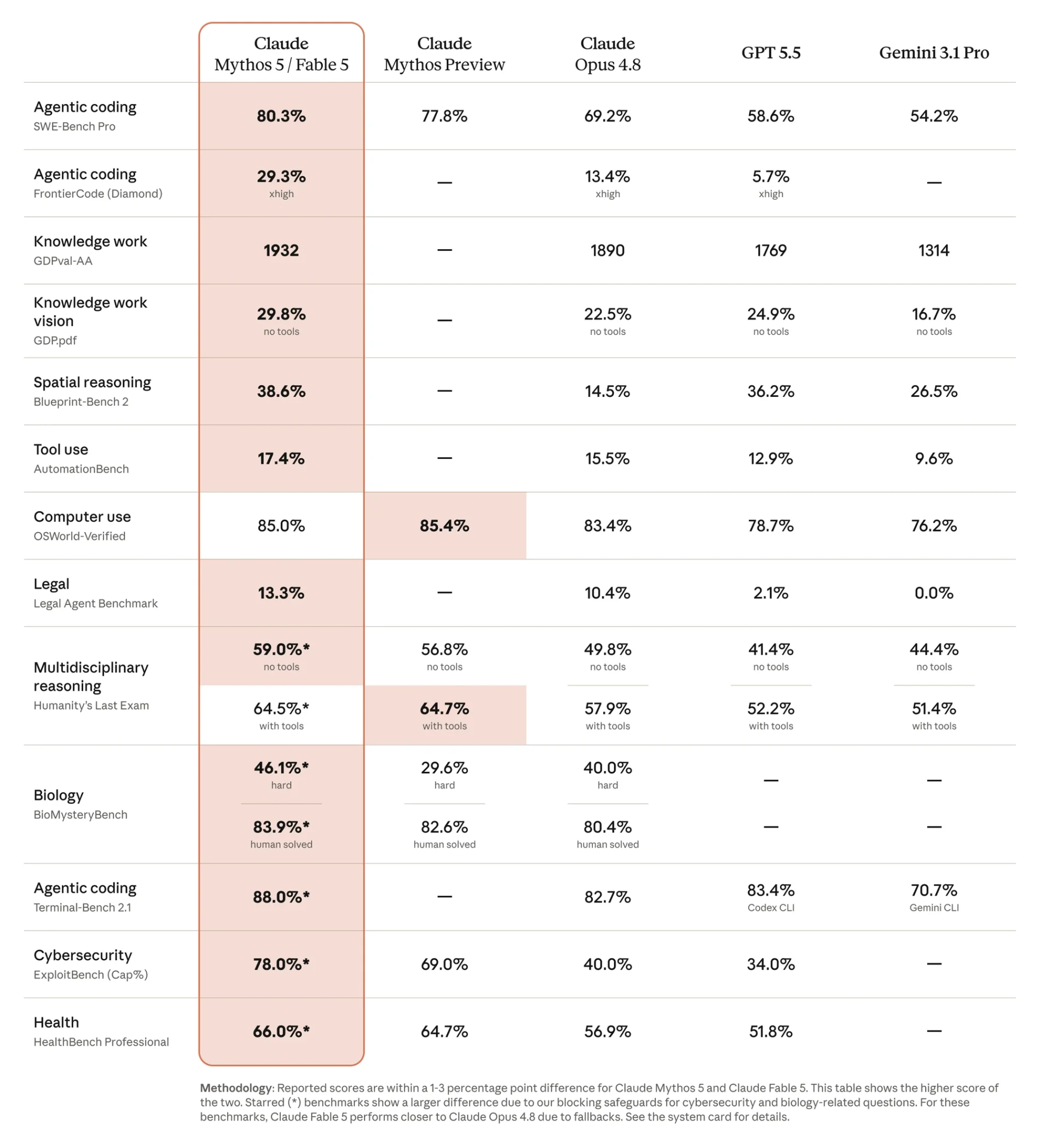
Anthropic’s claim: “top of the industry on virtually every benchmark we’ve tested, with the gap widening on longer, more complex tasks.” A few real-world examples from the launch announcement that are easy to interpret:
- Code: Stripe used Fable 5 to migrate a 50-million-line Ruby codebase — a project originally estimated to take a full team two months. It finished in a day.
- Vision: Given a few screenshots, it can reconstruct a web app’s source code.
- Long-horizon memory: With file-based memory enabled, it improved three times faster than Opus 4.8 on an extended gaming benchmark.
- Specialized domains: Analytics company Hex says it’s the first model to cross 90% on their core analysis tests; Hebbia reports it scored highest across all models on financial analysis tasks.
Independent signals from the 48 hours after launch matched: Artificial Analysis ranked it #1 overall intelligence out of 152 models. Simon Willison — well-known AI engineer — ran it for five-plus hours and called it “a beast: slow, expensive, but genuinely hard to find something it can’t do.” The community’s consistent observation: it burns through credits fast, roughly twice the rate of Opus.
Getting the Most Out of the Promotional Period
Note (updated 8/31): Access to Fable 5 has been restored. The promotional period has ended, and usage credits are now required for usage-based billing.
Per Anthropic’s promotional terms:
- Promotional period June 9–22, 2026: Fable 5 is included in Pro, Max, Team, and some Enterprise plans — no extra charge, but it draws from your plan’s normal usage quota. Free tier excluded.
- From June 23: Fable 5 is no longer included in base plans. Continued use requires purchasing usage credits billed at API rates. Anthropic also sells discounted credit packs — for example, $50 face value for $45.
- Anthropic said it may extend the promotional window if capacity allows, with a longer-term goal of folding Fable 5 back into subscription plans.
Practical read: the two-week window is a free trial. If you’re on a paid plan, throw your hardest tasks at it now, then decide after June 23 whether the capability is worth buying credits for.
Penchan’s Take
- The ceiling moved. Fable 5 adds a tier above Opus for the hardest, longest tasks. Worth trying there. Everyday work still belongs on Opus and Sonnet — the cost difference is real.
- The “hand off sensitive questions to Opus” design is clever — but you need to know how it behaves. It’s more nuanced than a flat refusal. The catch is that the conversation stays on Opus after a trigger, so remember to switch back manually.
- One model, two access levels, may become a pattern. Splitting a single model into a public version and a professional version — handling capability and safety separately — is a template other labs will probably follow.
- Availability itself is a risk. Fable 5 was temporarily inaccessible after a US government export-control directive on June 12, before access was restored. It’s a reminder that frontier models are shaped not only by technology and business, but also by geopolitics and regulation. Don’t build critical workflows around a single model.
I switched Claude Code’s primary model to Fable 5 on launch day. My experience matched the community: noticeably better endurance on long tasks, and yes, credits disappear faster.
The Temporary Suspension (June 12, 2026; Access Restored)
Fable 5 is available again. The following account of the temporary suspension is retained for the record.
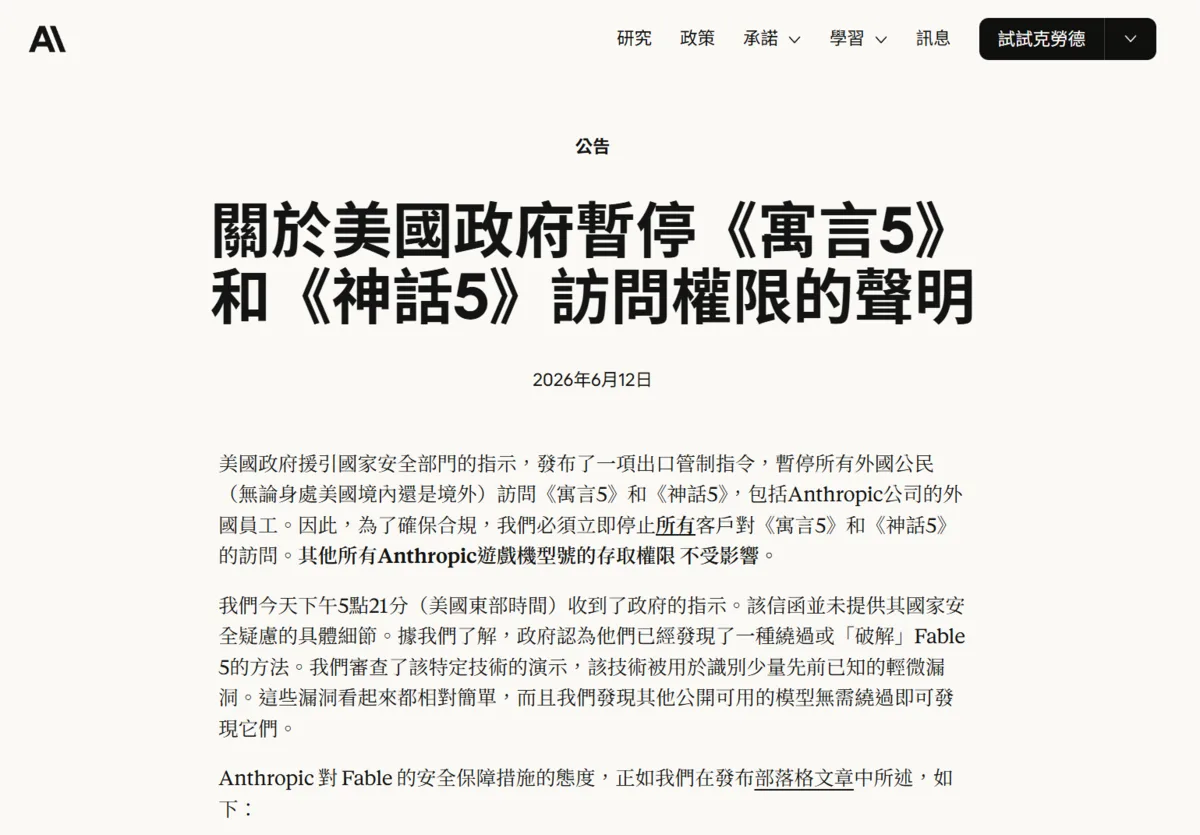
At 5:21 PM ET on June 12, Anthropic received an export control directive from the US government ordering it to suspend all access to Fable 5 and Mythos 5. The suspension applied to every customer, including foreign nationals inside and outside the US and even Anthropic’s own foreign-national employees. The suspension has ended, and Fable 5 is now available normally.
Key points from the official announcement:
- The stated reason: National security authority, with few specifics provided. Anthropic’s understanding is that the government believes someone found a way to jailbreak Fable 5’s safety guardrails.
- Anthropic’s position: The company publicly pushed back, calling it unreasonable to recall a commercial model deployed to hundreds of millions of users over “a narrow, potential jailbreak.” Anthropic stated directly that if this standard holds, it “would effectively halt new model deployments for every frontier AI provider.”
- Other models unaffected: Opus 4.8, Sonnet, and the rest of the Claude lineup are running normally. Only Fable 5 and Mythos 5 are suspended.
- What happened next: Anthropic subsequently restored access to Fable 5 and Mythos 5.
Full official statement: US Government Directive on Fable 5 and Mythos 5 Access.
Refunds During the Suspension (Ended)
During the suspension, Anthropic offered prorated refunds. That option is no longer relevant now that Fable 5 has been restored.
Further Reading
— Penna / Penchan