
Comet is Perplexity’s AI browser. It has an AI assistant built in beside the page, and besides looking things up, it can organize your tabs, read your mail, and even finish a whole string of steps on its own. If the answer engine is Perplexity’s fight with Google over search, Comet stretches the front line to the entire browser.
If you want to get to know Perplexity as a company first, start with What kind of company is Perplexity.
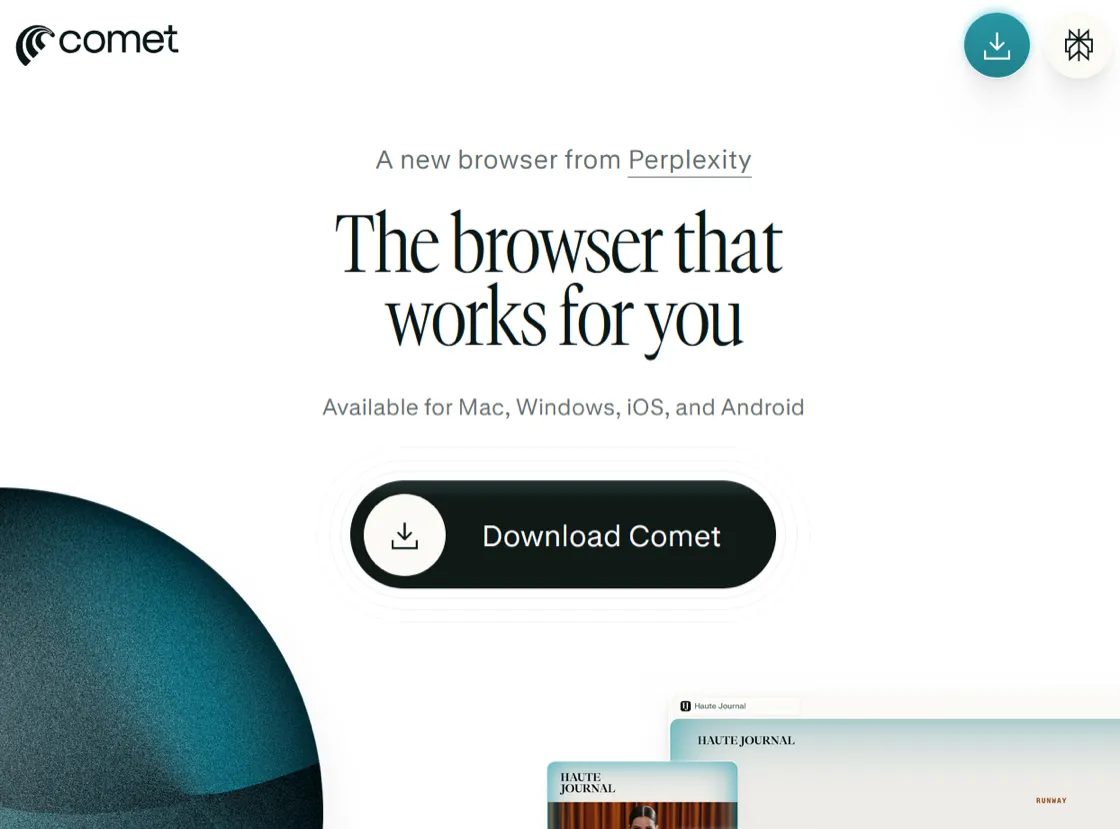
What Comet Is: A Browser That Operates on Its Own
Comet looks like a normal browser. The difference is the AI assistant that’s always in the sidebar: you can ask it to summarize a page, organize your open tabs, figure out how to reply to an email, or compare information across pages.
| When | What happened |
|---|---|
| July 2025 | Opened first to paying Max users (about 200 US dollars a month) |
| October 2025 | Became a free download |
| March 2026 | Comet Enterprise launched for companies; iPhone version released |
As of October 2026, Comet runs on Mac, Windows, iOS, and Android, and the basic features are free. Going from a pricey paid plan all the way down to free shows how eager Perplexity is to pull people into this gateway.
Computer: From “Answering” to “Doing”
Computer, launched in February 2026, is Perplexity’s more advanced AI agent. It works through apps like Gmail, Slack, and Notion one after another in an isolated cloud environment, finishing long, multi-step tasks in one go. Behind the scenes, it picks the best fit from models made by several companies, including the GPT and Claude families.
Since then it has moved step by step onto your own computer:
- Personal Computer (desktop app): came to Mac in April 2026 and Windows in August.
- Portable Computer (local version): from August to September 2026, added support for NVIDIA DGX Spark, Windows PCs with NVIDIA RTX graphics cards (24GB of video memory or more), and AMD Ryzen AI Max PCs, so the whole agent can run entirely on your own machine.
This shows Perplexity wants to turn from “a search tool that answers” into “a digital employee that does things for you.” It’s also why Amazon sued: when an AI agent logs into Amazon to shop for a user, does that count as unauthorized access? In August 2026, the US Court of Appeals for the Ninth Circuit threw out the lower court’s earlier injunction, finding that in this case “it was the user, not Perplexity, who accessed Amazon,” while stressing that it was not setting new rules for AI agents. The case went back to the district court. For the full story, see the answer engine’s copyright war and AI agent lawsuits.
The Security Concern: The Price of Letting an AI Operate for You
When an AI operates your browser, watch out for prompt injection: a bad actor hides malicious instructions in a web page, an image, or a URL, and when the AI agent reads them, it carries them out as if they were your commands.
The Brave team showed how to hide instructions in white-on-white text or in images, luring Comet into reading a user’s Gmail, grabbing a verification code, and leaking it. Security firms LayerX and Cato have each also demonstrated attacks that a single URL can trigger. These are mostly warnings from security research, some were patched after being reported, and the problem is shared by all agentic browsers. Even OpenAI has publicly admitted that prompt injection may be very hard to stamp out completely.
The Browser War: A Fight Over the Gateway
For the past twenty years, the gateway to the web was Google’s search box. AI is reshuffling that gateway, and every company wants to be the first AI you touch when you go online. A browser is also stickier than any single app: it sees everything you browse, and it can act for you across websites.
- OpenAI: launched the ChatGPT Atlas browser in October 2025, turning ChatGPT directly into a browsing interface.
- Google: instead of making a new browser, built Gemini straight into Chrome, where people can use it directly in supported regions.
Comet’s strengths are that it started early and lets you switch between models from several companies. Its challenge is convincing people to switch browsers just for it. Comet plus Computer is Perplexity’s bet on growing from a “search tool” into a “daily gateway.” If the bet fails, the gateway stays in the hands of the giants.
Penchan’s summary
Comet extends “search” into “doing things for you,” and that direction is right. But it also raises a real question: how willing are we to hand our browser, accounts, and inbox to an AI that could be tricked by one instruction hidden on a web page?
For now, the smart way to use it is for low-risk, repetitive chores (organizing tabs, summarizing long reads, drafting replies), while keeping things like online banking and company secrets in your own hands. Once the safety measures catch up, there will be plenty of time to hand over more keys.
Further reading: What kind of company is Perplexity, the answer engine’s copyright war and AI agent rulings, What is Sonar.