
Many people’s first impression of Grok is that “it’s very open.” That impression has a source: in March 2024, xAI released Grok-1’s weights and architecture under Apache 2.0, a generous move that was rare at the time. But as of October 2026, you can’t download the weights of the current flagship, Grok 4.7, at all.
This piece separates what was made public from the possible business reasons. To learn how to use Grok, see the Grok how-to guide. To first get to know how xAI relates to SpaceX, see What Is SpaceX?
First, separate “open weights” from “open source”
Open weights means anyone can download the model’s parameters. Apache 2.0 and MIT are open-source licenses, but whether an AI model is fully open source also depends on whether its training code and data information are public.
So a model can have open weights and still not be open source: its license might forbid commercial use, forbid training a competing model, or let the vendor take the rights back. When you see the words “open source,” read the license.
What each Grok generation released
| Model | How it was released | How open |
|---|---|---|
| Grok-1 (March 2024) | Apache 2.0 | Weights and architecture; not a fully open-source AI system |
| Grok-2 (weights released August 2025) | Custom license with more restrictions | Not open source, only open weights |
| Grok 3 and later, including the current flagship Grok 4.7 (September 2026) | Usable only through official products or the API | Not open source; closed |
As of October 2026, xAI publishes only Grok-1 and Grok-2 weights on Hugging Face: the first under Apache 2.0, the second under a more restrictive custom license.
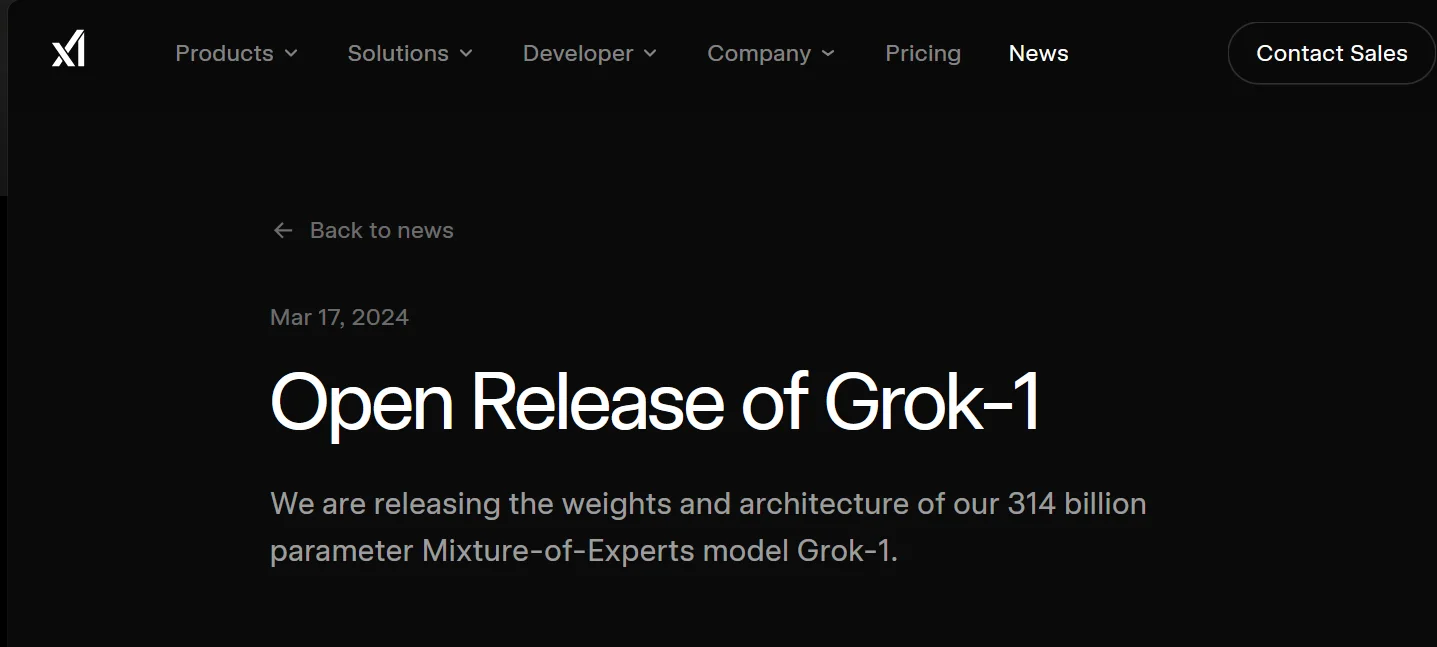
Figure: In March 2024, xAI announced it was open-sourcing Grok-1, releasing the weights and architecture of this 314-billion-parameter model.
Why open it at first? The latecomer’s play
In 2024, xAI was a latecomer, with OpenAI, Google, and Anthropic ahead of it. Open-sourcing a flagship buys the three things a latecomer lacks most: mindshare, research talent, and a developer community. It also set xAI apart from OpenAI, which was often criticized at the time for “being called Open but not being open enough.”
In other words, for xAI back then, open-sourcing Grok-1 mattered more for marketing and hiring than for technology.
Why pull it back later?
Grok 3 and Grok 4 launched in 2025 without public weights, before the 2026 SpaceX acquisition and IPO. Keeping flagship weights private may help commercialization, but xAI has not officially explained why the strategy changed.
Flagship capability is what sells subscriptions and API access.
Openness hasn’t disappeared entirely: in July 2026, SpaceXAI open-sourced its coding tool Grok Build under Apache 2.0, but it contains no model weights. Open the tools, keep the model: that is its approach now.
Penchan’s summary
Each Grok generation released something different. Commercialization is a possible reason, but xAI has not officially explained why the strategy changed.
Next time a company announces something as “open source,” read the license first, then check whether it released model weights or just the tools around them.