The Nexo Card is a Mastercard crypto card funded from a Nexo account. You can spend by borrowing or by using account assets directly. Taiwan and Hong Kong are not currently on the official eligibility list. This guide covers what the card is, where residents can apply, and how its rewards and fees work. See Things to know before applying for fees and risks.
What is Nexo? Company background
Nexo launched in 2018 and focuses on crypto-backed borrowing. In April 2018, it completed a private token sale worth $52.5 million. Its co-founder and managing partner is Antoni Trenchev. A July 2026 Nexo press release said the company had more than $7 billion in client assets and had processed over $430 billion cumulatively. Nexo launched its card in Argentina on July 8 of the same year.
The card runs on Mastercard. DiPocket UAB, a Lithuanian electronic money institution, issues the card in Europe (the EEA and UK). The account is custodial: assets are held by Nexo rather than by you. In the EEA, Tangany provides custody and DLT Finance handles trading. The card has two modes:
- Credit Mode: spend by borrowing against crypto collateral, creating a crypto-backed loan.
- Debit Mode: spend assets from the Savings Wallet, with a spending order you can set.
It supports more than 100 digital assets, stablecoins, and FIATx. It is for personal accounts and supports Apple Pay and Google Pay.
For the full comparison, see Nexo Card review and comparison, or compare it with other cards in the crypto card comparison.
Nexo Card rewards: Credit Mode only
Nexo has four tiers: Base, Silver, Gold, and Platinum. Each requires at least $5,000 in assets. Base does not require NEXO holdings; Silver, Gold, and Platinum require NEXO equal to at least 1%, 5%, and 10% of your other assets, respectively. The table below shows the European (EEA and UK) rules.
| Item | Base | Silver | Gold | Platinum |
|---|---|---|---|---|
| NEXO holding requirement | None | At least 1% of other assets | At least 5% of other assets | At least 10% of other assets |
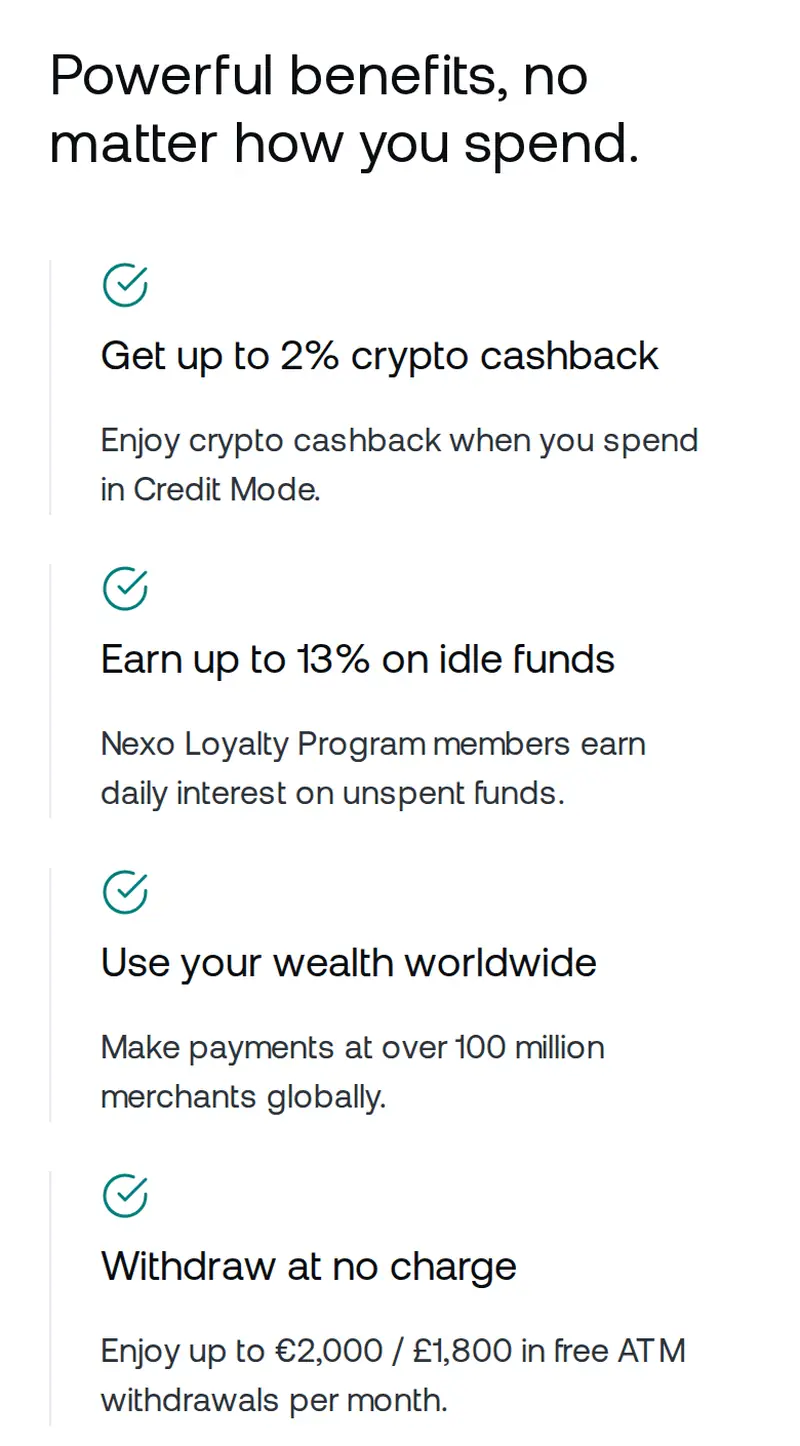
| Reward (paid in NEXO) | 0.5% | 0.7% | 1% | 2% |
| Reward (paid in BTC) | 0.1% | 0.2% | 0.3% | 0.5% |
| Monthly reward cap | $50 | $100 | $150 | $200 |
| Monthly free ATM allowance | €200 / £180 | €400 / £360 | €1,000 / £900 | €2,000 / £1,800 |
| Credit Mode rate (LTV below 20% with low-rate setting enabled) | — | — | 3.9% | 1.9% |
| Standard annual Credit Mode rate | 17.9% | 15.9% | 11.9%–12.9% | 9.9% |
Rewards apply only to Credit Mode purchases, not Debit Mode. The monthly cap resets on the first day of each month. UK residents do not receive crypto rewards. ATM withdrawals, PayPal, Curve top-ups, and certain other merchant categories are ineligible.
Nexo also advertises up to 13% annual interest on idle funds, paid daily; this also requires at least $5,000 in assets.
Nexo Card fees and limits
- Fees: no annual, monthly, or inactivity fee. A virtual card is free to activate and requires at least $50 in assets.
- Card currency: choose euros or pounds when activating the virtual card; the choice cannot be changed later.
- FX fee (EUR/GBP card): transactions in EEA, UK, and Swiss currencies that require conversion incur 0.2% on weekdays and 0.7% on weekends. Other currencies incur 2% on weekdays and 2.5% on weekends. The weekend window runs from Friday 21:00 or 22:00 UTC to Sunday 22:00 or 23:00 UTC.
- ATM: after the free allowance, each withdrawal costs 2%, with a minimum of €1.99 or £1.99. Limits are €600 (£540) per withdrawal, €2,000 (£1,800) per day, and €10,000 (£9,000) per month. The ATM operator may charge separately.
- Funding: you do not need to top up the card separately. Debit Mode spends Savings Wallet assets; Credit Mode uses the collateralized credit line.
See Nexo Card fees in detail for the complete fee list.
Things to know before applying
- Residents of Taiwan and Hong Kong cannot currently apply. The card page says it is open to citizens and residents of selected European countries; the application also requires an identity document issued in Europe, which Taiwanese documents do not meet.
- Rewards have conditions: Credit Mode only and at least $5,000 in assets. Credit Mode is borrowing, and a fall in collateral value can lead to liquidation.
- Assets are held in custody by Nexo. Nexo says Earn and Borrow are not deposits, are outside MiCAR, and have no deposit insurance.
- Nexo has a regulatory record: in January 2023, Nexo Capital paid $22.5 million to the US SEC over its unregistered Earn product and another $22.5 million to the states. In January 2026, California’s DFPI fined it $500,000 for unlicensed lending.
How to apply for the Nexo Card (using a referral code)
These are the virtual-card steps for residents of Europe (the EEA and UK). The referral link must be used when creating a new account; it cannot be added after registration.
- If eligible for the referral program, register through the referral link in this article. Code
nky2s1sd78is already in the link, so you do not need to enter it. If you are not eligible for the referral program, register directly on Nexo’s website. - Download the Nexo app, register, and complete identity verification.
- Add at least $50 to the account.
- Open the Card tab, tap “Activate Card,” choose euros or pounds, then tap “Add to Wallet” to add it to Apple Pay or Google Pay.
The referral program excludes residents of the UK, Italy, Turkey, Canada, Russia, Belarus, and New York State, among other places. Residents of those places should register directly on Nexo’s website.
Using the card in Taiwan and Hong Kong
Nexo’s help centre lists Taiwan and Hong Kong as ineligible. Its card page says the card is available only to citizens and residents of selected European countries, including the EEA and UK; Argentina has a separate card page. Applicants need a European-issued identity document, which Taiwanese documents do not meet. Taiwan and Hong Kong are not on Nexo’s account-opening exclusion list, but that does not make the card available there.
For a crypto card that can be obtained in Taiwan or Hong Kong, see the RedotPay card application guide. To learn how to hold stablecoins, see the stablecoin storage guide.