In May 2026, Anthropic’s Series H set its post-money valuation at about US$965 billion. Its IPO is expected to begin trading on the Nasdaq on November 19, under ticker ANT. This article explains its funding ladder, revenue measures, and listing progress. It summarizes public information, not investment advice. To learn about the company first, start with What Is Anthropic?.
Keep one point in mind: private valuation, annualized revenue, full-year actual revenue, and public share price are different things.
A Three-Step Jump in Eight Months: The Funding and Valuation Ladder
| Round | Date | Amount Raised | Post-Money Valuation |
|---|---|---|---|
| Series A | 2021 | About US$124 million | Not disclosed |
| Series F | September 2025 | About US$13 billion | About US$183 billion |
| Series G | February 2026 | About US$30 billion | About US$380 billion |
| Series H | May to June 2026 | US$65.2 billion | About US$965 billion |
(Rounds B through E are omitted. This table shows only the largest recent milestones.)
In about eight months, the post-money valuation rose from US$183 billion to US$380 billion and then US$965 billion. Series H was led by Altimeter, Dragoneer, Greenoaks, and Sequoia. Its valuation was above OpenAI’s March 2026 round of about US$852 billion. This is Anthropic’s latest private valuation before the IPO.
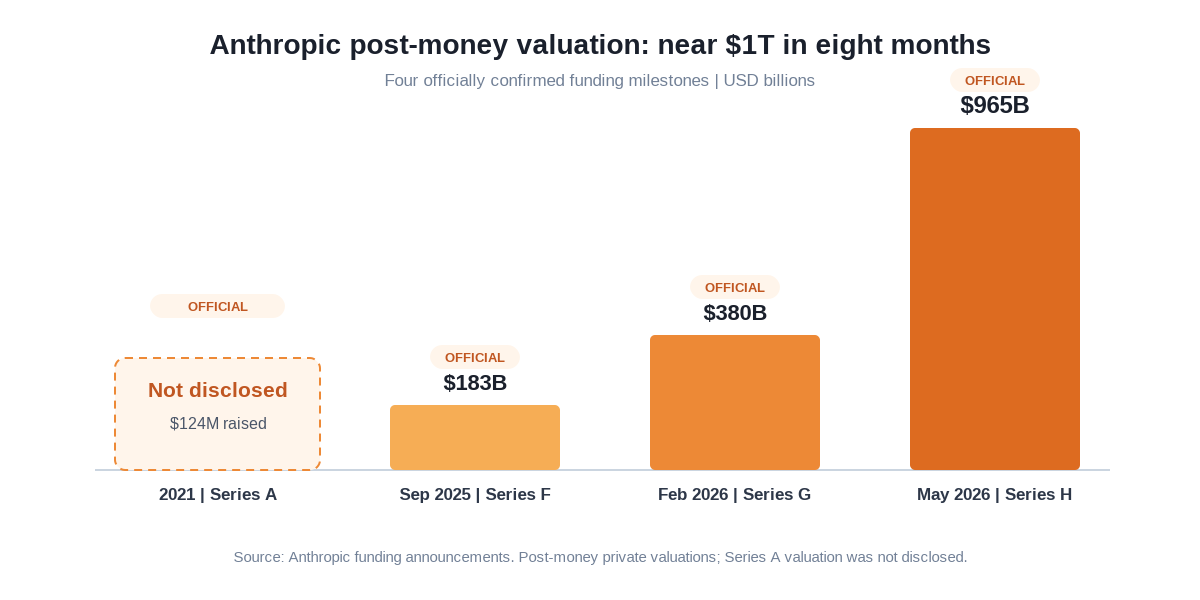
This is a private-market valuation: a price a small group of investors agreed on for a funding round, not a share price traded each day on a public market.
ARR Is Not the Same as Actual Revenue
Anthropic’s official ARR (annualized revenue) figures were above US$5 billion in August 2025, US$14 billion in February 2026, and above US$47 billion in May. According to Bloomberg, it had passed US$65 billion by the end of July 2026.
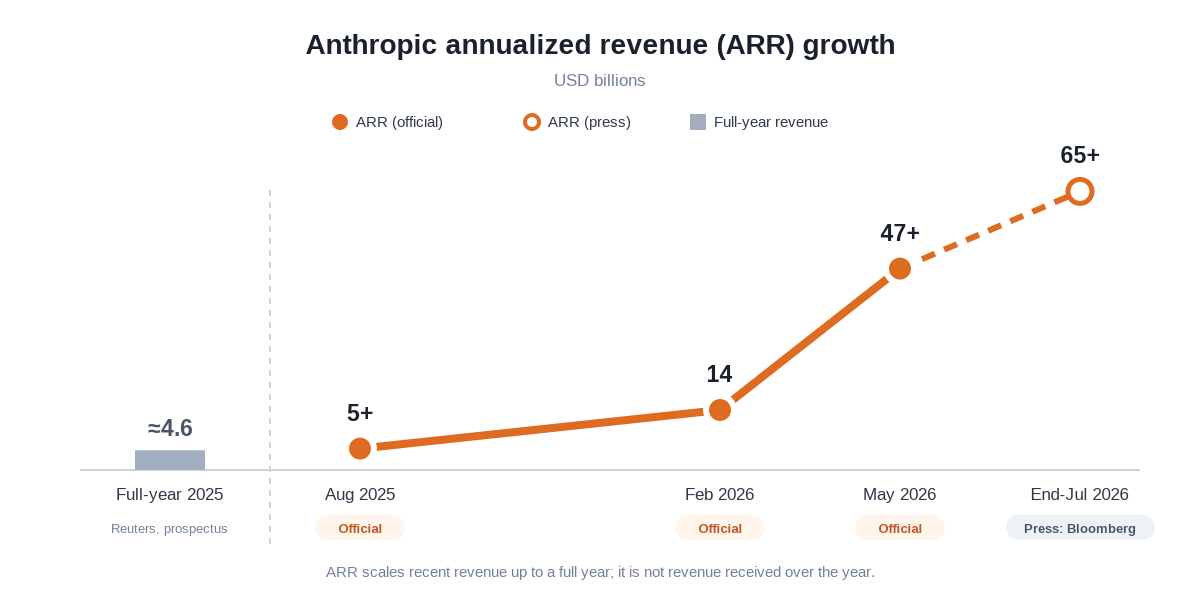
ARR takes recent revenue and multiplies it to a full-year pace. It shows speed, not the final full-year result. For example, ARR was above US$5 billion in August 2025, while the S-1 reports full-year 2025 revenue of about US$4.6 billion.
Other financial figures in the S-1 (2026 figures are unaudited):
- 2025 losses: Operating loss of about US$8.1 billion and net loss of about US$42 billion, including about US$34.3 billion in non-cash accounting charges.
- First half of 2026: Revenue of about US$16.3 billion, compared with US$1.16 billion in the same period a year earlier. The operating loss narrowed to US$693 million, and Q2 operating income was US$974 million. The net loss was US$80.7 billion, including about US$72.4 billion from value changes in convertible notes and similar instruments as their value rose. This was not cash paid out.
- Q3 (S-1/A amendment): Revenue of about US$17.0 billion, up about 47% from Q2. Anthropic’s official IPO website also says Q3 revenue was more than 12 times the same quarter a year earlier. The operating loss was US$567 million, so the core business went back to a loss. Adjusted operating income, the company’s own measure that excludes some costs and is defined by the company, totaled a positive US$4.081 billion for the first nine months.
- Sales channels: In the first half of 2026, 48% of revenue came through cloud service provider (CSP) marketplaces. For the first nine months through September, the five largest customers accounted for about 25%, and no single customer exceeded 10%.
In one sentence: ARR is the speedometer for how fast the company is going, not the odometer for how far it traveled over a full year.
How to Read the Valuation: Three Views in the Market
The market reads the same US$965 billion in three ways. These views show where the debate lies, not which side to choose.
- Optimists: Enterprise AI spending will keep growing, and Claude’s enterprise customers are loyal, so a high revenue multiple is justified.
- Neutrals: Growth is real, but the price already reflects a lot of good news. Next, revenue and profit must deliver.
- Skeptics: ARR may overstate actual revenue, while losses and compute costs are high. This price treats optimistic expectations as facts.
The three views differ in their assumptions: ARR or full-year revenue, which multiple to use, and whether profit can improve. Change the assumptions and the “fair valuation” changes a lot.
Behind the Valuation: The Compute Commitments
Anthropic does not make its own chips. It gets compute through long-term contracts with partners such as AWS, Google, and Microsoft Azure. According to the S-1, as of the end of June 2026, fixed or minimum-guarantee compute commitments totaled about US$265.6 billion, over terms of 1 to 20 years. After June, Anthropic signed or amended more contracts, adding about US$245 billion in future minimum payments, some conditional.
A high valuation comes with large commitments. If growth continues, these contracts provide capacity. If growth slows, they become a heavy bill. For more on compute, see Anthropic’s compute gamble.
IPO Progress: Price Range and Timeline
Anthropic publicly filed its S-1 on October 26, 2026, seeking a Nasdaq listing under ticker ANT. The amended filing of November 10 added a price range: US$70 to US$78 a share for 825 million shares. Based on total shares outstanding after the offering, that implies a valuation of about US$916 billion to US$1.02 trillion. CNBC instead uses the fully diluted share count (which also counts shares that could be created later), which gives about US$1.405 trillion at the top price. Goldman Sachs and Morgan Stanley lead the 22 underwriters.
According to Anthropic’s official IPO website, ipo.anthropic.com, the roadshow began on November 10, pricing is expected on November 18, and trading is expected to begin on November 19 (US Eastern time), subject to regulatory clearance. For the roadshow’s price, the valuation conversion, and the concurrent private placement, see Anthropic IPO Roadshow. For S-1 financials, governance, and lockup details, see Anthropic IPO explained.
According to Anthropic’s official page, retail offerings are expected in Australia, Canada, certain European countries, Japan, Switzerland and the UK, each through named brokers. Taiwan is not on the list. Before listing, shares cannot be bought on an exchange. After listing, readers outside the US usually buy US stocks through an international broker. For account-opening guides, see IBKR account-opening guide and Firstrade guide. To compare them, see IBKR vs. Firstrade. These explain ways to trade; they are not recommendations.
Penchan’s summary
Anthropic’s valuation captures the AI investment boom: the growth is real, the price investors are willing to pay is real, and assumptions sit between them.
This is a summary of public information, not investment advice. For more history, see the Pre-IPO deep-dive report. More reading: What Is Anthropic?, Anthropic vs. OpenAI, and Why a public benefit corporation.
Understanding how a number is measured matters more than memorizing the number itself.