Google launched Gemini 3.5 Flash on May 19 at I/O 2026, and it went live globally — including Taiwan — the same day.
I’ve tested it across the Gemini App, AI Studio, and the API. There’s more to say than I expected: which surfaces have already switched over, which are still rolling out, and where it actually differs from the previous generation and Google’s own flagship. This article sticks to the parts you can actually use.
4 Ways to Access Gemini 3.5 Flash
Here’s where you can get 3.5 Flash right now, and how to turn it on.
1. Gemini App (consumer)
Go to gemini.google.com, open the model dropdown in the top-left, and select 3.5 Flash. The Taiwan release notes entry for May 19 says it plainly: select 3.5 Flash from the model drop-down. If your version hasn’t rolled out yet, it’ll update automatically within a few days.
2. Google AI Studio (free API testing)
Head to aistudio.google.com, sign in, select 3.5 Flash, and start a new chat. Taiwan is on Google’s available regions list — no access restrictions. The free quota is enough for small experiments; for production workloads, move to the API. One thing worth knowing: free plan conversations are used to improve Google’s products; paid API usage is not. Google spells this out explicitly on their pricing page.
3. Gemini API (for developers)
The model code is gemini-3.5-flash. No allowlist required — just call it. Three serving modes are available: Standard for general use, Flex for non-real-time batch workloads, and Priority for latency-sensitive online scenarios. Full details are in the Gemini API docs.
4. Gemini Enterprise Agent Platform (enterprise)
On Google Cloud, the new Gemini Enterprise Agent Platform has a dedicated 3.5 Flash model page with Cloud model IDs and capability details. One thing enterprise buyers should check: ML processing runs in US and EU multi-regions. “Available in a region” and “data processed in that region” are not the same thing. If data residency matters for your compliance requirements, get clarity on this before signing anything.
What Actually Changed
Google’s published benchmarks (sourced from the DeepMind 3.5 family page and the 3.5 Flash model page):
| Benchmark | Gemini 3.5 Flash | Gemini 3 Flash | Gemini 3.1 Pro | What it measures |
|---|---|---|---|---|
| Terminal-bench 2.1 | 76.2% | 58.0% | 70.3% | CLI agent tasks |
| MCP Atlas | 83.6% | 62.0% | 78.2% | Tool calling |
| OSWorld-Verified | 78.4% | 65.1% | 76.2% | Desktop agent operation |
| Finance Agent v2 | 57.9% | 42.6% | 43.0% | Financial analysis tasks |
| SWE-Bench Pro Public | 55.1% | 49.6% | 54.2% | Real GitHub bug fixes |
| MMMU-Pro | 83.6% | 81.2% | 80.5% | Multimodal reasoning |
| CharXiv Reasoning | 84.2% | 80.3% | 83.3% | Chart understanding |
| MRCR v2 128k avg | 77.3% | 67.2% | 84.9% | Long-context recall |
| Humanity’s Last Exam | 40.2% | 33.7% | 44.4% | Hardest reasoning |
| ARC-AGI-2 | 72.1% | 33.6% | 77.1% | Abstract reasoning |
Against the previous Gemini 3 Flash, the jump in agentic tool use is the most visible thing in the table — it looks like a generational gap. That’s clearly where Google focused the retraining effort.
Against its own flagship Gemini 3.1 Pro, 3.5 Flash pulls ahead on coding, tool use, and multimodal tasks, but 3.1 Pro still leads on three things: long-context recall, hardest reasoning benchmarks, and abstract logic. The bottom three rows in the table belong to Pro.
My read: 3.5 Flash is built for tasks where you need the model to take multiple steps on its own, iterate, and act. Gemini 3.1 Pro is still better suited for situations where you’re feeding in a long document and want careful, thorough analysis. Google hasn’t taken down the 3.1 Pro page, which tells you they’re not positioning 3.5 Flash as a full replacement.
What Third-Party Tests Show
Google picks its own benchmarks, so third-party results are more interesting.
The Artificial Analysis report from May 19 rated Gemini 3.5 Flash noticeably higher than Gemini 3 Flash on overall quality, clocked it at roughly 4x the response speed of comparable models, and found a lower hallucination rate — though I’ll come back to that. Multimodal understanding hit the highest score in their records.
The OpenLM Chatbot Arena+ snapshot from May 18 — based on 6 million+ blind human preference votes — put Gemini 3.5 Flash in the top cluster alongside GPT-5.5, Claude Opus 4.7 Thinking, and Gemini 3.1 Pro.
Worth keeping in mind: Arena scores human preference, not raw capability. It means people in blind tests rated 3.5 Flash’s responses on par with the top-tier models — not that it beats them on every task. Think of it as a signal that most users find its output useful, not a universal quality verdict.
3 Features That Are Still US-Only
The real centerpiece of this year’s I/O was the agentic tool chain. But the most interesting pieces of that are US-only. Better to be clear about this upfront.
Gemini Spark: Google’s “24/7 always-on agent.” The official announcement puts it behind AI Ultra subscriptions and US-only, starting with trusted testers before a US beta. Spark runs in the background continuously — watching your Calendar to help with scheduling, monitoring Gmail to surface tasks, proactively reporting back when something needs attention. Taiwan’s subscription page lists Spark as US only, English only.
Daily Brief: Auto-generated daily summaries pulled from your connected Gmail and Calendar. US-only.
AI Inbox in Gmail: Automatically turns emails into actionable tasks. US-only.
The most practical thing you can do right now: open the Gemini App and check whether your model has already switched to 3.5 Flash (if not, it’ll happen automatically within a few days). Then try something you’d normally throw at the old version and see how the speed and specificity compare. I tested “analyze the three main risks in this PDF” — 3.5 Flash’s response had more depth, and it was noticeably faster.
3.5 Flash vs 3.1 Pro: Which One to Use
The question I expect most people to have. Direct answer:
Go with 3.5 Flash if your use case involves:
- Multi-step agentic tasks where the model needs to use tools on its own (iterating on code, fetching data, running full task chains)
- Fast, responsive interaction where latency matters
- Feeding in images, video, or PDFs to produce summaries or analysis
- High-volume batch workloads where you’re willing to trade off real-time response for cost
Stick with 3.1 Pro if your use case involves:
- Deep analysis of long documents — 100+ pages (3.1 Pro still leads on long-context recall)
- The hardest reasoning tasks (Pro still wins on the toughest benchmarks)
- Creative or deliberative content where careful thinking matters (Google’s own positioning for Pro points here)
If you’re still unsure, open two chats in AI Studio side by side — one 3.5 Flash, one 3.1 Pro — and run your actual work through both. Half an hour of real comparison beats any benchmark table.
One more thing: Gemini 3.5 Pro is not out yet. Google’s launch blog said “next month,” and the DeepMind family page says “3.5 Pro coming soon” — that points to June 2026. Any article claiming 3.5 Pro is already generally available before then is either misreading the announcement or AI-generated.
One Concern Worth Noting: Spark’s Privacy Model
Now that we’ve covered what you can use, here’s something I think is worth keeping in mind.
The Verge’s piece from May 20 is the most useful English-language take I read on this year’s I/O. The argument is straightforward: Google’s entire agent roadmap rests on users being willing to connect their Gmail, Calendar, Drive, Photos, Search history, and YouTube history to AI. Spark, Daily Brief, Personal Intelligence — all of it is built on that premise.
The Verge isn’t saying “Google is stealing your data.” That framing is wrong. What it’s pointing out is that OpenAI and Anthropic also offer connectors, but Google’s position is different — it already sits on top of your Gmail, Docs, and Photos. What it wants to connect to is its own data. Opt-in is opt-in, sure. The real question is whether, once you’ve opted in, you trust the system not to make mistakes, not to fall victim to prompt injection, not to send out the wrong email.
Spark hasn’t opened outside the US yet, which actually gives everyone else time to watch what happens in the American beta. There’s no urgency to connect your Gmail before the rest of the world gets access.
If you care about keeping your content out of model training, the paid API is the clearest option. Google’s official docs explicitly state that the free plan uses conversations to “improve our products” — the paid tier does not.
My Take
Honestly, this year’s I/O didn’t get me that excited.
Gemini 3.5 Flash is genuinely fast, genuinely capable with tools, and the benchmarks look strong. But Google’s push toward a full agentic tool chain rests on users connecting Gmail, Calendar, Drive, and Photos to an always-on AI. Whether that model holds up even in the US is an open question, let alone in other markets. Spark not launching outside the US yet is actually useful — it gives everyone else a window to watch the beta before making any decisions.
For individual users, the Gemini App already gives you 3.5 Flash. The speed and tool-calling improvements are real. Try it first. For developers and advanced users, this generation makes “AI working in the background around the clock” more technically viable — but the “always-on AI that follows your life” model still needs more beta feedback before drawing conclusions.
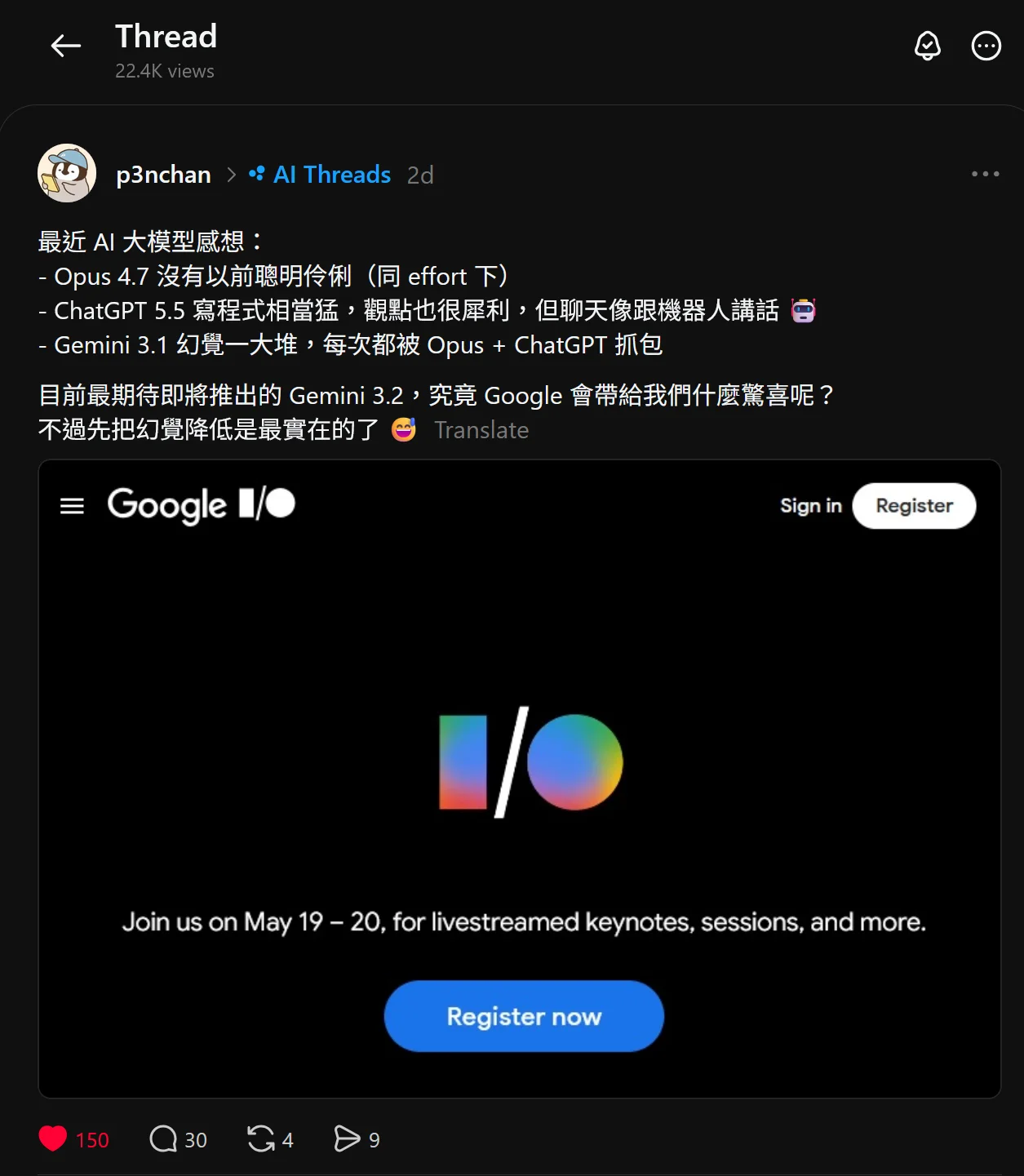
There’s also a problem Google didn’t address at I/O: hallucination. Before 3.5 Flash launched, I posted on Threads about Gemini 3.1’s persistent hallucination problem — it kept getting caught by Opus and ChatGPT. After 3.5 launched, I ran another round of testing and watched the community discussion. The problem isn’t fixed. Artificial Analysis measured a 31 percentage point drop in hallucination rate versus Gemini 3 Flash, which is movement in the right direction. But that’s nowhere near solving the problem. For anything that requires factual accuracy — academic citations, legal text, technical documentation, financial figures — one pass through Gemini is still not enough. Run external verification.
Gemini 3.5 Pro is still a month out. Until then, any article claiming “the full Gemini 3.5 lineup is here” either didn’t read the announcement carefully or was written by AI.
Back to the Pillar
This article is an extension of the Gemini Chinese Guide. For help choosing a subscription plan, see Gemini Free vs Google AI Pro. To compare with ChatGPT, see Gemini vs ChatGPT. For a broader look at the agentic tool landscape, see AI Agent Tools Comparison.
Sources
- Google: Gemini 3.5: frontier intelligence with action
- Google DeepMind: Gemini 3.5 family / Gemini 3.5 Flash / Gemini 3.1 Pro
- Google AI for Developers: Gemini 3.5 Flash model page / Pricing / Available regions / Changelog
- Google Cloud: Gemini Enterprise Agent Platform model page
- Google: Google I/O 2026 developer highlights / AI subscription updates / Taiwan subscriptions / Taiwan release notes
- Artificial Analysis: Gemini 3.5 Flash: Everything You Need to Know
- OpenLM: Chatbot Arena+
- The Verge: Google’s AI future demands trust and your personal data
- Simon Willison: Gemini 3.5 Flash
- Hacker News: Discussion thread