
In June 2026, Binance did something no crypto exchange had done before: it opened up U.S. stock trading directly inside the App.
That means you no longer need to open a separate overseas brokerage account or wire U.S. dollars. With one Binance account and some USDC on hand, you can buy U.S. stocks such as Apple, NVIDIA, and Tesla, starting from $5.
This 2026 updated guide walks through what Binance U.S. Stocks are, how they differ from the recently popular “tokenized stocks,” how the fees work, and how to buy step by step. The interface is based on the latest Binance App and is written for Taiwan users.
What is Binance U.S. stock trading? Officially launched in June 2026
Binance U.S. stock trading is a feature that lets you buy and sell U.S.-listed stocks and ETF directly on Binance. In Binance’s own framing, it marks a move from “crypto exchange” toward a “multi-asset financial super App.” Crypto assets and traditional stocks now sit in the same account.
The core points:
- Number of instruments: 7,000+ U.S. stocks and ETF, including familiar tech stocks and ETF
- Minimum amount: from $5, with fractional shares supported
- Payment method: mainly USDC; balances such as BNB and USDT can also be automatically converted into USDC for orders
- Trading hours: some instruments support 24/5 trading
- Fees: zero Binance commission, with only the partner broker’s platform fee, detailed below
In plain terms, it compresses the hassle of “opening a U.S. brokerage account” into a button inside the Binance App. For people already using Binance who also want to allocate a little to U.S. stocks, it removes the full process of FX conversion, cross-border wires, and another account.
Don’t have a Binance account yet? Start with the Binance registration guide, then come back to buy U.S. stocks.
Binance “real U.S. stocks” vs “tokenized stocks”: what’s the difference?
This is where most people get confused, and it is worth clearing up first.
Over the past year or two, ” tokenized stocks ” have become popular in crypto, such as xStocks. You may have seen them on Bybit, Kraken, or Binance Wallet. The concept is that an issuer wraps shares into tokens on a blockchain, claiming 1:1 backing by the real stocks so you can trade them on-chain 24/7.
The U.S. stock trading Binance launched this time gives you the actual stock itself. Here is the difference:
| Comparison | Binance U.S. stock trading (this article) | Tokenized U.S. stocks (such as xStocks) |
|---|---|---|
| Nature | Real U.S.-listed stocks | Blockchain tokens claiming 1:1 backing by shares |
| Custody | Custody-held by regulated broker Alpaca | Issuer-collateralized and held in on-chain wallets |
| Transfer out | Can be transferred to other brokers | Mostly circulates inside the crypto ecosystem |
| Dividends | Automatically credited | Depends on the issuer; often synthetic or none |
| Trading venue | Binance App, Trade → Stocks | Binance Wallet, decentralized exchanges, some exchanges |
| Trading hours | 24/5 for some instruments | Often 24/7 |
| Best for | People who want to really hold stocks | People who want round-the-clock on-chain trading |
One-line distinction: if you want real stock exposure, dividends, and the option to transfer out later, use Binance U.S. stock trading; if you only want to move in and out on-chain all day, then consider tokenized stocks. Everything below is about the former: real U.S. stocks.
How does Binance U.S. stock trading work? Alpaca custody and an ADGM license
The first question many people ask is: “A crypto exchange is selling stocks. Is it safe? Whose stocks are they?”
The key is that Binance U.S. Stocks sit behind a regulated brokerage structure. Binance itself does not custody your securities:
- Nest Trading Limited: acts as your introducing broker and sends out your orders
- Alpaca Securities LLC: a U.S. licensed broker responsible for order execution, clearing, settlement, and custody
In other words, you are buying real stocks custody-held by Alpaca, not tokens “printed” by Binance. This also means your securities support transfers out, theoretically to another broker, which is very different from tokenized stocks.
Binance U.S. stock trading operates under an ADGM (Abu Dhabi Global Market) license, with a regulatory framework behind it rather than a gray-zone setup.
Transparency note: Binance also discloses in its official disclaimer that it may receive payment for order flow (PFOF) for routing your orders. This is common in the U.S. brokerage industry, but it is worth knowing.
A few operating details:
- Order types: market orders and limit orders are supported; limit order duration can be same-day (DAY) or good-till-cancelled (GTC, up to 90 days)
- Price protection: the order price cannot deviate by more than ±10% from the current national best bid and offer (NBBO), avoiding unreasonable limit prices
- Settlement: sales use T+1 settlement, completing on the next trading day after execution
Binance U.S. stock fees: zero commission, but there is a platform fee
“Zero commission” is Binance’s headline selling point, but you need the full fee structure so you do not mistake it for completely free.
Binance itself does not charge trading commission. The cost comes from the platform fee charged by the partner broker:
| Order amount | Platform fee |
|---|---|
| $350 or less | Fixed $0.35 per order |
| Above $350 | 0.1% of the trade amount (10 basis points) |
Examples:
- Buy $100 of stock → platform fee $0.35 (equal to a 0.35% cost)
- Buy $1,000 of stock → platform fee $1 (0.1%)
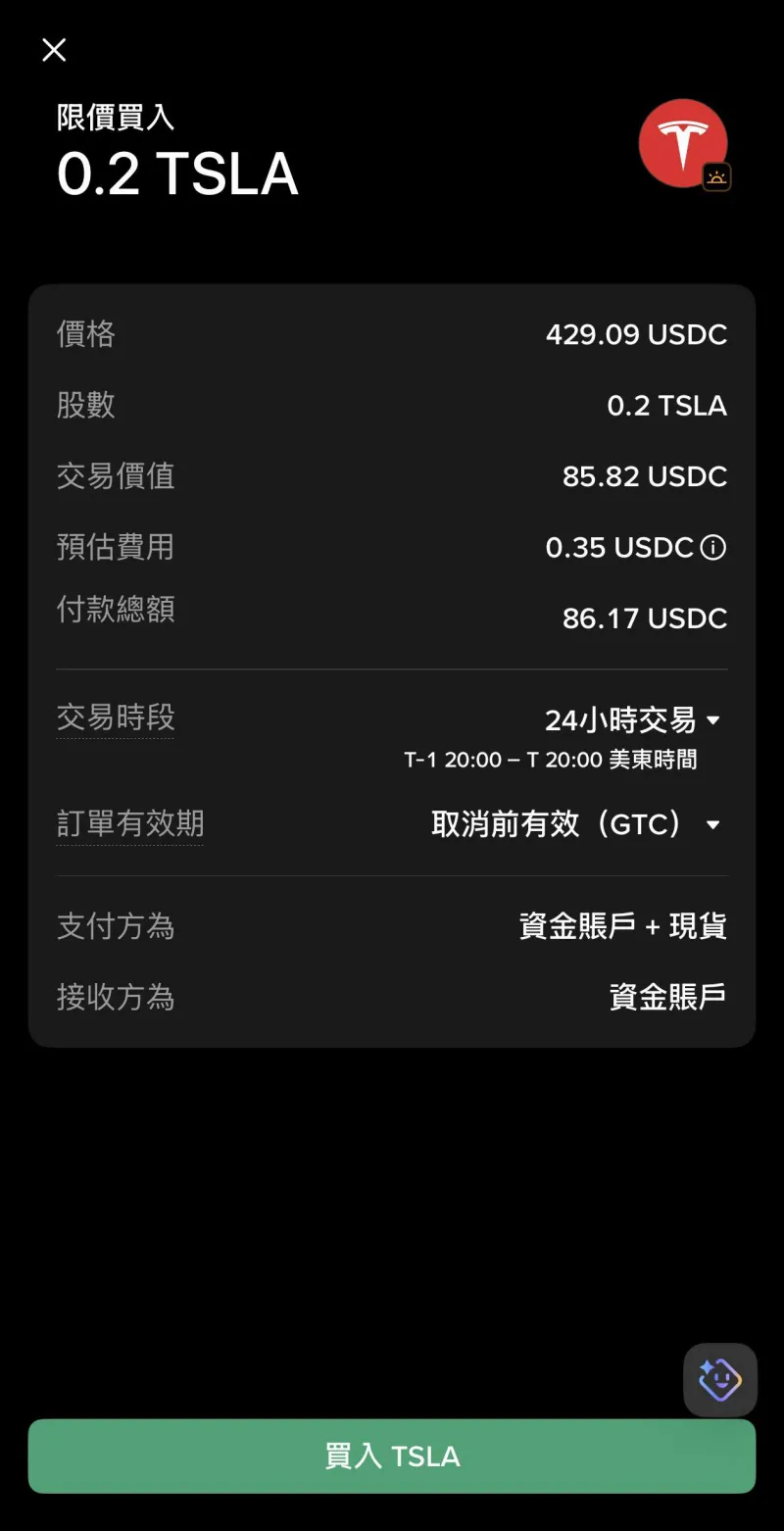
Actual testing matches this: buying 0.2 shares of TSLA with a trade value of about 85.82 USDC (under 350) showed an estimated fee of 0.35 USDC and a total payment of 86.17 USDC, as shown in the order walkthrough screenshot below.
You can see that the smaller the amount, the larger the share taken by the fixed $0.35 fee. If you are only testing with a small amount, be ready for that cost. Once the order size gets larger, 0.1% is quite competitive for U.S. stock trading.
Two other possible costs to note:
- ADR depositary fees: some ADR stocks of non-U.S. companies may charge $0.01 to $0.03 per share per year
- Dividend withholding tax: dividends you receive may be subject to withholding tax
For a full comparison of Binance fees across spot, futures, deposits, and withdrawals, see the Binance fee guide.
Want to reduce per-order fees? Another stablecoin route into a broker
Binance U.S. Stocks win on convenience, but every order has a platform fee, so the percentage cost is high for small trades. If you trade more often and want to use stablecoins to fund a traditional broker directly to reduce single-order costs, consider another route: use USDC through FluidKey to fund IBKR (Interactive Brokers). IBKR is a long-established U.S. stock broker, and its fee structure differs from Binance’s. For cost-sensitive long-term investors, it may be cheaper. The two methods fit different situations, so choose based on your trading habits.
How to buy Binance U.S. Stocks: App step-by-step with screenshots
The actual operation is quick. First make sure your App is updated to the latest version (iOS 3.15 or above, Android 3.15.7 or above) and that you have USDC in the account (or balances such as BNB or USDT that can be converted automatically).
No funds yet? Start with the Binance deposit guide and prepare your USDC.
Step 1: Switch the App language to Traditional Chinese
Open the Binance App → Settings → switch the language to Traditional Chinese. The U.S. stock trading section is shown most completely in the Traditional Chinese interface, so follow along with that.
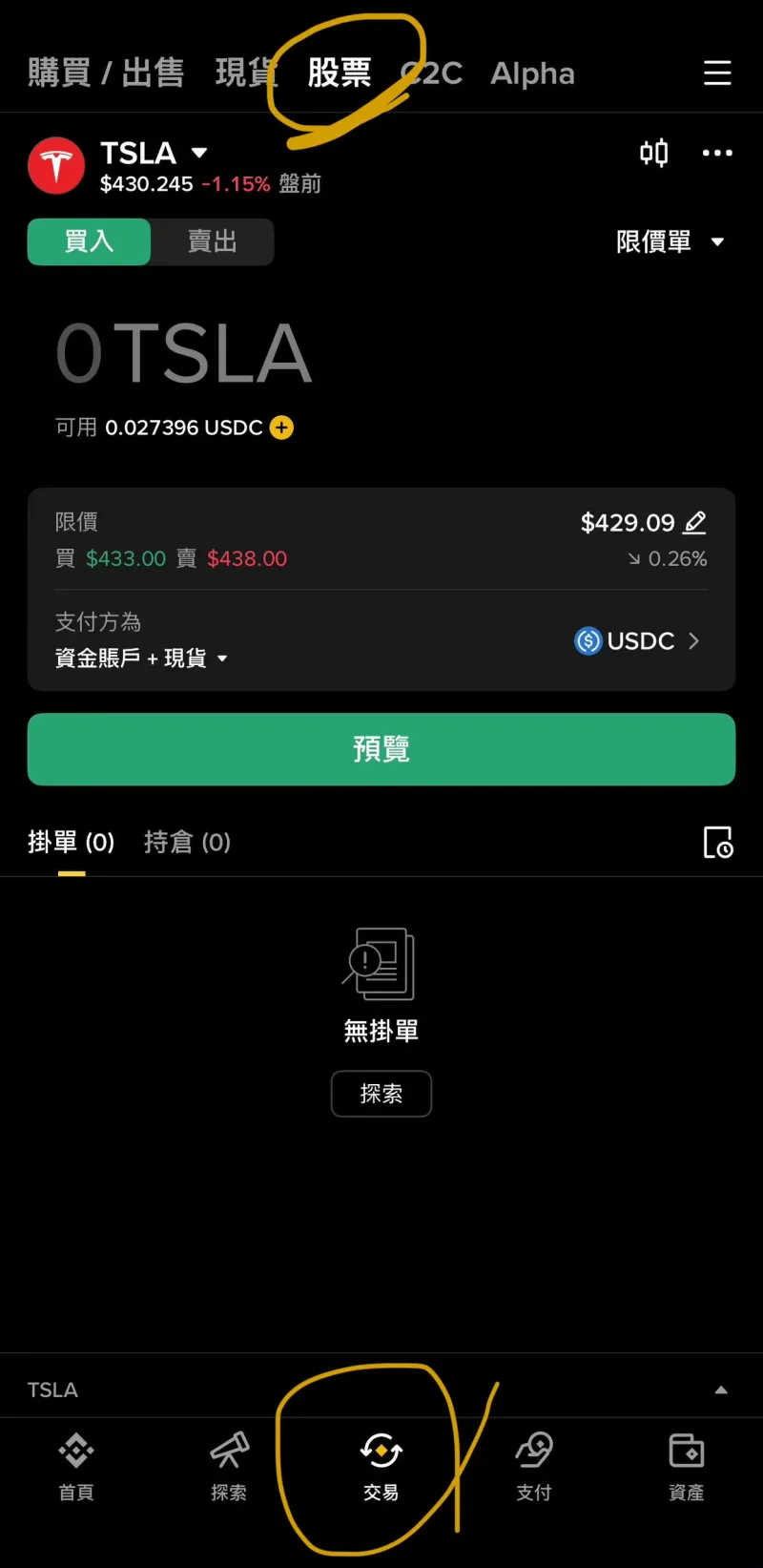
Step 2: Enter the U.S. stock section and choose a stock
Return to the App home screen, tap Trade at the bottom, then choose the Stocks tab at the top to enter U.S. stock trading. Search for and select the stock you want to buy, such as TSLA, then choose Buy and the order type (market or limit).
Step 3: For the first trade, accept the securities trading terms
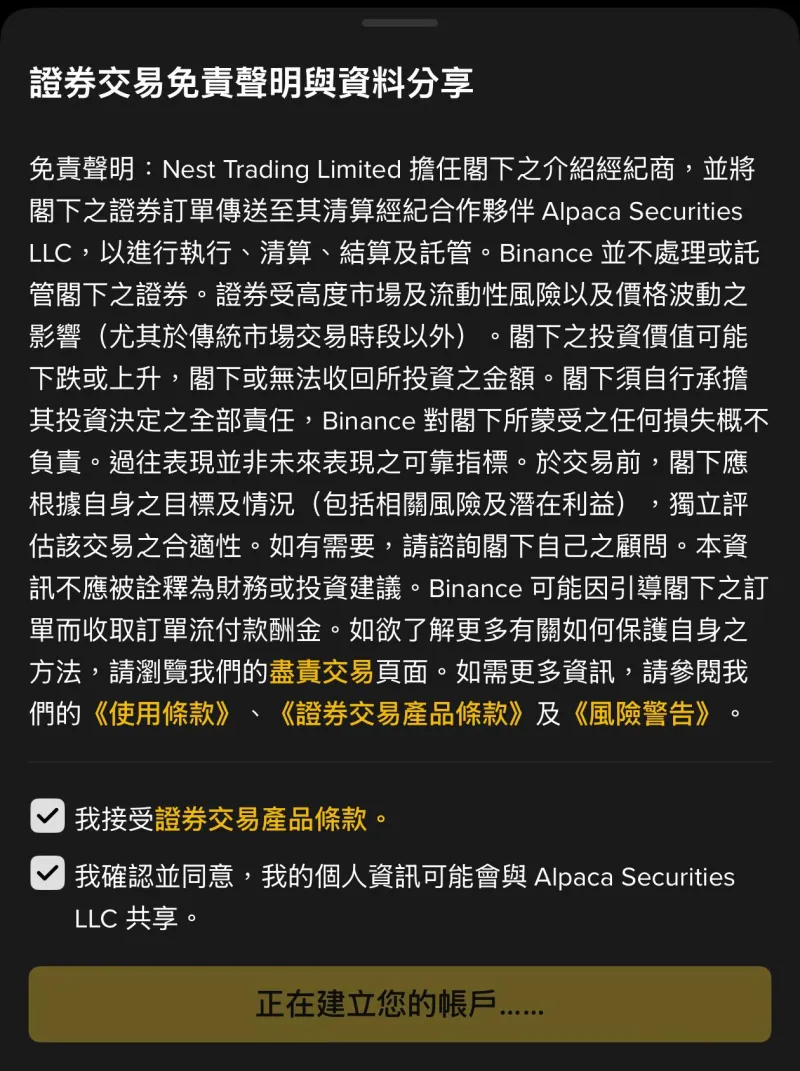
The first time you place an order, the App shows a Securities Trading Disclaimer and Data Sharing prompt. You need to tick two items to continue:
- I accept the Securities Trading Product Terms
- I acknowledge and agree that personal information may be shared with Alpaca Securities LLC
After you tick them, the system automatically creates a securities account for you. This is a one-time step and will not appear again later.
Step 4: Enter the amount and confirm order details
Enter the number of shares or the amount (minimum $5, fractional shares supported). After tapping Preview, you will see the full details: price, shares, trade value, estimated fee, total payment, trading session, and order validity. If everything looks right, tap Buy.
Step 5: Done, then check open orders
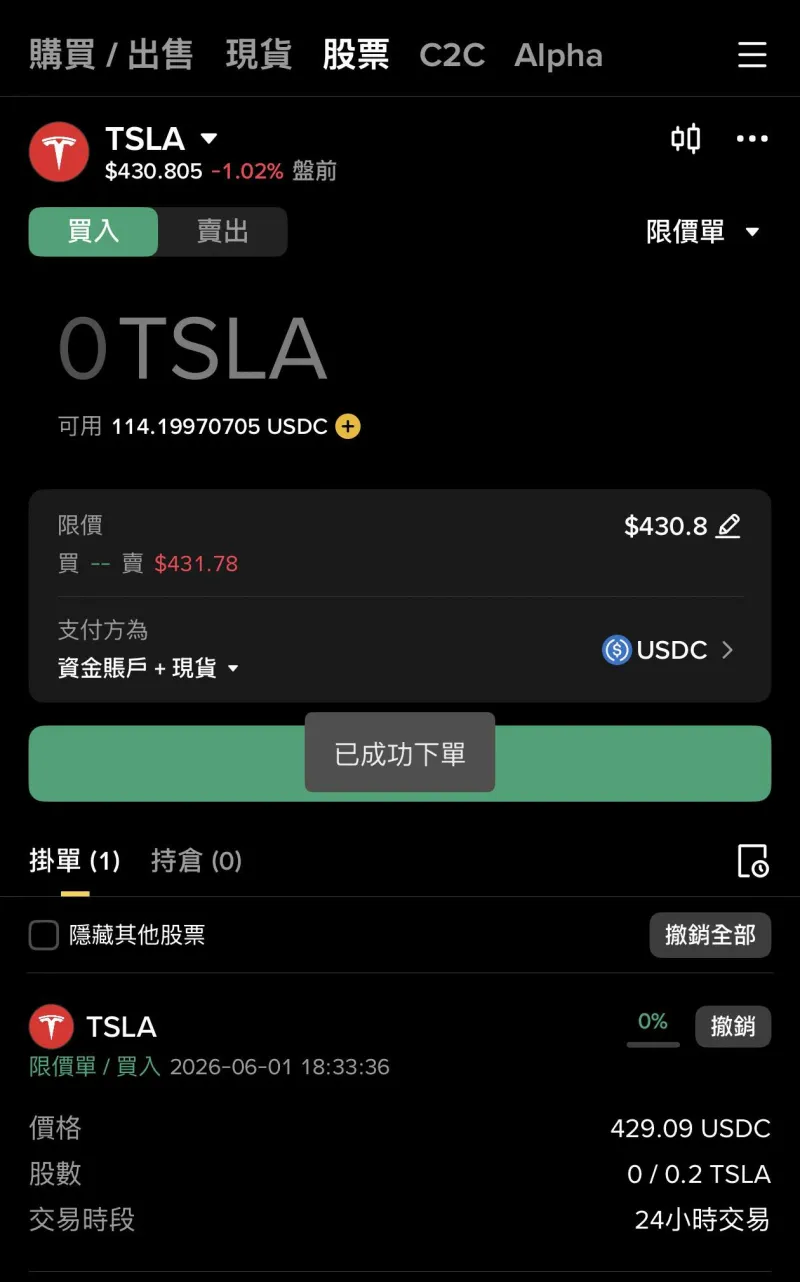
After submission, the App shows Order placed successfully. You can track this order under the Open Orders tab below, and once filled it will appear in Holdings.
Can’t see the Stocks entry? First confirm that the App is updated to the versions above and the language is set to Traditional Chinese. If it still does not appear, your region may not be supported yet.
If you do not have a Binance account yet, this is a good time to start:
Who is Binance U.S. Stocks for? Limits and risks
Binance U.S. Stocks are convenient, but they are not for everyone and they are not risk-free. Think through these points before starting:
Situations where it fits
- You already use Binance, hold stablecoins, and want to add some U.S. stock exposure
- You want to buy higher-priced stocks with small amounts (fractional shares start from $5)
- You want to manage crypto and stocks in the same App rather than switching platforms
Limits and risks to note
- Availability: only available to eligible users and depends on jurisdiction, so not every region may be supported
- Tax: you need to track your own tax responsibilities for U.S. stock dividends and capital gains, including possible dividend withholding tax
- Settlement delay: sale proceeds are usable only after T+1 settlement, unlike instant crypto transfers
- Platform concentration risk: keeping both crypto and stocks in the same account is convenient, but the other side is concentrating eggs in one basket; assets you do not use often are still better diversified across custodians
- Regulatory environment: Taiwan’s rules for offshore exchanges and new services such as buying stocks with crypto are still evolving, and the environment may change
Final reminder: this article is a tutorial and product explainer, not investment advice. Every investment has risk. Evaluate based on your financial situation and risk tolerance before buying, and you are responsible for your own gains and losses.