
You have some USDC and want to use it to buy U.S. stocks. Before June 2026, that was a little awkward for crypto users. Now there is a new option: Binance has launched U.S. stock trading directly.
Stablecoin holders now have two routes in front of them: use the newly launched Binance U.S. Stocks, or use FluidKey to fund long-established broker IBKR (Interactive Brokers) with USDC and then buy.
This article takes the perspective of “I already have USDC” and lays out the fees, funding costs, and use cases for both routes so you can choose the one that makes economic sense.
The short answer: one-line routing
If you do not want the details, remember these two lines:
- Small amounts, occasional buys, convenience first → Binance U.S. Stocks, no separate account, place orders directly with USDC
- Larger amounts, frequent trading, a real broker in your own name → IBKR, much cheaper at larger sizes because it charges by share
The rest of the article explains the numbers behind that conclusion.
What do the two routes look like?
Although the end point is the same, “buy U.S. stocks,” the structure of the two routes is very different.
| Comparison | Binance U.S. Stocks | IBKR (funded with FluidKey) |
|---|---|---|
| Account | Inside the Binance App, no separate brokerage account | Need a separate IBKR account + KYC |
| Who holds the shares | Custody-held by Alpaca (Binance does not custody) | Brokerage account directly in your own name |
| Funding method | Place orders directly with in-account USDC | USDC goes through FluidKey and funds by ACH |
| Instruments | 7,000+ U.S. stocks and ETF | Global markets, including U.S. stocks, ETF, options, futures, and more |
| Trading hours | Some instruments support 24/5 | Regular U.S. market session plus pre-market and after-hours |
| Time to start | A few minutes | Requires account opening and funding, so slower |
In short, Binance U.S. Stocks win on “fast” and “easy”; IBKR wins on “complete” and “in your own name.”
Fees are the key: by amount vs by share
This is the most important part. The two routes use fundamentally different fee models, and that decides which is cheaper at different order sizes.
Binance U.S. Stocks: Binance charges zero commission. The cost is the partner broker’s platform fee, calculated by trade amount:
- Orders of $350 or less: fixed $0.35
- Orders above $350: 0.1% of the amount (10 basis points)
IBKR (Pro tiered): charged by share, at $0.0035 per share, with a $0.35 minimum per order and a cap of 1% of trade value.
The difference is here: Binance’s fee grows proportionally with the amount, while IBKR’s fee follows the share count and barely inflates with order value. A few scenarios make it clear (assuming you already hold USDC and IBKR uses Pro tiered pricing):
| Single order amount | Binance U.S. Stocks | IBKR | Cheaper route |
|---|---|---|---|
| $100 | $0.35 | $0.35 minimum | Tie |
| $350 | $0.35 | $0.35 | Tie |
| $1,000 | $1.00 | About $0.35 | IBKR about 3x cheaper |
| $5,000 | $5.00 | About $0.35 | IBKR about 14x cheaper |
| $10,000 | $10.00 | About $0.35 to $1 | IBKR about 10x to 20x cheaper |
The dividing line is clear: under $350, the two are tied; above that, IBKR pulls further ahead on trading fees.
Funding cost: the number stablecoin holders need to count
But trading fees alone are not the whole picture. For stablecoin holders, IBKR adds another cost layer: funding. That needs to be included.
- Binance U.S. Stocks: your USDC is already in the Binance account, so the order deducts it directly and funding cost is close to zero
- IBKR: USDC must first go through FluidKey and into IBKR via ACH. New FluidKey users get $3,000 of free monthly allowance (deposits and withdrawals combined). The excess is charged 0.3%
That funding fee makes the conclusion more precise:
- If your monthly deployment is within $3,000: FluidKey funding is free, so IBKR’s trading-fee advantage can be fully captured
- If your monthly deployment is far above $3,000: FluidKey’s 0.3% funding fee is actually higher than Binance’s 0.1% trading fee. At that point FluidKey is not the best route; people moving larger amounts usually fund IBKR with a same-name bank wire. A wire is usually a fixed fee (in Taiwan, outbound international USD wires are often around $20 to $50 in practice; this article uses $30 as an estimate). The larger the amount, the lower that fixed fee becomes as a percentage, and IBKR’s low per-share trading fee then matters more
In other words, FluidKey’s stablecoin fast lane is really positioned for small amounts and testing. For the full steps, same-name rule, and foreign-exchange reporting red lines, see the illustrated guide to funding IBKR with stablecoins.
Total cost at a glance: $1,000 / $10,000 / $100,000
Combine trading fees and funding fees, and compare total cost for a single buy at three sizes (assuming a share price around $430, IBKR Pro tiered pricing, and a same-name wire fee of about $30; actual wire fees depend on the bank):
| Single order amount | Binance U.S. Stocks | IBKR + FluidKey funding | IBKR + same-name wire (including about $30 wire fee) |
|---|---|---|---|
| $1,000 | $1.00 | $0.35 | $30.35 |
| $10,000 | $10.00 | $21.35 | $30.35 |
| $100,000 | $100.00 | $291.81 | $30.81 |
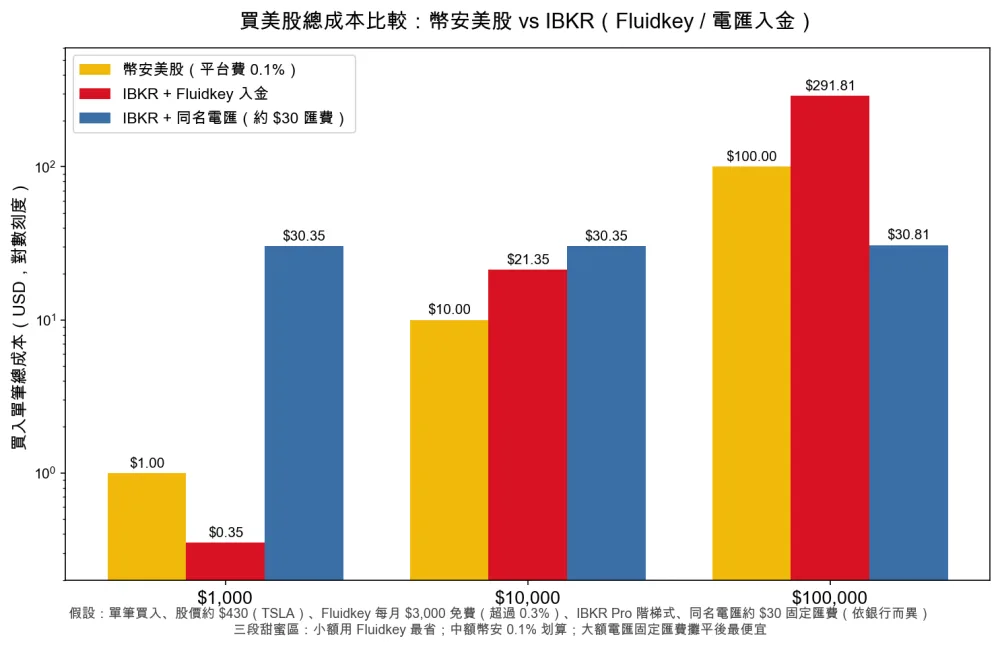
The chart makes the sweet spots clear. Each route is cheapest at a different size:
- Small amounts (within $3,000 per month): use FluidKey to fund IBKR. Funding is free and trading fees are low, so it is the cheapest
- Medium amounts: Binance U.S. Stocks. The 0.1% platform fee can be lower than either funding route in this band
- Large amounts: IBKR with a same-name bank wire. Even with about $30 of fixed wire fees, larger amounts dilute the fee, and IBKR’s per-share trading cost is extremely low
One trap is easy to miss: IBKR + FluidKey is only cheapest for small amounts. Once the amount exceeds FluidKey’s $3,000 monthly free allowance, the 0.3% funding fee becomes more expensive than Binance’s 0.1%. Buying $100,000 can cost nearly $300 in funding fees.
Scenario check: which type are you?
Once you combine trading fees and funding costs, the choice is straightforward.
Choose Binance U.S. Stocks if you are:
- Already using Binance, already holding USDC, and want to add some U.S. stock exposure conveniently
- Placing smaller orders and not trading often
- Prioritizing the convenience of “one App for crypto + stocks” and do not want to open another brokerage account just to buy stocks
Choose IBKR (small FluidKey funding or large bank wire) if you are:
- Scaling to larger amounts or trading more frequently, and are sensitive to per-order costs
- Want the shares held directly in a traditional brokerage account in your own name rather than through custody
- Need a broader set of markets and products, such as options, futures, or global equities
Many people end up using both: small, spur-of-the-moment buys go to Binance; core long-term positions sit at IBKR.
Other differences worth knowing
Beyond fees, several points affect the long-term experience:
- Holding form: Binance U.S. Stocks are custody-held by Alpaca and support transfers out; IBKR is direct holding in your own brokerage account. Both are real stocks, but IBKR’s “in your own name” structure feels safer to some people
- Settlement: Binance U.S. Stocks use T+1 settlement after selling before funds are usable; IBKR follows the standard stock settlement cycle too
- Tax: U.S. stock dividends for non-U.S. persons usually have withholding tax. This applies on both sides, and gains still need to be reported and taxed according to your own rules
- Market breadth: if you want to trade options, futures, or markets outside U.S. stocks, IBKR’s coverage is far broader than Binance U.S. Stocks
There is no absolute winner. The right route depends on your order size, trading frequency, and whether you care more about convenience or cost.
To start directly, read the Binance U.S. stock trading guide or the steps for funding IBKR through FluidKey. If you do not have accounts yet:
Final reminder: this article is a tutorial and comparison, not investment advice. Every investment has risk. Evaluate based on your financial situation and risk tolerance, and you are responsible for your own gains and losses.