
Many people meeting Gemini for the first time get confused by a row of names: Flash, Pro, Flash-Lite, Omni, plus numbers like 3.6 and 3.8 trailing behind.
In fact, Gemini is a whole family of models. Google splits different needs into several product lines, like one car model sold in fuel-saver, performance, and entry-level trims. To get to know the company behind it, start with What kind of company is Google.
Gemini Is a Family, Not a Single Model
To understand Gemini’s naming, split it into two layers.
The first layer is the product line: Flash, Pro, Flash-Lite, and Omni. It tells you what task a model was built for. The second layer is the generation number, like 3.5, 3.6, or 3.8. A newer number usually means stronger capabilities. So “Gemini 3.8 Flash” means “the Flash line, generation 3.8.”
There is one exception. On September 30, 2026, Google announced its new frontier model, Gemini 4 Argon. “Argon” is not one of the four product lines. It is first available to security defenders through Google’s Fairwind program, and as of October 2026 it is not on the public API model list.
Where Each of the Four Lines Sits
| Product line | Positioning | Best-fit scenarios |
|---|---|---|
| Pro | Reasoning + long context | Complex reasoning, reading long documents, coding |
| Flash | The workhorse for speed and value | High-volume apps such as chat assistants, customer support, and batch processing |
| Flash-Lite | The cheapest tier in the family | Easy tasks with a huge number of calls |
| Omni | Audio and video multimodality | Understanding and generating images, audio, and video |
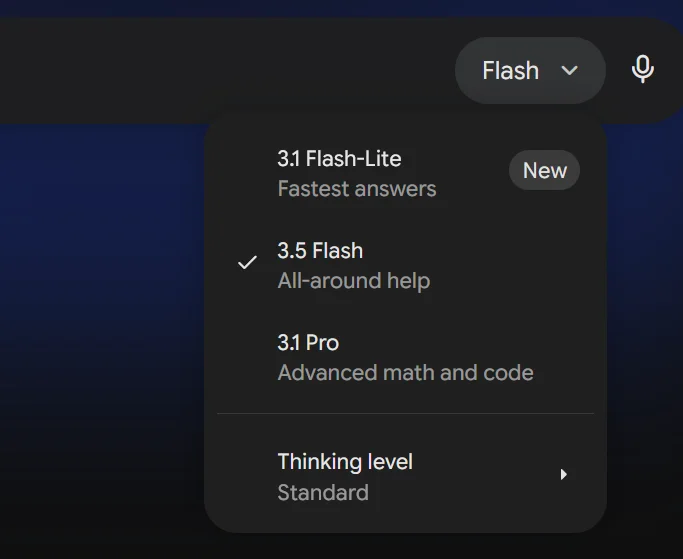
According to the official model list (checked October 2026), the API versions of each line are: Flash is Gemini 3.8 Flash (released September 2, 2026), Pro is Gemini 3.1 Pro (preview), Flash-Lite is Gemini 3.5 Flash-Lite, and Omni is Gemini Omni Flash (preview). The lines don’t always upgrade together, and their version numbers don’t need to match.
According to Google, starting October 9, 2026, the free tier picks a model automatically by default: Flash-Lite for most questions, and possibly Flash or Pro for harder ones.
Google also has a set of small open-weight models called Gemma. That is separate from the main Gemini lines covered here.
Omni: From Understanding to Generating Audio and Video
Omni launched at Google I/O in May 2026. Earlier Gemini models could already read images, watch video, and listen to audio. Omni goes one step further: it takes images, audio, video, and text as input, generates starting from video, and lets you edit video directly through conversation. For anyone who wants to use AI to make short videos or assets, this is a newly added line.
Which One Should You Pick
Working backward from your need is easiest:
- Real-time, high volume, controlled cost: Flash. Most production apps start here.
- Complex reasoning, harder code: Pro. For long documents, compare each model’s context limit first.
- Simple tasks with a huge number of calls: Flash-Lite, to keep the bill as low as possible.
- Handling or generating audio and video: Omni.
To start wiring up the API, see the Google AI Studio guide, and check the current model names in the official docs.
What the Pricing Roughly Looks Like
Prices go stale fastest, so here are only relative highs and lows. The free Gemini app picks a model automatically; paid plans offer more model choice and higher limits. Developers pay for the API by usage: Flash-Lite is cheapest, Flash sits in the middle, and Pro costs the most. Long context and newer generations usually cost more per unit. For exact prices, see the official pricing page.
Where This Family Is Headed
Set the version numbers aside, and Gemini’s direction is clear: better thinking (spending more compute to reason before answering), longer context (reading a whole document at once), agentic capability (chaining multi-step work on its own), and full multimodality (understanding and generating audio and video together).
Penchan’s summary
Any “latest version” soon becomes an old one. What’s worth remembering is the division of labor. Next time Google releases a new model, first ask “which line is this a new version of?” and the names won’t confuse you.
Further reading: What kind of company is Google, Gemini vs. ChatGPT: who has more users.