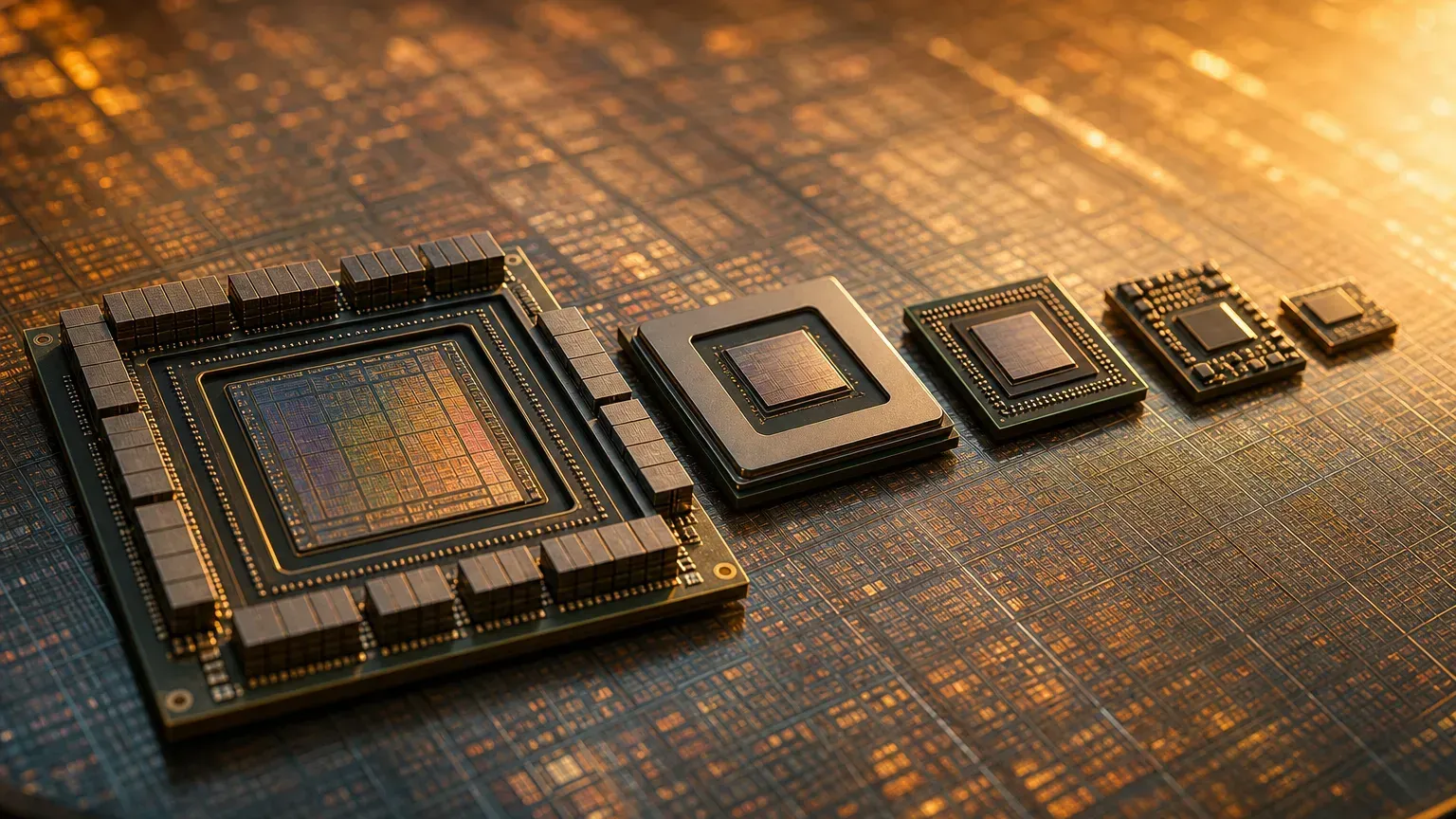
The “AI chip” in the news sometimes means NVIDIA’s GPU, sometimes Google’s TPU, and sometimes some processor inside your phone. So which one is the real AI chip? The answer: all of them.
This piece breaks down the five members of the AI chip family, then covers training vs inference and cloud vs on-device. It’s the beginner’s overview for Gate 1, “AI chips,” in The AI Hardware Supply Chain, End to End.
What Is an AI Chip?
An AI chip (also called an AI accelerator) is the umbrella term for hardware optimized for AI workloads. It’s not one single kind of chip.
Why does AI need special chips? Because AI math has a distinct pattern: lots of matrix multiplication, tensor math (think of a tensor as an extension of a matrix, the big tables of numbers a model works on), low-precision calculation, and all of it can run at the same time. An ordinary CPU isn’t good at this kind of large-scale parallel work, so the industry built chips that speed it up: GPU, ASIC, TPU, NPU, and FPGA. Each has its own strength, and together they’re called AI chips.
Core-Data Snapshot
These numbers give you a sense of the AI chip market’s scale. All are research-firm estimates.
| Topic | Data | Source and timing |
|---|---|---|
| Global semiconductor revenue | About US$1.6 trillion estimated for 2026, up 92% year over year | Gartner, August 2026 forecast |
| AI data center ecosystem share | About 36.5% of 2026 semiconductor revenue; estimated above 53% by 2030 | Gartner, August 2026 forecast |
| NVIDIA AI chip market share | About 70% | TrendForce, 2025 estimate |
| ASIC-based systems’ share of AI servers | About 27% in 2026; GPU-based systems still the majority | TrendForce, April 2026 estimate |
The Five AI Chips and What Each Does
| Type | What it is | What it’s good for |
|---|---|---|
| GPU | General-purpose parallel processor, flexible, with a mature ecosystem (CUDA) | Large-model training, cloud inference, research |
| ASIC | Custom chip built for a specific task, highly efficient, not flexible | Cloud giants’ in-house chips (like AWS Trainium and Meta MTIA), cutting costs |
| TPU | Google’s in-house ASIC, specialized for tensor math | Google Cloud, Google’s own models and customer workloads |
| NPU | Low-power AI chip that goes into phones, laptops, and cars | Real-time on-device AI, power saving, works offline |
| FPGA | Reconfigurable (its hardware logic can still be changed after it ships), a middle ground between flexibility and efficiency | Low latency, industrial use, prototyping |
To dig into the GPU, see the GPU gate, and for the flagship generation, see Blackwell. To see why cloud giants build their own chips, see ASIC and TPU.
Training Chips vs Inference Chips
Both are AI chips, but whether a chip is used for training or inference changes what matters most.
Training teaches a model from huge amounts of data, like taking a student from zero to mastery. It needs enormous compute, very large memory, fast chip-to-chip links, and long, stable runs. Inference is the trained model, now live, quickly answering new inputs, like the student taking an exam. It cares more about latency, cost, and performance per watt.
GPUs and TPUs can do both. But inference costs money every time it’s used, so more and more chips on the market are designed inference-first.
Cloud vs On-Device
Cloud AI chips sit in data centers. They have big compute and can scale up, which suits large-model training and high-volume API inference, but they use a lot of power. On-device AI chips (mostly NPUs) sit in phones, laptops, and cars. Their strengths are low latency, privacy, and working offline; the trade-off is that size and power limit them.
More and more AI apps split the work: the heavy part runs in the cloud, the real-time part runs on the device.
Penchan’s summary
AI chips are a family of accelerators, not just the GPU. GPUs lead the cloud on flexibility and a mature ecosystem, ASICs and TPUs trade flexibility for efficiency by being custom-built, and NPUs get into phones and laptops by saving power.
Once you see this split, the next time the news says a company has launched an “AI chip,” you can first tell which kind it is and what it should be compared with.