When the news says “a company bought tens of thousands more Nvidia GPUs,” it sounds like plugging in graphics cards. In reality, an AI chip first has to be etched in a fab, packaged together with memory, linked by optical fiber into a cluster of thousands, cooled rack by rack, and then placed in a data center that uses a lot of power. That whole path is the “AI hardware supply chain.”
Its lifeline runs through a few points, and two of them are in Taiwan. To look at individual companies, see the AI industry overview.
The Whole Chain in 30 Seconds
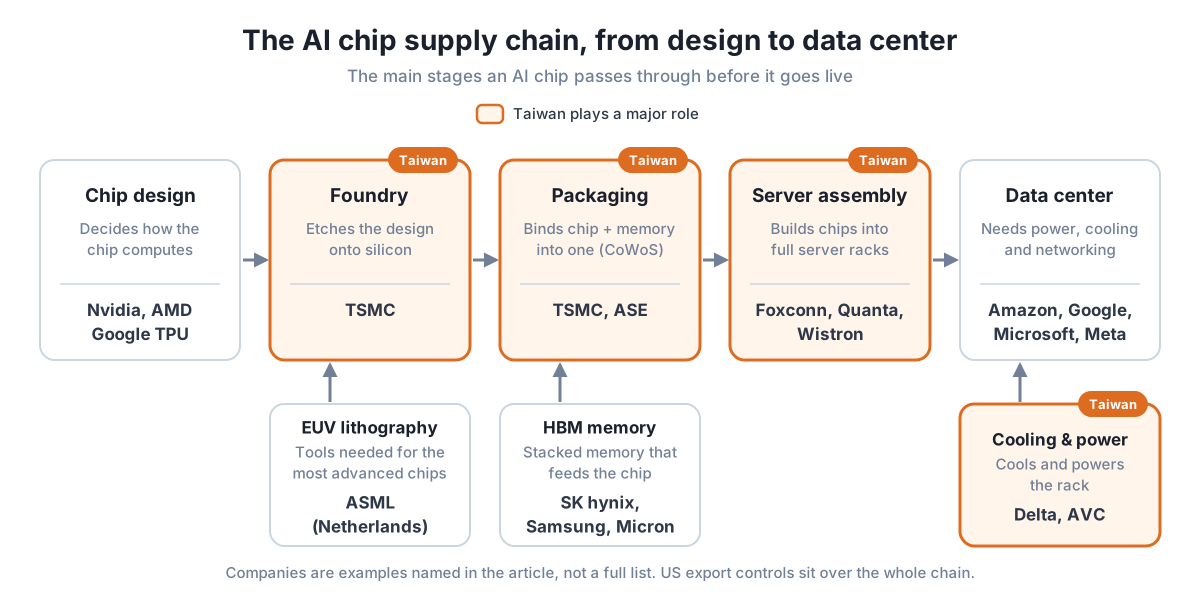
| Gate | What it does | Key players | How tight is it? |
|---|---|---|---|
| 1 AI chips | Decides what compute looks like | Nvidia, AMD, Google TPU | Nvidia leads |
| 2 HBM memory | Feeds data to the chip | SK Hynix, Samsung, Micron | ✅ Three-company oligopoly |
| 3 Advanced packaging | Bonds chips and memory into one unit | TSMC CoWoS, ASE | ✅ Not enough capacity |
| 4 Foundry | Etches the design onto silicon | TSMC; equipment from ASML | ✅ Process + EUV |
| 5 Optical interconnect | Links thousands of chips into a cluster | Optical-module and silicon-photonics makers | High technical bar |
| 6 Cooling and liquid cooling | Removes the heat of a full rack | Delta Electronics, AVC, Vertiv | Tighter as power rises |
| 7 Data centers and power | Builds facilities and connects power | Cloud giants, power companies | ✅ Grid-limited |
| 8 Export controls | Decides who can buy | U.S., allies, China | Cross-layer variable |
Gate 1 · AI Chips (GPUs)
A GPU uses many small cores computing at the same time, which fits AI’s matrix math well. Nvidia leads this gate, and its moat includes the CUDA software ecosystem. In the quarter ending July 2026, Nvidia’s data-center revenue was $89 billion, up 117% year over year. Blackwell is still the main shipping product; in August 2026 NVIDIA said Vera Rubin had begun volume shipments. AMD and the cloud giants’ in-house chips (such as Google TPU) are chasing.
Taiwan in this gate: Nvidia’s full-rack systems are mostly assembled by Taiwanese companies such as Foxconn, Quanta, and Wistron.
Further reading: AI chips · GPU · GPU vs CPU · Blackwell · ASIC · TPU · Nvidia supply chain · Unified memory
Gate 2 · HBM High-Bandwidth Memory
HBM stacks memory vertically and places it right next to the GPU. Think of it as very wide memory standing up, so the GPU doesn’t have to wait for data. According to Counterpoint, Q2 2026 HBM revenue share was SK Hynix 50%, Samsung 33%, and Micron 18%. All three companies’ HBM4 has passed Vera Rubin qualification (Jensen Huang, June 2026). Supply is still tight: Micron says most of its 2027 HBM supply is already under contract.
Taiwan in this gate: Micron makes HBM in Taiwan, and Taiwan also has the packaging lines that integrate HBM with the GPU.
Further reading: HBM · HBM4 · HBM stocks
Gate 3 · Advanced Packaging (CoWoS)
The GPU and HBM need to move nearly 20 TB of data per second between them, which a normal circuit board can’t do. TSMC’s CoWoS integrates them side by side in one package. Almost every high-end AI chip needs it, so packaging capacity directly decides GPU shipments. TSMC chairman C.C. Wei said in July 2026 that packaging capacity was so tight it “limited customers’ growth.” TSMC doesn’t publish its capacity; according to media estimates compiled by TrendForce, monthly capacity grows from about 70,000 wafers at the end of 2025 to about 130,000–140,000 by the end of 2026.
Taiwan in this gate: The main capacity is in Taiwan, and ASE and SPIL are expanding too. TSMC’s first packaging plant in Arizona only broke ground in 2026.
Further reading: CoWoS · Advanced packaging · Glass substrates
Gate 4 · Foundry and Lithography Equipment
A foundry makes chips for other companies: Nvidia designs, TSMC manufactures. According to TrendForce, TSMC held 72.5% of the global foundry market in Q2 2026, with second-place Samsung at 5.9%. In the same quarter, 7nm and below made up 77% of TSMC’s wafer revenue.
Further upstream, the most advanced processes rely heavily on extreme-ultraviolet (EUV) lithography machines, which only the Netherlands’ ASML can mass-produce; some 7nm processes can still use DUV.
Taiwan in this gate: TSMC expanded its Arizona investment plan to $265 billion, but 2nm enters volume production in Taiwan first; the U.S. fabs won’t reach this generation until the end of the decade.
Further reading: Foundry · Advanced process · TSMC 2nm · EUV · ASML · Semiconductor equipment · Taiwan semiconductors
Gate 5 · Optical Interconnect
Thousands of GPUs exchange data constantly. At high speeds, signals over copper fade, so clusters switch to light, with speeds moving from 800G toward 1.6T. The next step is co-packaged optics (CPO), which puts the optical engine right next to the switch chip to save power. Nvidia announced its CPO switches were in full production in August 2026.
Taiwan in this gate: TSMC’s silicon-photonics platform, COUPE, has started production.
Further reading: Silicon photonics · CPO
Gate 6 · Cooling and Liquid Cooling
A GB300 NVL72 rack with 72 GPUs draws about 130–140 kilowatts (GIGABYTE spec). Fans and air conditioning can’t handle that, so coolant flows straight through cold plates on the chips, or servers are submerged in liquid (immersion cooling). TrendForce estimates the share of AI chips using liquid cooling will rise from about 33% in 2025 to 53% in 2026.
Taiwan in this gate: In an August 2026 forecast, TrendForce expected AVC to ship Vera Rubin cold plates in Q3. According to media reports, Delta Electronics’ coolant distribution units are on Nvidia’s qualified list.
Further reading: Liquid cooling · Immersion cooling · AI server stocks · ODM
Gate 7 · Data Centers and Power
The International Energy Agency estimates global data-center electricity use will go from 485 TWh in 2025 to about 950 TWh in 2030. Amazon, Google, Microsoft, and Meta’s 2026 capex guidance adds up to about $720–745 billion. The cloud giants have also signed nuclear power deals, but most new-type nuclear plants are still under review or construction. In some regions, the grid and land have become as much of a limit as chips.
Taiwan in this gate: Taiwan mainly supplies power supplies, uninterruptible power systems, and liquid-cooling equipment. It is not a major data-center hub.
Further reading: Data centers · SMR
Gate 8 · Geopolitics and Export Controls
This gate is a layer of rules over the other seven: who can buy high-end GPUs and who can make advanced processes is decided by the export rules of the U.S. and its allies.
- A narrow door for the H200: From January 15, 2026, U.S. exports to China of chips below the top tier, like the H200, moved to conditional case-by-case review. The chips must first go through testing in the U.S., and a 25% tariff applies. Actual shipments are small: Nvidia said they were under 1% of its data-center revenue for the quarter ending July 2026, and Beijing also approves each purchase one by one.
- Allied equipment: The MATCH Act (scaled back in April 2026) would fully restrict ASML’s DUV immersion machines for China, require licenses for servicing, and push allies to follow. As of late September 2026, it was still stuck in the Senate.
- The tiers no longer apply: The early-2025 “AI Diffusion” framework once put Taiwan in Tier 1, but the U.S. stopped enforcing it from May 2025, and in July 2026 said it would not write a replacement rule.
- China’s own chips: Huawei says the Atlas 950 is in large-scale commercial use, and the Ascend 960 is expected in 2027.
Further reading: Chip war · Export controls · Silicon shield
Which Gates Are the Tightest?
| Tightest link | Why it’s tight | Concentrated in |
|---|---|---|
| Advanced process (7nm and below) | All high-end AI chips depend on it | 🇹🇼 TSMC |
| CoWoS advanced packaging | Decides GPU shipments | 🇹🇼 Taiwan |
| HBM memory | Three-company oligopoly, tight supply | 🇰🇷 South Korea, 🇺🇸 Micron |
| EUV lithography equipment | Key equipment for the most advanced processes | 🇳🇱 ASML |
Penchan’s summary
The AI compute race is really a race over hardware and capacity: if you can’t make the chips, can’t package them, or can’t supply the power, even the strongest model can’t run.
The bottlenecks are concentrated in Taiwan. That is strategic value, and also the single-point risk the world cares about most.
The next ceiling may be power. Whoever can solve power supply, cooling, and energy efficiency holds the key to the next round.