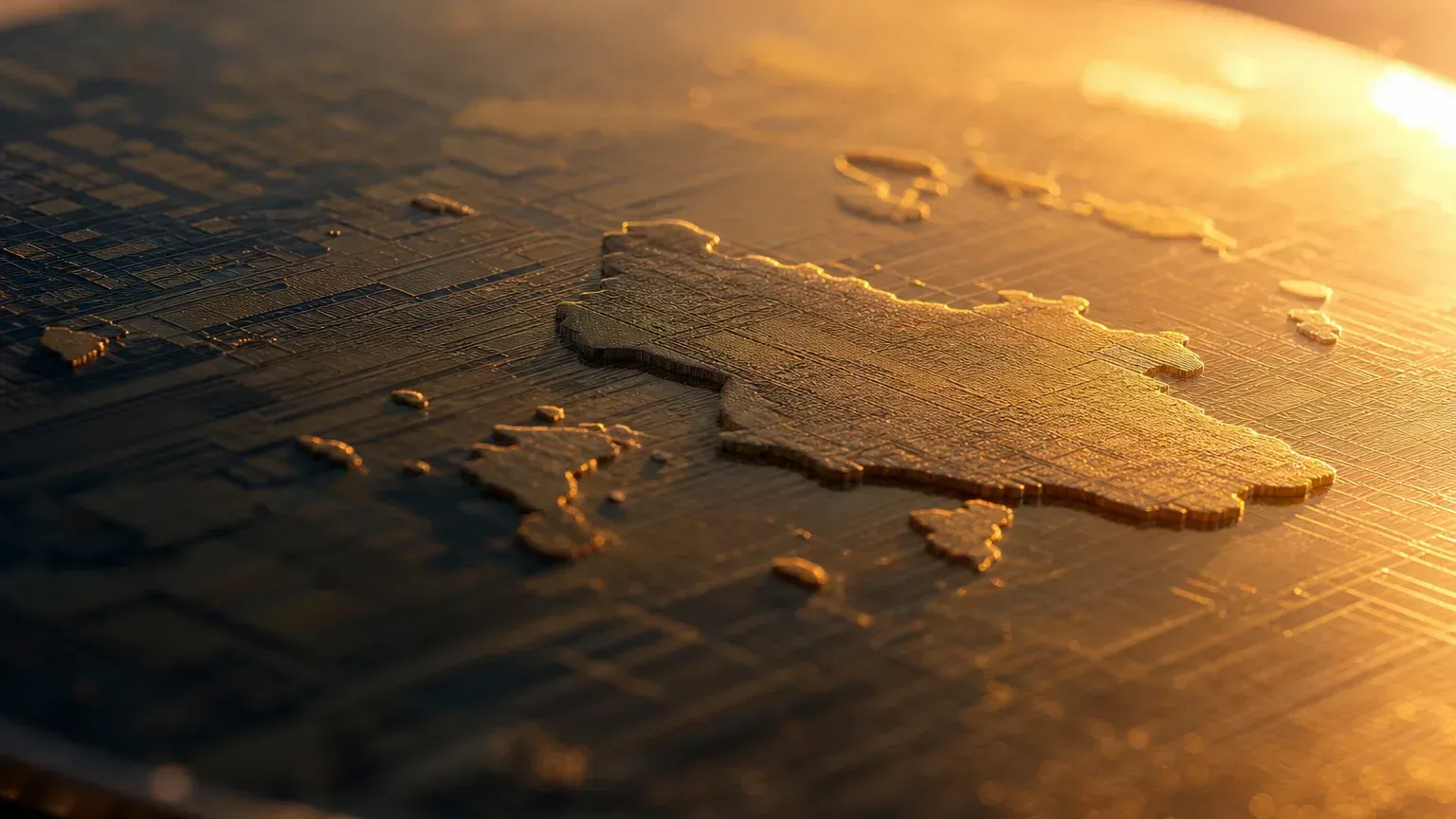
When tensions around the Taiwan Strait make international news, one term often comes up: the Silicon Shield. The idea is that “Taiwan’s chips are so important that they have become a shield that protects it.” Does that claim hold up?
This piece breaks down its logic, the arguments for and against it, and whether overseas expansion dilutes it. The Silicon Shield is a hypothesis, not a settled conclusion; this article presents each side neutrally and makes no political prediction. It extends the geopolitics side of The AI Hardware Supply Chain, End to End.
What Is the Silicon Shield?
The Silicon Shield is an analytical lens. The logic goes like this:
Taiwan makes the great majority of the world’s most advanced chips. Those chips are key parts of AI, phones, cars, industry, and even defense systems. A serious supply-chain disruption would badly hurt global technology and the economy. Because of this shared interest, countries lean toward keeping the Taiwan Strait stable, so Taiwan’s place in semiconductors indirectly forms a kind of strategic deterrent.
Core-Data Snapshot
| Topic | Figure | Timing / Source |
|---|---|---|
| TSMC’s global foundry market share | 72.5% | Q2 2026, TrendForce |
| TSMC’s advanced-process share | 7nm and below = 77% of wafer revenue | Q2 2026, TSMC earnings call |
| Taiwan’s share of the most advanced chip capacity | Estimated around 92% | USITC (circa-2021 framing), cited by Stimson 2025 |
| TSMC’s new fabs in Taiwan | 13 advanced-process and packaging fabs to be built over the next several years | July 2026, TSMC earnings call |
| TSMC’s overseas footprint | Arizona, U.S.: total planned investment of US$265 billion; Kumamoto Fab 2, Japan: planned for 3nm, volume production in 2028; Dresden, Germany: topped out in September 2026 | TSMC official, CNA |
The Arguments for the Silicon Shield
One is high supply-chain concentration. Data centers, telecom, cars, and defense systems all rely on Taiwan’s advanced chips, so keeping the Taiwan Strait stable becomes a shared interest for many countries.
Two is supply-chain complementarity. U.S. firms mostly handle chip design and end demand, while Taiwanese firms handle high-yield manufacturing. Some think tanks argue that the AI supply chain will make this complementarity even tighter; the more intertwined the interests, the more valuable the status quo is to everyone.
The Arguments Questioning the Silicon Shield
Skeptics do not deny that Taiwan’s semiconductors are important. Their question is: does “important” equal “an effective deterrent”?
Some think tanks note that countries needing chips does not mean they will take a specific action in a Taiwan Strait crisis; decisions also weigh escalation risk, military cost, and political limits. Some academic research argues that the Silicon Shield narrative lacks a rigorous theoretical basis and looks more like a “wishful claim.” A September 2026 analysis in CommonWealth Magazine’s English edition quotes analyst Matt Turpin: semiconductors are neither the reason Beijing wants Taiwan nor the thing that holds it back.
Overseas Expansion: Is the Silicon Shield Being Diluted?
TSMC’s fabs in the U.S., Japan, and Germany raise a debate: does this dilute the Silicon Shield?
The dilution camp argues that if a large share of advanced capacity moves out of Taiwan, Taiwan’s “stickiness” to outside security interests may decline. Taiwanese officials have said that moving 40% of semiconductor capacity to the U.S. is “impossible.”
The no-dilution camp notes that the overseas fabs are mostly new capacity that spreads geographic risk. According to a July 2026 TaiwanPlus report, industry analysts call Taiwan the “mother fab”: R&D and the first wave of volume production stay in Taiwan, and only after yields stabilize is the process copied to Arizona. In July 2026, Economy Minister Kung Ming-hsin also said the U.S. can hardly catch up with TSMC’s capacity in Taiwan. Taiwan’s built-up ecosystem of talent, suppliers, equipment maintenance, and high yields is also hard to copy elsewhere in the short term.
Both sides have their proponents. The answer depends on how capacity ratios, technology generations, and policy evolve.
Why It Is Discussed More Often in the AI Era
The Silicon Shield is not a new term, but AI has brought it back. AI has pushed advanced logic chips, HBM, advanced packaging, and data centers from a tech topic up into an economic-security issue for many countries. When advanced chips are seen as a bottleneck for developing AI, places with the manufacturing capability, such as Taiwan, Japan, and the Netherlands, naturally show up more often in geopolitical discussions.
For the full picture of the chip war and export controls, read The Chip War and Export Controls. For how Taiwan’s semiconductor industry divides the work, see Taiwan’s Semiconductor Supply Chain. To look back at all eight gates of the chain, return to the supply-chain overview.
Penchan’s summary
The Silicon Shield is worth knowing, but it is one angle on Taiwan’s semiconductors, not a security guarantee.
In the overseas-expansion debate, the key is where the most advanced R&D and the first wave of volume production stay. The most practical way to approach this topic is to understand each side’s arguments and not treat any one claim as the conclusion.