NVIDIA designs the most sought-after AI chips in the world, yet it doesn’t own a single wafer fab. It outsources all of its manufacturing, and most of that supply chain runs through Taiwan.
This piece first looks at what NVIDIA does itself, then follows one GPU all the way to a full rack, and finally looks at where the bottleneck is. It is the NVIDIA-angle extension of the AI supply-chain overview.
What NVIDIA Does Itself, and What It Outsources
NVIDIA is a fabless (factory-less) semiconductor company. Its core strength is design: GPU chips, system architecture, and the CUDA software that keeps developers hooked. It also designs its own networking chips, such as InfiniBand, Spectrum-X, and ConnectX.
Actually making the chips is all outsourced.
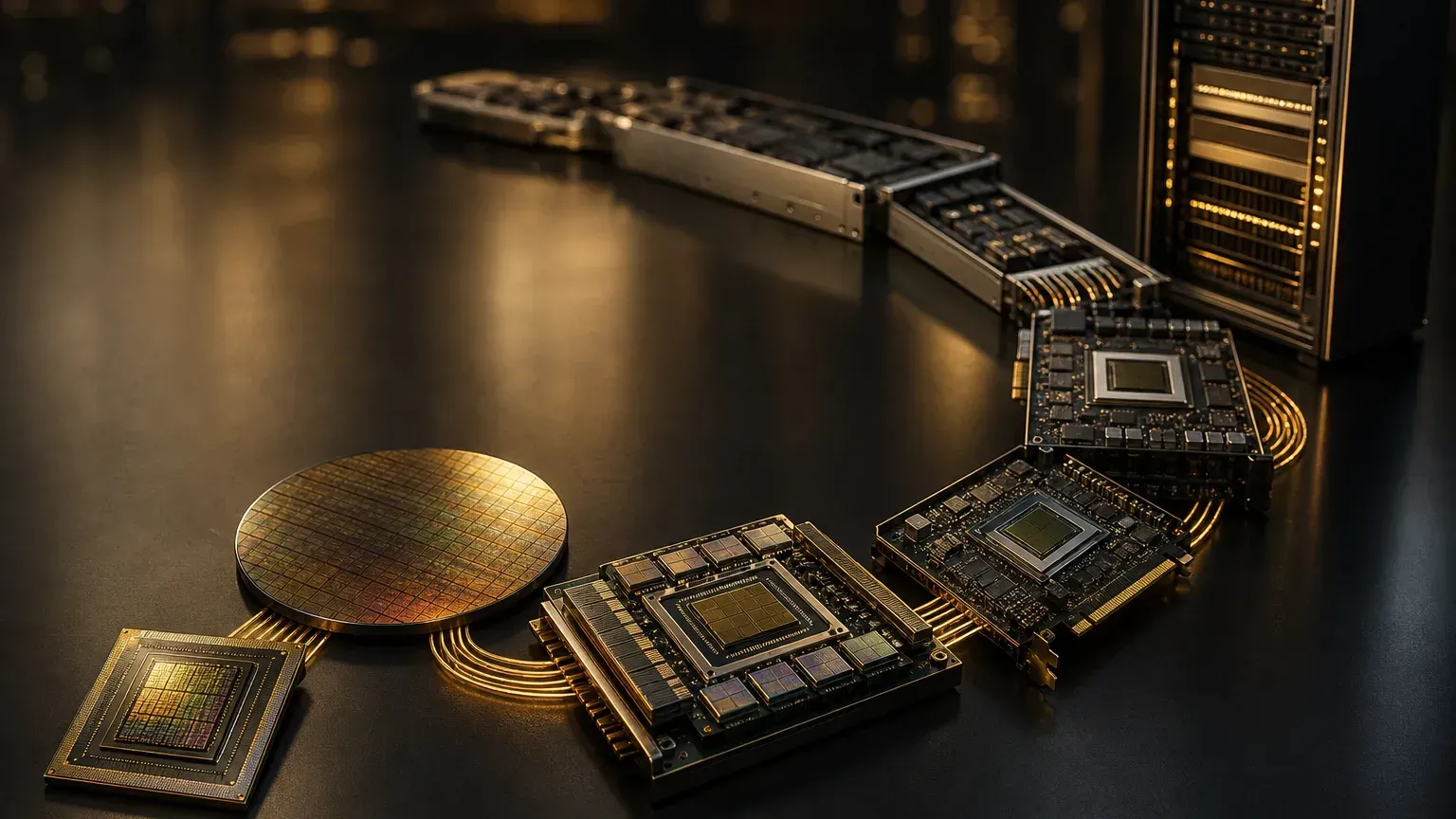
From Chip to Full Rack: Four Stops, End to End
| Stop | What happens | Who mainly does it |
|---|---|---|
| 1. Foundry | Turns the design into a chip | TSMC. Blackwell uses a custom 4NP process (NVIDIA official); Rubin on 3nm is the supply-chain and research-firm reading, not announced by NVIDIA |
| 2. Advanced packaging | Uses CoWoS to bind the GPU and several HBM stacks onto one substrate | Mainly TSMC, with some steps done with packaging-and-test firms |
| 3. HBM | High-bandwidth memory stacked next to the GPU | SK Hynix, Samsung (Korea), Micron (US) |
| 4. Full system & rack | Builds the modules into a full-rack system, adding cooling, power, networking, and the rack | Foxconn, Quanta, Wistron, Wiwynn, and other Taiwan firms |
Of the four stops, Taiwan leads at stops one, two, and four. The main HBM suppliers are SK Hynix, Samsung, and Micron, and Micron also does HBM packaging in Taiwan. According to media reports, Jensen Huang said in June 2026 that HBM4 from all three makers has passed Vera Rubin certification, and SK Hynix began volume shipments of HBM4 in the second quarter of 2026. NVIDIA has not disclosed each firm’s share of supply.
The rack products are changing generation. NVIDIA began volume shipments of Vera Rubin in August 2026, but it also says Blackwell (including GB300) still makes up the vast majority of revenue.
The Taiwan Partners NVIDIA Names
When NVIDIA announced in May 2026 that Vera Rubin was in full production, its list of system-manufacturing partners included Taiwan’s Foxconn, Quanta (QCT), Wistron, Wiwynn, Inventec, Pegatron, Compal, Gigabyte, ASUS, MSI, and others.
Real shipments have started too. Foxconn’s Ingrasys produced Microsoft’s first Vera Rubin NVL72 racks in August 2026, and according to media reports, Foxconn expects volume shipments to begin in the fourth quarter.
Many Taiwan firms also work on the components: cooling and liquid cooling, power, rack mechanicals, connectors, and cables. For Taiwan’s full semiconductor division of labor, see Taiwan’s semiconductor supply chain.
Where It Jams Up: Advanced-Packaging Capacity
The most watched bottleneck in the NVIDIA supply chain is advanced packaging.
On the July 2026 earnings call, TSMC chairman C.C. Wei said plainly that packaging capacity is so tight it is already limiting customers’ growth. TSMC also raised its 2026 capital spending to US$60–64 billion. On its August 2026 earnings call, NVIDIA said it expects supply to remain a constraint at least through the end of fiscal 2028.
So how much NVIDIA can ship often depends on how much capacity the tightest step can release, and TSMC’s advanced packaging is that valve.
How to Read ‘NVIDIA Supply-Chain Concept Stocks’
“NVIDIA concept stocks” are an evergreen theme in Taiwan’s stock market. The market lumps in all the manufacturing, packaging, assembly, and component firms above.
For this group, knowing where each company sits in the chain is more useful than chasing a list. NVIDIA does not disclose each supplier’s order value, allocation, or margins. Official partner lists and media showcases only show that a firm’s role fits, not how many orders it has won or that it will benefit. This piece only describes industry roles and the supply-chain division of labor. It does not list beneficiary stocks, rank individual names, or give investment advice. For how stocks at the server-system layer are grouped, see AI server concept stocks.
Penchan’s summary
NVIDIA only designs. Foundry, advanced packaging, and full-rack assembly all happen in Taiwan, while HBM comes mainly from SK Hynix, Samsung, and Micron. Taiwan carries a lot of weight at both the manufacturing end and the system-integration end.
Even with the move to Vera Rubin, the tightest step is still TSMC’s advanced-packaging capacity. When you look at the NVIDIA supply chain, the point is to understand who does what, not to treat a partner list as a guarantee of orders.