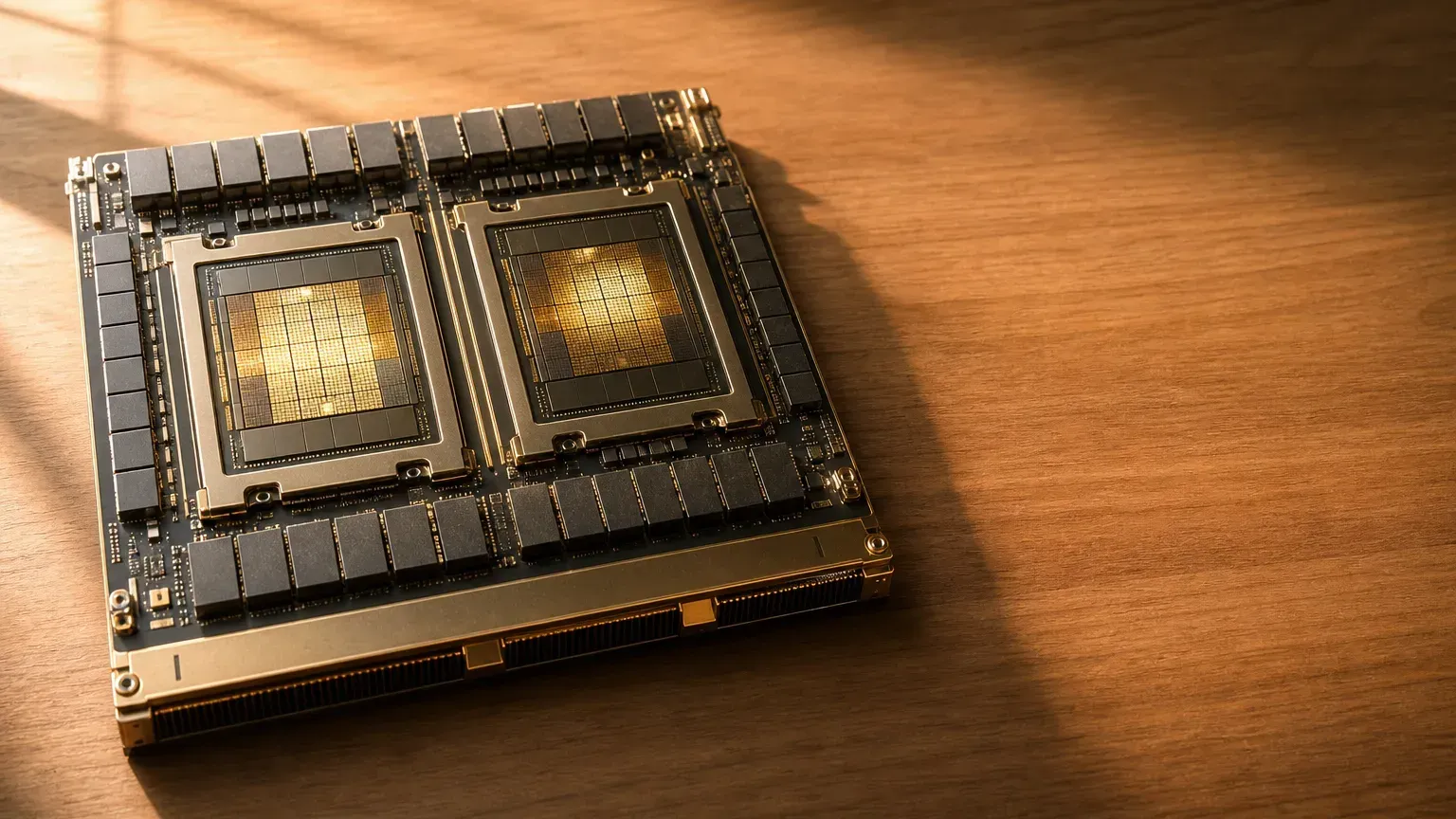
Every time NVIDIA holds a launch event, the news fills up with names: B200, GB200, GB300, NVL72, Rubin. Each name points to a product at a different level or from a different generation.
This piece first separates three levels — GPU, superchip, and rack — then looks at specs, shipping status, the next-gen Vera Rubin, and the role of Taiwan’s contract manufacturers. It is the deep-dive version of Gate 1, “AI chips,” in The AI Hardware Supply Chain, End to End.
First, Get It Straight: GPU, Superchip, Rack
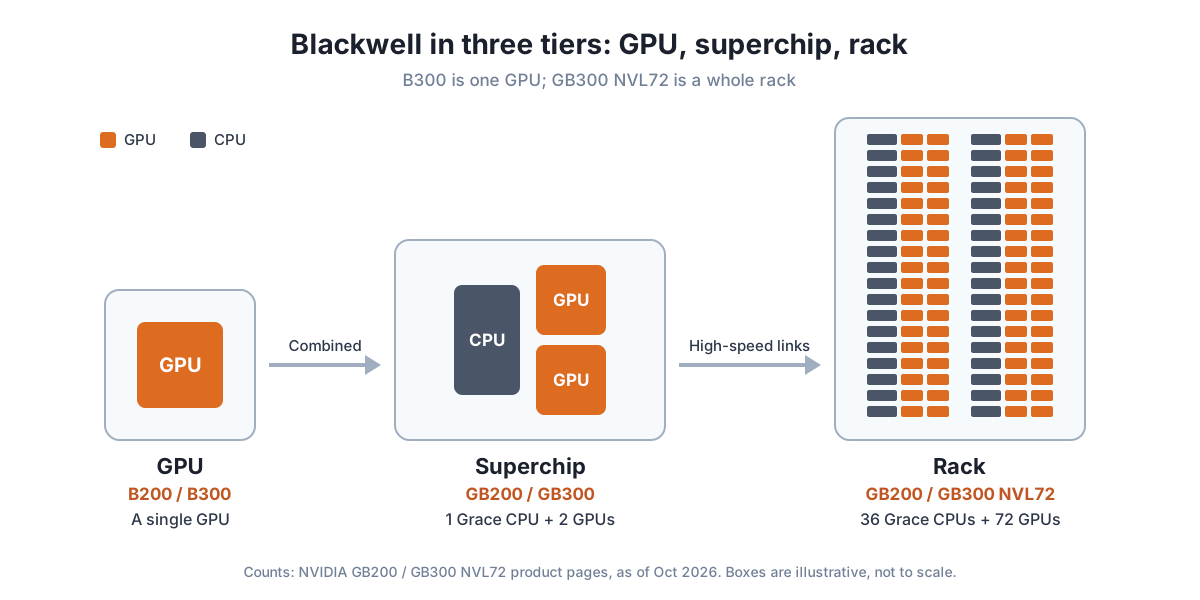
- B200 / B300: a single GPU, the basic compute chip.
- GB200 / GB300: one Grace CPU plus two GPUs, bound into one “superchip.”
- GB200 / GB300 NVL72: 36 Grace CPUs and 72 GPUs joined by high-speed links into a full rack, used as one supercomputer.
When you see GB300 NVL72, it means a whole rack. When you see B300, it means one GPU inside that rack.
What Is Blackwell?
Blackwell is the AI chip architecture NVIDIA launched in 2024 and shipped in volume across 2025 and 2026. It follows Hopper (H100/H200).
The key design is joining two large compute dies into one GPU. A single die can only be so big, so NVIDIA links two of them with a 10 TB/s connection (NV-HBI). The whole chip has about 208 billion transistors and is made on TSMC’s 4NP process.
It also leans on NVFP4, an ultra-low-precision number format. It stores numbers more cheaply in exchange for more operations per second, which raises AI inference throughput.
Core-Data Snapshot
Two terms first: HBM is the high-speed memory placed next to the GPU, and PFLOPS is a unit of operations per second. Numbers follow NVIDIA’s published figures.
| Product | Level | Key specs |
|---|---|---|
| B200 (HGX) | GPU | 180GB HBM3E, bandwidth up to 8 TB/s, power up to 1000W |
| B300 (Blackwell Ultra) | GPU | 288GB HBM3E, 8 TB/s bandwidth, NVFP4 about 15 PFLOPS, power about 1400W |
| GB200 NVL72 | Rack (72 GPU + 36 Grace) | 13.4TB HBM3E, NVFP4 about 720 PFLOPS |
| GB300 NVL72 | Rack (72 GPU + 36 Grace) | 20TB HBM3E, NVFP4 about 1,080 PFLOPS |
(NVFP4 figures are dense values. NVIDIA’s marketing often cites higher sparse values, such as 1,440 PFLOPS for GB300 NVL72.)
From B200 to B300: Same Architecture, One Step Up
The B300, officially called Blackwell Ultra, launched in 2025 as a stronger version of the same architecture. Memory goes up to 288GB and dense NVFP4 compute up to 15 PFLOPS, so it can hold larger models. The cost is higher power.
Where Is Blackwell Shipping?
Blackwell is the main product shipping today. When NVIDIA reported results for Q2 of fiscal 2027 (ended July 2026) in August 2026, it said the Blackwell architecture still made up the large majority of revenue. Full GB300 NVL72 racks landed long ago: in October 2025, Microsoft Azure built a cluster of thousands of GB300 GPUs for OpenAI.
How much can ship is limited by supply. On the same earnings call, NVIDIA said it expects supply to stay tight at least through the end of fiscal 2028. TSMC also said in July 2026 that advanced packaging capacity was already limiting customer growth.
Next-Gen Vera Rubin: Shipping, but Not Yet the Main Product
On May 31, 2026, NVIDIA announced that Vera Rubin was ramping to full production. Production shipments began in August, and the product page says “Available Now.” NVIDIA’s August results release said CoreWeave, Google Cloud, Microsoft Azure, Oracle Cloud, and Nebius already have Vera Rubin NVL72 racks running. NVIDIA expects Vera Rubin to make up about 20% of data-center revenue in the quarter ending in late October 2026.
Rubin moves to next-gen HBM4 memory. According to media reports, Jensen Huang said in June 2026 that HBM4 from all three makers — SK hynix, Samsung, and Micron — had passed Rubin certification.
The handoff is gradual. Research firm TrendForce estimated in August 2026 that GB300 racks are the main product shipped in 2026, and that Rubin (VR200) won’t become the largest share until 2027.
GB300 vs. Vera Rubin: What’s the Difference?
Both look the same from outside: a full rack of 72 GPUs and 36 CPUs. The difference is that every part is a new generation. The table below comes from NVIDIA’s product pages:
| Item | GB300 NVL72 | Vera Rubin NVL72 |
|---|---|---|
| Configuration | 72 Blackwell Ultra GPUs + 36 Grace CPUs | 72 Rubin GPUs + 36 Vera CPUs |
| GPU memory | 20TB HBM3E | 20.7TB HBM4 (288GB, 19.2 TB/s per GPU) |
| Memory bandwidth (rack) | Up to 576 TB/s | 1,400 TB/s |
| NVLink bandwidth (rack) | 130 TB/s | 216 TB/s |
| FP4 compute (sparse) | 1,440 PFLOPS | 3,600 PFLOPS (inference) |
| FP4 compute (dense) | 1,080 PFLOPS | 2,520 PFLOPS (training) |
| CPU cores | 2,592 Arm Neoverse V2 | 3,168 NVIDIA-designed Olympus |
Three differences in plain terms:
- New memory generation: Capacity is about the same, but HBM3E becomes HBM4, and rack bandwidth rises about 2.4 times. AI inference often depends on how fast data can move, so this matters a lot.
- Compute specs: Dividing the FP4 figures gives about 2.3 to 2.5 times. But GB300 doesn’t name a workload while Rubin splits inference and training, so this is only a theoretical spec ratio, not a measured result.
- CPU and interconnect change too: The CPU becomes Vera, with NVIDIA-designed cores, and NVLink bandwidth rises about 1.7 times.
NVIDIA’s own multipliers each compare against something different. In the September 2026 MLPerf inference preview, Vera Rubin NVL72 delivered up to 3.7 times the throughput of GB300 NVL72. The product page’s “up to 10x more tokens per megawatt” compares against the older GB200 NVL72. Don’t mix the two numbers.
Taiwan’s Role at This Gate
NVIDIA designs the chips and TSMC makes them. Assembling full rack systems and shipping them in volume falls mainly to Taiwanese companies.
When NVIDIA announced Vera Rubin’s production ramp in May 2026, it named Taiwanese partners including Foxconn, QCT (part of Quanta), Wistron, Wiwynn, Inventec, Pegatron, and Compal, and said it has 150 supply-chain partners in Taiwan alone. For the prior-generation GB300 NVL72, its server partners also included Taiwanese ODM/EMS firms such as Foxconn, Inventec, Pegatron, QCT, Wistron, and Wiwynn (NVIDIA release). In August 2026, Foxconn said its subsidiary Ingrasys had produced Microsoft’s first Vera Rubin NVL72 racks. This is only an industry map and makes no investment judgment on any stock.
Penchan’s summary
Remember the levels first: B200/B300 are GPUs, GB200/GB300 are superchips, and NVL72 is a rack of 72 GPUs.
The generation change is gradual: Blackwell is still the main product shipping in 2026, and Vera Rubin began production shipments in August 2026. When the news says something is “X times faster,” first check which generation it compares against and how it was measured.
To learn about the HBM that feeds data to GPUs and the CoWoS packaging that seals chips and memory together, read What Is HBM and What Is CoWoS. To see how the whole chain fits together, head back to the supply-chain overview.