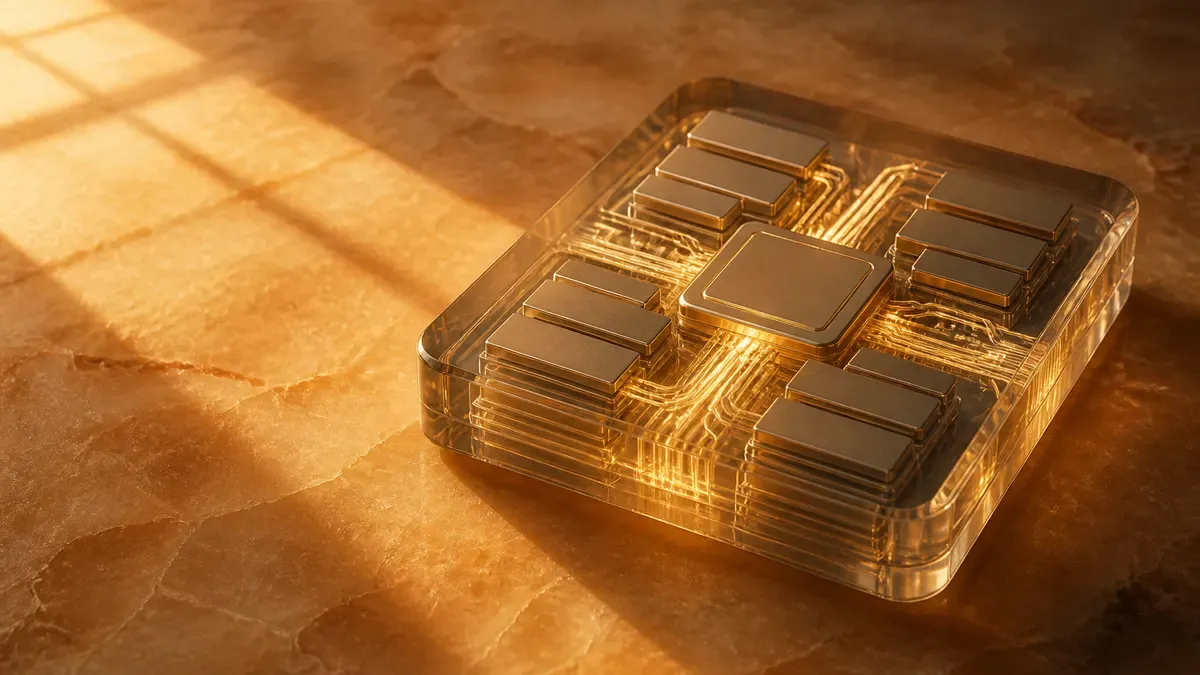
The 32GB, 128GB, and 512GB on a Mac spec sheet look like ordinary computer memory, but they work in a completely different way. Once you understand unified memory, you can see why a desktop Mac can hold an AI model of around 400 billion parameters locally, while a 32GB Nvidia graphics card cannot.
This is the memory follow-up to the end-to-end AI hardware supply chain.
What is unified memory? One sentence and one picture
In a PC with a discrete graphics card, the CPU uses system memory, and the graphics card uses its own graphics memory (VRAM). Data moves between them over the PCIe bus (the high-speed channel on the motherboard that connects components), and when the CPU hands data to the GPU, it usually has to copy it over first.
Apple Silicon removes that step. The CPU, GPU, and Neural Engine (the unit dedicated to speeding up AI work) share the same block of LPDDR5X memory, placed right next to the chip. Any processor that needs data reads the same block directly.
In one sentence: unified memory means every processor shares the same block, so data does not have to move.
How is it different from memory in a traditional computer?
| Traditional architecture (Windows PC + discrete graphics card) | Apple Silicon unified memory | |
|---|---|---|
| Memory type | DDR5 system memory plus GDDR7 on the graphics card, one each | One block of LPDDR5X, shared by everything |
| How data moves | CPU → PCIe → GPU; a copy is required | No moving; everything reads the same block |
| How much memory the GPU can use | Only the memory on the graphics card (32GB on the RTX 5090) | Almost all of it (up to 512GB on the M5 Ultra) |
| Expansion | System memory can be swapped; graphics memory cannot | Fixed at the factory; decided when you buy |
The key row is “how much memory the GPU can use.” If a model does not fit in the RTX 5090’s 32GB, part of it has to sit in system memory and be fed over PCIe in batches, and speed drops sharply.
The tradeoff is bandwidth: the RTX 5090 has 1.79TB/s, the M5 Ultra 1.2TB/s, and the M5 Max 614GB/s. Once a model fits, speed still depends on compute, bandwidth, and software. When it does not fit, capacity becomes the first hurdle.
Key data snapshot
Apple’s unified memory lineup, announced in August 2026 and on sale in Taiwan from September 22:
| Chip | Max unified memory | Memory bandwidth | Products | Taiwan starting price |
|---|---|---|---|---|
| M6 | 32GB | 170 GB/s | Mac mini | NT$29,900 |
| M5 Pro | 64GB | 307 GB/s | Mac mini | NT$59,900 |
| M5 Max | 128GB | 614 GB/s | Mac Studio, MacBook Pro | NT$84,900 (Studio) |
| M5 Ultra | 512GB | 1.2 TB/s | Mac Studio | NT$199,900 (entry configuration, not the 512GB version) |
Apple says the 512GB Mac Studio launches at the end of October 2026.
Similar products from other companies:
| Product | Memory | Status |
|---|---|---|
| NVIDIA DGX Spark (GB10) | 64GB / 128GB | 64GB version launches through partners on October 23, 2026, from US$4,999 |
| AMD Ryzen AI Max 400 | Up to 192GB | According to The Register, the first systems start at US$6,799 |
| NVIDIA DGX Station (GB300) | 748GB coherent memory | Deskside workstation; NVIDIA says it supports trillion-parameter models |
Why unified memory matters for AI
Running an AI model has two hurdles: memory capacity decides whether it can run at all, and bandwidth affects how fast it runs. If the model does not fit, high bandwidth does not help.
Take the 70-billion-parameter Llama 3 70B. After 4-bit quantization, its weights take about 40GB. The RTX 5090’s 32GB cannot hold it; the M5 Max’s 128GB holds it easily.
One step bigger is the mixture-of-experts (MoE) model Llama 4 Maverick, with 400 billion total parameters. After 4-bit quantization its weights take a couple hundred GB, while two RTX 5090 cards together have only 64GB. A 512GB M5 Ultra can hold it on a single desktop; the comparable deskside option is the DGX Station.
The bigger the model, the more capacity becomes the hurdle. A Mac’s large capacity helps it hold big models, but actual speed still depends on the model and the software.
Supply chain role: the fight over LPDDR5X
The LPDDR5X used for unified memory is the same type used in phones, and it has three main suppliers: Samsung, SK hynix, and Micron.
In 2026, memory makers gave priority to the more profitable HBM (the high-bandwidth memory used by AI data center GPUs), which squeezed LPDDR5X production. According to TweakTown, prices for 96Gb (12GB) LPDDR5X products rose 89% quarter over quarter in the second quarter of 2026. Tim Cook, then Apple’s CEO, called this memory price surge a “hundred-year flood” on the July 2026 earnings call.
The increase shows up in prices: the Mac mini M6 starts at NT$29,900 in Taiwan, up from NT$19,900 for the previous generation.
Nvidia adds demand too. AI racks also use LPDDR5X: the Vera Rubin NVL72 racks Supermicro ships carry up to 54TB per rack. Tom’s Hardware reports that Nvidia’s large purchases could push up memory prices for phones and servers.
Taiwan’s role at this stage
The M6 is Apple’s first 2nm chip. Apple has not named its foundry; according to TechNode and other reports, it is TSMC.
The M5 Ultra uses Apple’s UltraFusion technology to join four dies into one chip. That is a different route from the CoWoS advanced packaging used in AI data centers, but it relies on advanced packaging just the same.
Penchan’s summary
Unified memory merges the memory of every processor into one block. As models keep growing, capacity hits the ceiling before speed does, so this design has become the entry ticket for running large AI locally. Even Nvidia and AMD now offer similar products.
The cost is that the Mac is tied more tightly to the memory supply chain: LPDDR5X production is squeezed by HBM and its demand is shared with AI racks, and those prices flow straight into Mac prices.
To read about the other kind of memory used in AI data centers, see What is HBM. To see how the whole AI hardware supply chain fits together, go back to the supply chain overview.
This article organizes knowledge about the AI hardware industry. All specs and prices are as of publication and will be updated over time. Nothing here is investment advice.