“ODM stocks” shows up a lot in AI news. So what is an ODM? And why does every AI server story bring up Foxconn, Quanta, and other Taiwanese firms?
This guide first explains how ODM differs from OEM and EMS. Then it looks at why AI servers have made this old model shine again. Finally, it lays out how Taiwanese firms split the work and what the risks of this business are. For all seven links in an AI server, read AI server stocks: the seven-link supply chain.
What ODM Means
ODM stands for Original Design Manufacturer. In plain terms, it means design and manufacturing in one package. The brand (a cloud giant or a computer brand) sets the specs and places the order. The ODM handles design, development, validation, and mass production, then ships the product under the brand’s name.
Two related terms often appear alongside it:
- OEM (Original Equipment Manufacturer): the brand finishes the design and the contractor builds to it. The brand controls the design.
- EMS (Electronics Manufacturing Services): focuses on large-scale assembly, testing, and supply-chain services.
In practice the three overlap, and one large manufacturer may do all three. The key point: ODM means the contractor also does the design. That adds a layer of engineering value over pure assembly, but it is still a business of making things for someone else.
Why AI Servers Put ODM Back in Focus
ODM has been a core strength of Taiwan’s electronics industry for decades, from notebooks to servers. What pushed it to the front is the complexity of AI servers.
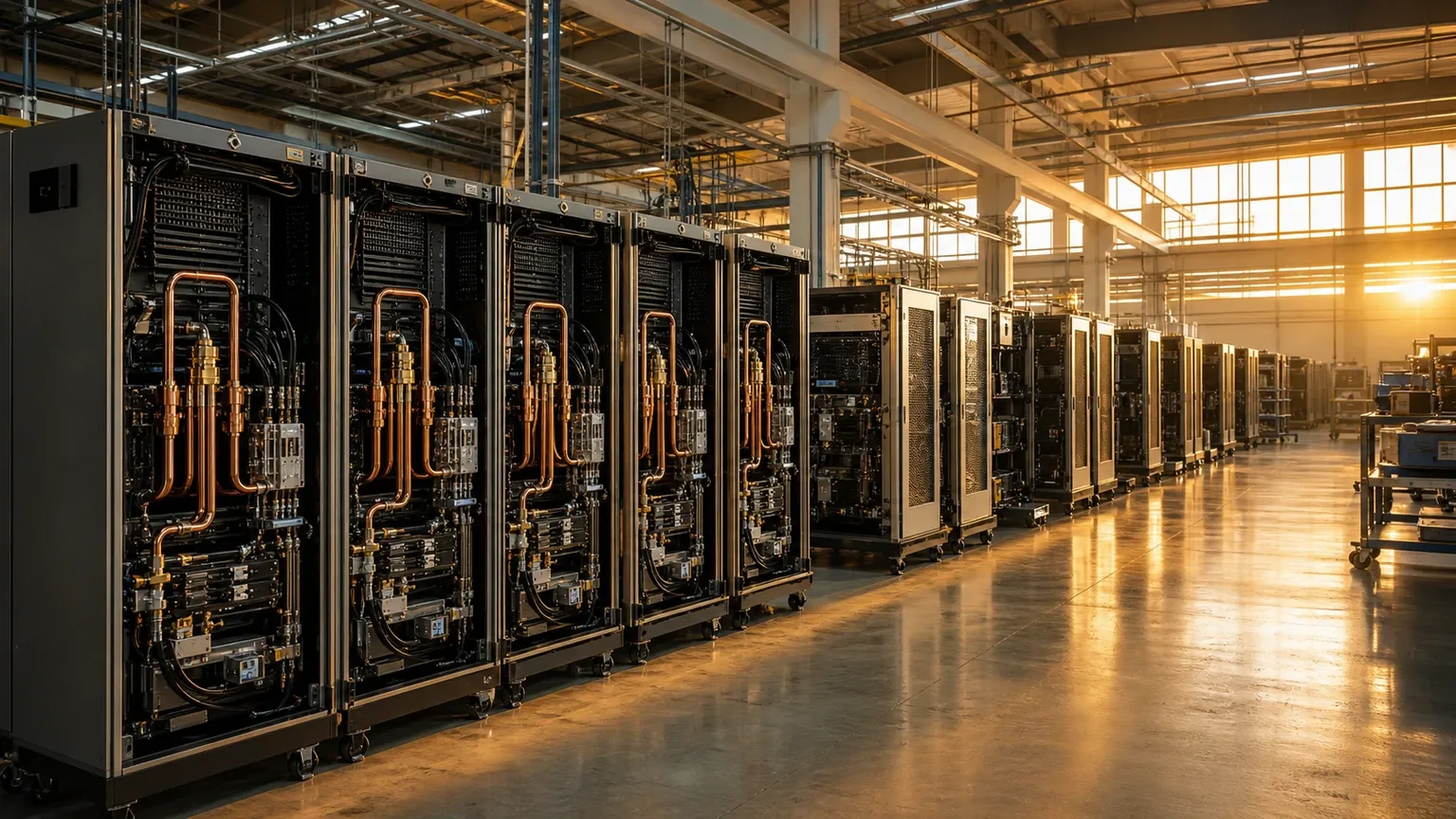
Today’s AI servers are mostly full-rack systems. A rack holds GPUs, CPUs, HBM memory, motherboards, switches, power supplies, liquid cooling, and the rack itself, and putting it all together is very hard. Cloud giants do not assemble these themselves. They hand the design and manufacturing of full systems and racks to ODMs with mass-production experience.
When the product generation changes, manufacturers have to retool their lines. In 2026 the shift is from NVIDIA GB300 to Vera Rubin. Foxconn said in August 2026 that Vera Rubin racks would start mass production in the third quarter. According to TechNice, Wistron said some customers are still buying GB300 while others have started adopting Vera Rubin.
The market often cites the claim that “Taiwanese firms make about 90% of the world’s AI servers.” That figure measures production / assembly, not brand, revenue, or profit share. Most AI servers are assembled by Taiwanese firms, but that does not mean the profit stays with them.
Taiwan ODM Division-of-Labor Map
Here are the Taiwanese firms often grouped as “AI server ODMs,” sorted by role:
| Company | Role | Public information in 2026 |
|---|---|---|
| Foxconn / Hon Hai (incl. subsidiaries) | The largest electronics contract-manufacturing group; builds full systems, racks, and components | Vera Rubin racks start mass production in Q3 (company press release) |
| Quanta | Long-standing cloud-server system manufacturer | AI servers are 75% to 80% of server revenue (according to Anue) |
| Wistron | Server system manufacturing | AI servers are over 95% of server revenue (according to TechNice) |
| Wiwynn | Spun off from Wistron; focused on cloud data-center servers | AI server business is led by ASIC (custom chip) projects (according to Commercial Times) |
| Inventec | Long-established server manufacturer | Expects server revenue to grow 30% in 2026 and exceed half of total revenue (according to Anue) |
| Gigabyte | Has its own brand and also does server manufacturing | Listed among NVIDIA’s Vera Rubin system manufacturing partners (NVIDIA, May 2026) |
This table only shows who broadly does what. It does not show orders won or how much a company benefits, it is not a ranking, and it is not investment advice. For order allocation and profits, check each company’s own earnings calls and financial reports.
The Nature of the ODM Business
- Driven by scale and yield: ODMs earn money by building complex systems at large scale and high yield, not from a brand premium.
- Highly concentrated customers: the main customers are a few cloud giants with strong bargaining power. One customer’s ordering pace can move revenue directly.
- Sensitive to volatility: demand cycles, product transitions, exchange rates, geopolitics, and component shortages all hit this group hard. For example, according to Anue, Inventec mentioned shortages of memory, CPUs, and PCBs in August and September 2026.
Below are each company’s consolidated gross margins for Q2 2026, which cannot directly represent the AI server business:
| Company | Consolidated gross margin | Source |
|---|---|---|
| Wiwynn | 9.3% | Company filing (compiled by BigGo) |
| Foxconn | 6.12% | Company press release |
| Wistron | 5.66% | According to Liberty Times |
| Quanta | 5.02% | According to Anue |
| Inventec | 4.23% | According to Anue |
From April 2026, Wiwynn switched memory purchasing for some customers to an agency model, which takes those amounts out of revenue and cost and lifts the gross margin. Each company’s product mix and transaction model differ.
Penchan’s summary
ODM is the business Taiwan’s electronics industry knows best: design and manufacturing in one package. The more complex AI servers get, the more this skill is needed.
To look upstream at how chips are made, read the Taiwan semiconductor supply chain and semiconductor equipment.
When looking at this group, the key is not whether it has an AI story. It is the three basics: scale-driven, thin margins, and concentrated customers. Being named only means a company has a place in this chain, not that it will benefit.