
When people talk about AI hardware, they usually talk about compute: how strong the GPU is, how fast the memory is, how hard the packaging is. But one gate is turning into a hard limit for data centers: heat. Once a full rack of GPUs draws more than a hundred-plus kilowatts, getting the heat out matters as much as the compute itself.
This is the deep-dive version of Gate 6, “cooling and liquid cooling,” in The AI Hardware Supply Chain, End to End.
Why AI Servers Have No Choice but Liquid Cooling
First, see how concentrated the heat is. NVIDIA’s GB300 NVL72 packs 72 GPUs and 36 CPUs into one rack. Based on system makers’ specs, the full rack draws about 130 to 142 kilowatts.
Traditional racks commonly run at 5 to 15 kilowatts each, and how much air cooling can handle depends on airflow and facility design. Racks like GB300 that draw over 100 kilowatts use liquid cooling to handle these dense heat sources.
The fix is simple: put coolant right against the chip and carry the heat away before it spreads through the whole server. Liquid moves heat far better than air. That’s why liquid cooling enters the picture.
How Does Liquid Cooling Work? Three Key Terms
Cold plate (direct-to-chip liquid cooling): a metal cold plate sits tight against the GPU, and coolant flows through tiny channels inside the plate to carry the heat away. The server itself never touches liquid, the barrier to adoption is lower, and it’s the mainstream approach in AI data centers.
Immersion: the whole server is submerged in a non-conductive dielectric fluid, so the heat goes straight into the liquid. Cooling efficiency is higher, but servicing, material compatibility, and standardization are harder, so adoption is slower. For details, see What Is Immersion Cooling.
CDU (coolant distribution unit): the heart of a liquid-cooling system. It handles pumping, heat exchange, temperature control, and filtration, delivers coolant steadily to every cold plate, and passes the absorbed heat to the machine room’s water loop or cooling equipment.
Core-Data Snapshot
| Item | Value | Source / Nature |
|---|---|---|
| Traditional rack power density | About 5-15 kW/rack (air cooling can handle) | Common industry figure |
| GB300 NVL72 full-rack power | About 130-142 kW (fully liquid-cooled) | System-maker specs, not published by NVIDIA |
| Vera Rubin NVL72 full-rack power | About 240 kW (Gigabyte solution) | System-maker spec, varies by configuration |
Where We Are in 2026: From Option to Standard
The biggest shift for liquid cooling is that in 2026 it went from “advanced option” to “default equipment.”
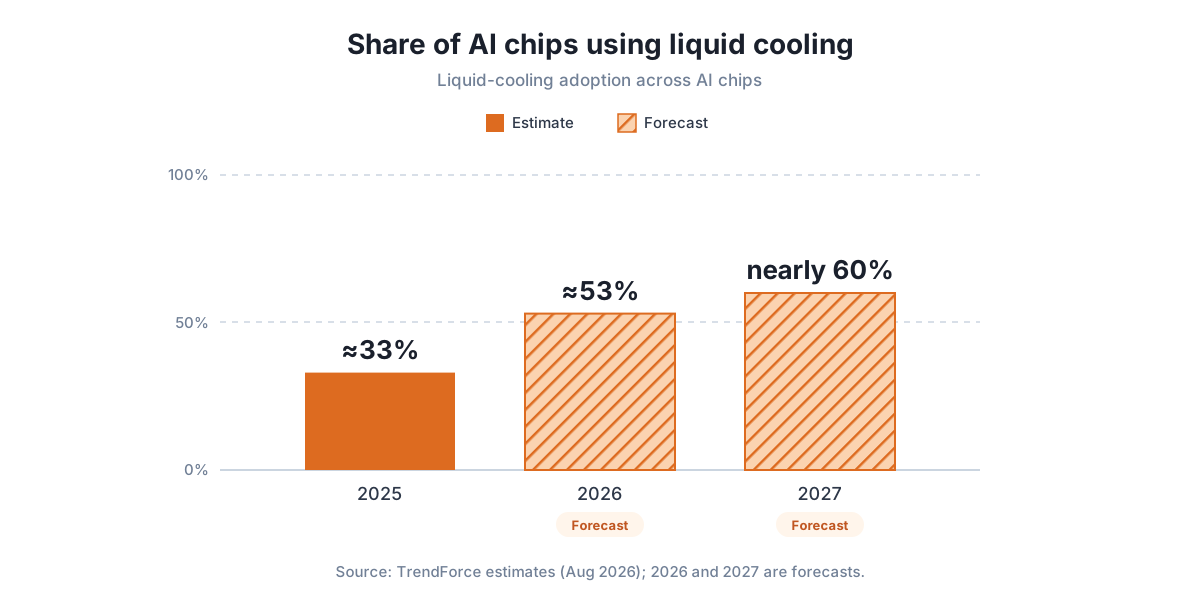
The GB300 NVL72 is already a fully liquid-cooled rack, and its successor, the Vera Rubin NVL72, goes further. NVIDIA says its racks can be 100% liquid-cooled, with no fans in the compute trays, and 45°C warm water is enough at the inlet, so the water doesn’t need to be chilled first. NVIDIA began volume shipments of Vera Rubin in August 2026, while Blackwell products such as GB300 still make up the bulk of shipments.
Cooling has to be designed from the start, together with power and the rack.
Taiwan’s Thermal Supply Chain: Another Hidden Strength
At this gate, Taiwan again holds a key position. To be clear: the following only describes public supply-chain roles. It doesn’t list beneficiary stocks, price targets, or buy/sell timing.
Taiwan already had a complete supply chain for thermal parts (fans, heat pipes, heat spreaders, chassis), and it is now moving into liquid cooling:
- Cold plates: In August 2026, TrendForce named Cooler Master, AVC (Asia Vital Components), BOYD, and Auras as the main suppliers, and said AVC expects to start shipping Vera Rubin cold-plate modules in the third quarter.
- CDUs: According to media reports, Delta’s 15-kilowatt, 150-kilowatt, and 3-megawatt CDUs are on NVIDIA’s qualified product list. AVC has also expanded from cold plates into CDUs and has won orders.
- Heat spreaders: According to TrendForce, Jentech is the sole supplier of heat spreaders for the Rubin platform.
This is only an industry map. It makes no investment judgment about any individual stock.
Cooling Is Actually Tied to Power
Cooling and power go together: the more power a rack draws, the more heat must be removed, and the more the existing power architecture strains on efficiency and copper usage.
So NVIDIA is pushing an 800-volt DC (800 VDC) data center power architecture, aimed at racks from 100 kilowatts to more than 1 megawatt, and says it improves efficiency and cuts copper usage. NVIDIA’s published partner list includes Taiwanese firms such as Delta, Lite-On, and Richtek.
For the data center and power story, read AI Data Centers next. To see what these heat-generating beasts look like, check out What Is Blackwell. To see how all eight gates connect, head back to the supply-chain overview.
Penchan’s summary
For this gate, remember one chain of cause and effect: AI chips draw more and more power, a single rack passes a hundred-plus kilowatts, and liquid cooling goes from option to standard.
Liquid cooling mainly comes in two forms, cold plate and immersion, while the CDU handles circulation and heat exchange. The denser compute gets, the more cooling and power matter.