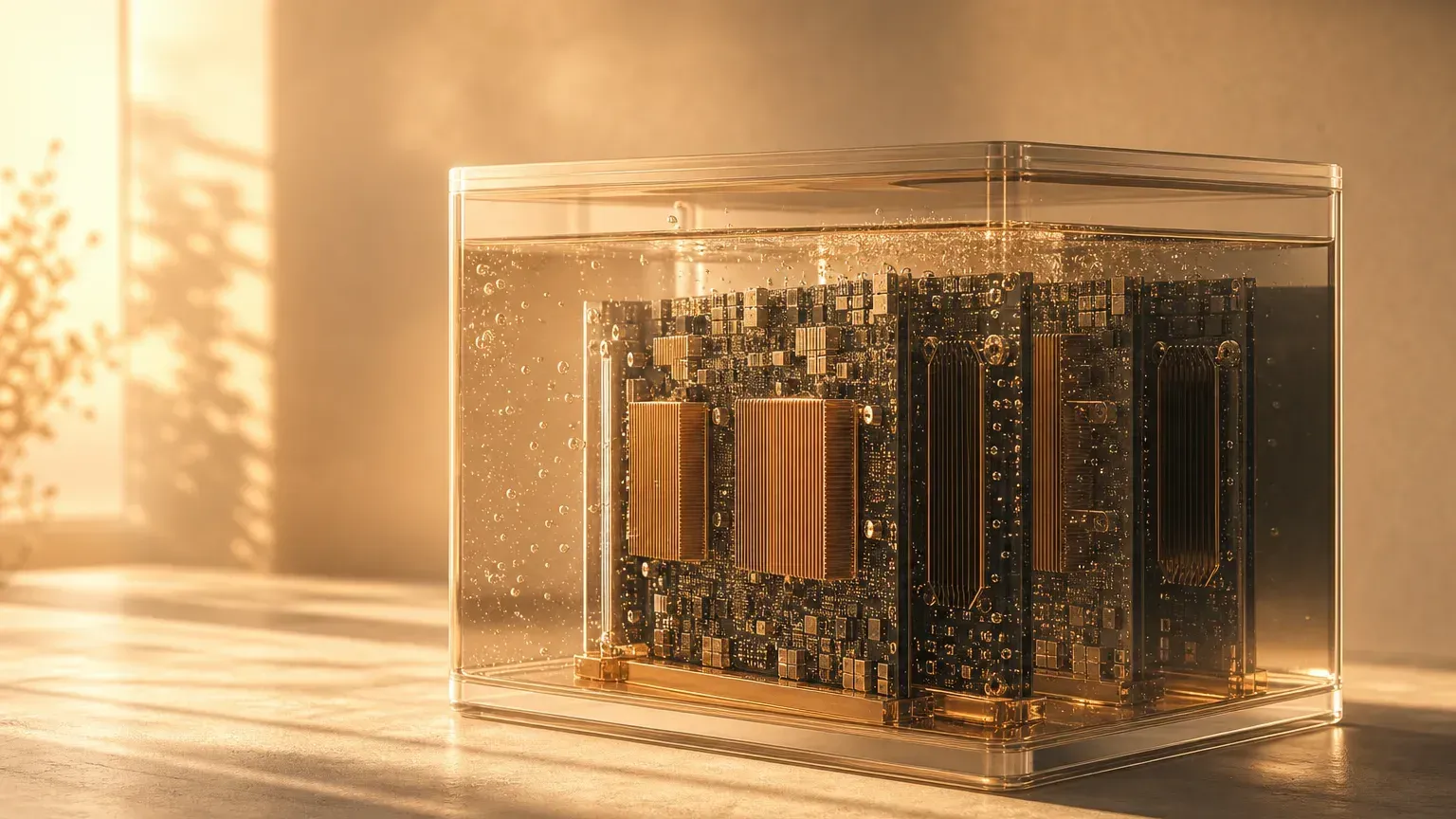
Liquid cooling explained why AI racks can’t avoid liquid cooling. This piece covers the type of liquid cooling that gets named most often, and misunderstood most often: immersion cooling, where the whole server sits in liquid.
It sounds like the most powerful option, but it isn’t the mainstream of AI cooling yet. This is an offshoot of the cooling gate in The AI Hardware Supply Chain, End to End.
What Is Immersion Cooling
Immersion cooling puts a server or its key parts fully into a non-conductive coolant (a dielectric liquid), so the liquid touches the hot components directly and carries the heat away. A cold plate only circulates liquid inside a metal plate pressed against the chip; under the definition of the industry standards body OCP, that does not count as immersion.
There are two types:
- Single-phase: the liquid absorbs heat but doesn’t boil. A pump circulates it, and a heat exchanger sends the heat out. It is simpler, often uses hydrocarbon or ester coolants, and carries lower fluorinated (PFAS) risk.
- Two-phase: the liquid boils into vapor as it absorbs heat, then turns back into liquid when it hits the condenser above. It removes more heat and suits ultra-high density, but the sealing is more complex, and it often uses fluorinated coolants.
How It Differs from Air Cooling and Cold Plate
| Technology | How it cools | Trade-offs |
|---|---|---|
| Air cooling | Fans plus facility air conditioning carry the hot air away | Mature and easy to maintain, but airflow, noise, and power draw get worse fast in high-density racks |
| Cold plate (direct liquid cooling) | Liquid flows through metal plates pressed onto the GPU and CPU | Small retrofit; the main route for NVIDIA’s AI racks |
| Immersion | The whole unit sits in coolant | Captures nearly all of the heat at high density, but maintenance, coolant, and floor load all have to be redesigned |
How much heat the liquid carries away depends on system design; cold plate can also be built as a fully liquid-cooled system. An analogy: air cooling is like blowing on a hot pot with a fan, cold plate is like pressing an ice pack against the bottom of the pot, and immersion is like dunking the whole pot in cold water.
Why AI Has Put It in the Spotlight
The reason is power density. A GB300 NVL72 rack draws about 132 to 142kW (server-maker specs; NVIDIA hasn’t published a per-rack figure), and fans fell short long ago. Immersion can handle extremely high density, and the same study found that, compared with air cooling, it has room to improve on both energy and water use.
The 2026 Picture: Liquid Cooling Ramps, Led by Cold Plate
According to TrendForce estimates from August 2026, the share of AI chips using liquid cooling rises from about 33% in 2025 to about 53% in 2026 and nearly 60% in 2027.
But the workhorse of this ramp is cold plate (direct-to-chip), not immersion. NVIDIA’s Vera Rubin NVL72, which starts shipping in the second half of 2026, is fully liquid-cooled with fanless compute trays, and it uses cold-plate modules. Immersion is mostly in pilots, special high-density cases, or crypto mining. The more accurate view is “promising, but still early.”
Players and Taiwanese Firms’ Roles
Internationally, firms making immersion tanks and solutions include Submer, GRC, and LiquidStack; LiquidStack was acquired by US HVAC giant Trane in March 2026. Supermicro and GIGABYTE work on server integration, and Vertiv on CDUs and cooling.
Among Taiwanese firms, those with clearer immersion products are Wiwynn (a two-phase immersion tank; it once collaborated with Microsoft), Delta (a two-phase immersion solution), and Kenmec (whose thermal business includes immersion liquid-cooling systems and coolant). Auras, Asia Vital Components, Kaori, Chenbro, and others are often grouped into “cooling stocks,” but their public information is mostly about cold plates, CDUs, and heat exchange, with less clarity on immersion products. Being named only reflects a possible industry role, not orders or how much a firm benefits. This article does not recommend individual stocks and does not constitute investment advice.
Where It’s Stuck: Coolant, Maintenance, and Standards
- Coolant: 3M completed its exit from PFAS manufacturing at the end of 2025, so two-phase systems that rely on fluorinated coolants face pressure on both supply and regulation.
- Maintenance: servers have to be lifted out of the liquid for servicing, so procedures, protection, and training all have to be rebuilt.
- Standards: industry standards still aren’t unified, and each vendor does things differently.
- Facility retrofits: the tanks are heavy, so floor load, plumbing, fire safety, and leak protection all have to be redesigned, a much bigger hurdle than for cold plate.
Penchan’s summary
Immersion’s cooling advantage is real, but what has ramped in AI liquid cooling over these two years is cold plate. When you see an “immersion stock,” first check whether the company sells immersion tanks, cold plates, or CDUs. Different roles mean different links to AI racks.
For the full picture of the cooling supply chain, read liquid cooling; for the compute and power ceiling of a data center, read the AI data center.