The ASML gate covered ASML the company. This piece covers the technology that makes it unique in the world: EUV. It is the one machine you can’t get around when making the most advanced chips, and this is the technical piece for the ASML gate in The AI Hardware Supply Chain, End to End.
What EUV Is
EUV stands for Extreme Ultraviolet Lithography. Its core is one number: a wavelength of just 13.5 nanometers.
Lithography is the step that “prints” circuit patterns onto a wafer. The shorter the wavelength of the light, the finer the lines. The previous mainstay, DUV (deep ultraviolet), uses 193 nanometers; EUV cuts that to 13.5 nanometers. To draw very dense patterns, DUV has to split one layer into several parts and expose them one at a time with different masks (multi-patterning). That adds steps, cost, and the risk of misalignment. EUV cuts down this splitting on the most critical layers.
A common myth is that “without EUV you can’t make advanced chips.” In fact, EUV is mainly used on the most complex critical layers. Some nodes can still be forced through with DUV multi-patterning, but at heavy cost, cycle-time, and yield pressure. So at 7nm and below, staying cost-competitive almost always means EUV.
How It Works: Light From Tin Droplets
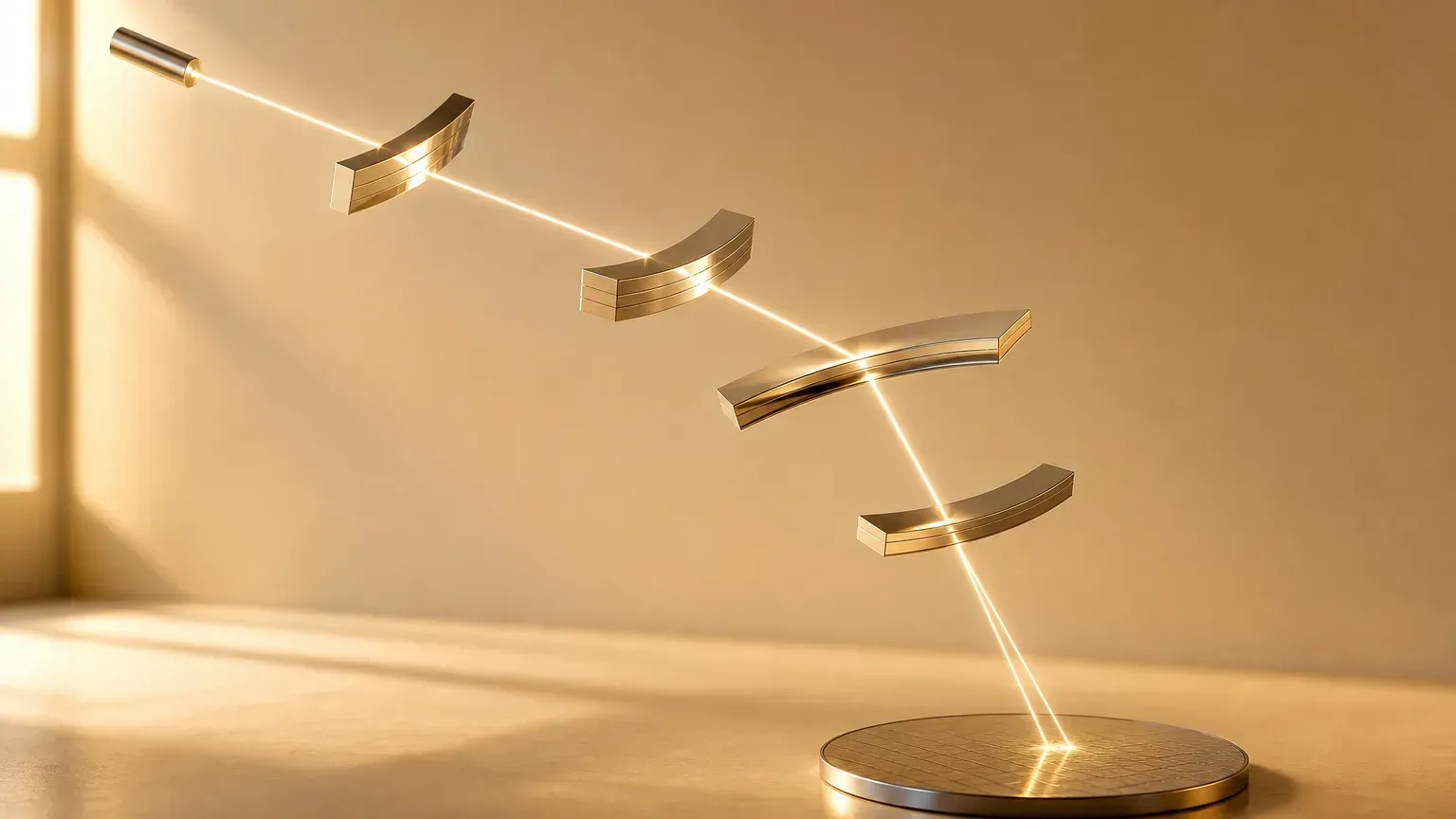
You can’t get EUV light from a bulb. ASML shoots out molten tin droplets about 25 microns across at high speed. A low-energy laser flattens each one, then a high-energy laser turns it into plasma, which gives off a flash of EUV light. This repeats about 50,000 times a second.
It gets harder. EUV is absorbed even by air, so the whole light path must be in a vacuum. It also can’t pass through lenses; it can only be reflected and focused by layers of precise multilayer mirrors. Every step is pushed to the limit, which is why only ASML in the world can build it.
Low-NA and High-NA
EUV machines come in two generations. The larger the NA (numerical aperture), the finer they can print.
| Low-NA EUV | High-NA EUV | |
|---|---|---|
| Model | NXE series | EXE series |
| Numerical aperture | 0.33 | 0.55 |
| Resolution | About 13 nm | About 8 nm |
| Price per machine (reported estimates) | On the order of $200 million | About $400 million |
Low-NA is the volume workhorse for 7, 5, 3, and 2nm processes; High-NA can print finer. The prices in the table are media reports and market estimates. In 2025, ASML recognized revenue on 48 EUV machines, 4 of them High-NA.
Who Uses It, and Export Controls
All three big advanced-process makers rely on EUV:
- TSMC: Its N7+ in 2019 was the world’s first process to use EUV in volume production. N5 and N3 then used it heavily, and 2nm (N2) entered volume production in Q4 2025. In September 2026, TSMC announced it will bring High-NA into volume production at advanced nodes from 2030, and is working with ASML on 12-inch photomasks.
- Samsung: Has used EUV since 7LPP, even in memory (DRAM).
- Intel: Started EUV volume production with Intel 4. In July 2026, Intel was already using High-NA in volume production for some chip layers of Panther Lake (18A). ASML calls this the first logic product made with High-NA in volume production.
The other side is export controls. EUV machines are under Dutch and U.S. controls and have never been sold to Chinese customers. Advanced processes can’t do their critical layers without EUV, and EUV comes only from ASML. That makes it a key node in the U.S.-China chip rivalry, and the core of both The Chip War and Export Controls. This article only states the facts of the controls and makes no political judgment.
The Supply Chain and Taiwan’s Role
ASML integrates EUV. Its light-source technology comes from Cymer, which ASML acquired, and the most critical optics, such as the mirrors, are supplied only by Germany’s ZEISS. These two parts are the hardest to copy.
Taiwanese firms mostly work on the periphery. Gudeng Precision makes EUV reticle PODs (reticle transport boxes) and is one of the few Taiwanese firms certified by ASML, so its role is fairly clear. Other mask, materials, and engineering-service firms the market mentions are mostly speculation by industry media and analysts. They show “possible roles,” not confirmed orders or how much anyone benefits. This article only describes industry roles. It does not rank individual stocks and does not constitute investment advice.
Penchan’s summary
EUV matters because three things stack up: the hardest layers of advanced processes need it, only ASML in the world can build it, and it is under export controls. Each one is critical alone. Stacked together, EUV stops being just a machine and becomes the geopolitical gate to “advanced-process capacity.” Who can use it, and which generation, partly decides who can make the most advanced chips.
To read about ASML the company, see What Is ASML. To see how the chips EUV prints are made, read Foundry and Advanced Process. To look at the whole chain again, go back to the supply-chain overview.