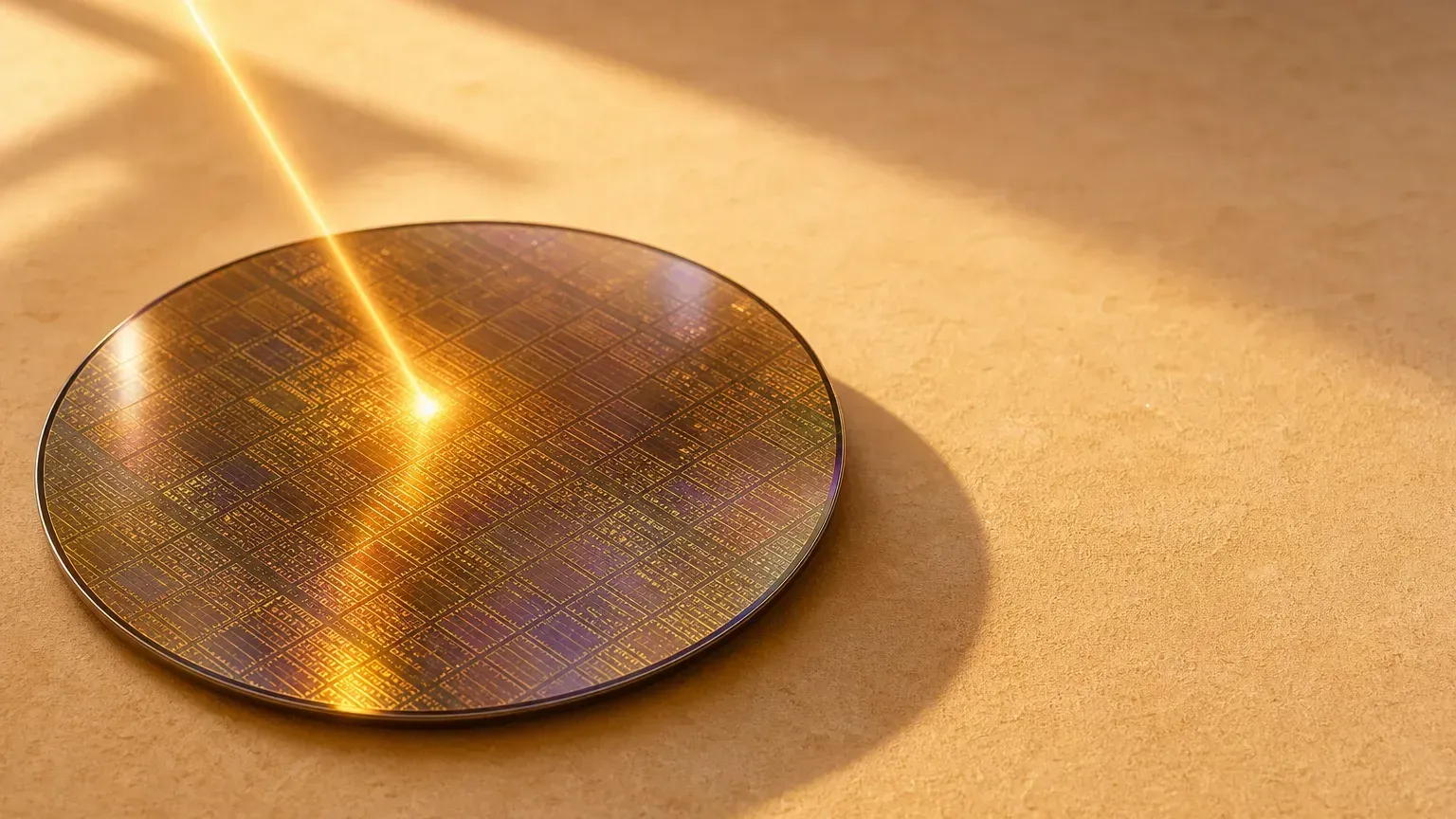
When AI chips come up, people think of TSMC making them and NVIDIA designing them. Go one step further upstream: to make the most advanced chips, TSMC first has to buy machines from a Dutch company, and one of those machines is something no one else in the world can build. That company is ASML.
This is the deep-dive version of Gate 4, “foundry and lithography equipment,” in The AI Hardware Supply Chain, End to End.
What Is EUV? One Sentence Plus a Metaphor
ASML’s best-known product is the EUV (Extreme Ultraviolet) lithography machine. It uses light to project a chip’s circuit pattern onto a silicon wafer. This step is called lithography.
The key is the wavelength. EUV light has a wavelength of just 13.5 nanometers. Think of light as a pen: the shorter the wavelength, the finer the tip, and the finer the lines it can draw. Advanced chips pack tens of billions of transistors into an area the size of a fingernail, and volume production mostly relies on this ultra-fine pen.
The earlier generation, DUV (deep ultraviolet), has a longer wavelength. To draw fine patterns with it, you split the pattern apart and expose each part separately. The industry calls this multi-patterning.
Why Advanced Nodes Mostly Use EUV
DUV can volume-produce advanced chips, but the finer the pattern, the more exposure and processing steps it takes. EUV lowers the process complexity and cost of critical layers.
High-end AI chips mostly use EUV processes, so ASML’s equipment supply affects how many of them can be made.
Why ASML Is the Chokepoint of the Whole Chain
The hard part of EUV isn’t only using it, but building it. One machine has tens of thousands of parts, and the light source, mirrors, and precision mechanics are all extremely hard to make. The result: ASML is the only company in the world that can volume-produce EUV machines. Each one costs over a hundred million euros, so only a handful of customers can both afford and obtain one.
Core-Data Snapshot
| Topic | Figure | Date / Source |
|---|---|---|
| EUV light wavelength | 13.5 nanometers | Spec |
| Low-NA EUV | 0.33 NA, single-exposure resolution about 13nm | ASML spec |
| High-NA EUV | 0.55 NA, about 8nm, patterns about 1.7× finer | ASML spec |
| Systems sold (revenue recognized) | 48 EUV (including 4 High-NA), 279 DUV | 2025, ASML annual report |
| Revenue | About €32.7 billion | 2025, ASML annual report |
| Full-year revenue guidance | €43–45 billion | 2026, announced by ASML in July 2026 |
Low-NA and High-NA: The New Generation Enters Volume Production
EUV comes in generations too. The difference is the lens’s numerical aperture (NA): the bigger the NA, the finer it draws. TSMC’s current advanced nodes rely on Low-NA. The new High-NA draws finer, but each machine costs more and is bigger.
High-NA moved into volume production in 2026. In July 2026, ASML said Intel was already using High-NA to volume-produce some chip layers of Panther Lake (18A process), the first logic product made in volume with it.
Export Controls: Why Major Powers Are All Watching ASML
EUV is the main ticket to volume-producing the most advanced chips, and only one company issues that ticket. That naturally makes it a geopolitical lever.
Under US and Dutch controls, ASML’s EUV has never been sold into China. Since 2024, the Netherlands has also required export licenses for older DUV immersion machines. The logic is simple: choke the equipment and you limit how advanced a country’s chip processes can get. That works further upstream than banning chips directly.
China is still a big ASML customer, buying machines other than EUV. According to a July 2026 CNBC report, ASML’s CFO expects China to make up about 20% of 2026 revenue. Bills in the US Congress such as the MATCH Act aim to fully restrict DUV immersion machines for China; as of late September 2026, they had not passed. For the rules in detail, see What Are Export Controls.
Taiwan and TSMC: Deeply Dependent, Adopting at Its Own Pace
TSMC’s N7+, N5, N3, N2 and other processes rely on ASML’s EUV.
But TSMC isn’t racing to be first with High-NA. It first pushed Low-NA with multi-patterning as far as it could go. Only in September 2026 did it formally announce that it will bring High-NA into volume production at advanced nodes from 2030, and work with ASML on 12-inch photomasks. Taiwan’s value at this gate isn’t just being able to buy the machines, but turning them into large-scale volume production.
ASML also uses AI on itself. It invested in the European AI startup Mistral in 2025. ASML says a 2026 pilot between the two used AI to diagnose machine subsystem errors and found problems more than 70% faster.
Penchan’s summary
For the technical details of EUV, read What Is EUV. To see how a finished chip gets packaged with memory, check out What Is CoWoS and What Is HBM. To see how all eight gates of the chain connect, head back to the supply-chain overview.
Remember where ASML sits: at the very top of the semiconductor chain, and the only company in the world that can build EUV machines. That exclusive position makes it both the lifeline of advanced nodes and a lever for export controls.