
When people talk about AI hardware, they usually watch the GPU, HBM, and CoWoS. But once a data center packs in tens of thousands of GPUs, another question comes up: how do these chips exchange data fast and without wasting power? The industry’s answer is silicon photonics.
This piece explains what silicon photonics is, how CPO saves power, and where Taiwan fits. It is the deep-dive version of Gate 5 in The AI Hardware Supply Chain, End to End.
What Is Silicon Photonics? One Sentence to Make It Clear
Silicon photonics is the technology of building the parts that carry light into a silicon chip or package.
Inside a chip, data is an electrical signal. Silicon photonics turns that signal into light, sends it over fiber, and turns it back into electricity at the other end. Remember it in one line: silicon photonics is the technology for moving data with light. The GPU still computes with electricity; silicon photonics only moves data between chips.
In the past, the electrical signal had to travel across the circuit board before an external optical module turned it into light. AI moves so much data that even this short trip became a burden, so the industry wants to move the conversion point right next to the chip.
Why AI Clusters Increasingly Need Optical Interconnect
Picture an AI data center as a huge sports team. The GPUs are the players, and optical interconnect is the passing routes. The more players there are and the more spread out they stand, the faster and farther each pass has to go.
When training a large model, tens of thousands of GPUs constantly exchange data, and the switch is often not in the same rack. As distance grows, copper signals fade and distort, and power use and heat shoot up. Fiber keeps speed high over long distances while using less power, and speeds have climbed from 400G to 800G and on to 1.6T.
Very short links still use copper cables. Light first solves the bottleneck between racks, where bandwidth needs are highest.
Core-Data Snapshot
| Topic | Value | Source / nature |
|---|---|---|
| Share of 800G+ optical module shipments | About 19.5% in 2024 → over 60% in 2026 | TrendForce estimate |
| 1.6T optical modules | Ramping into volume production in 2026, not yet replacing 800G | 2026 |
| CPO penetration in AI data-center optical-communications modules | About 0.5% in 2026, estimated at about 35% by 2030 | TrendForce estimate |
CPO Co-Packaged Optics: Moving the Optical Engine Right Next to the Chip
CPO (co-packaged optics) puts the “optical engine” beside the switch chip or accelerator, in the same package. The electrical signal no longer has to travel far across the circuit board before it becomes light. Less loss means less power.
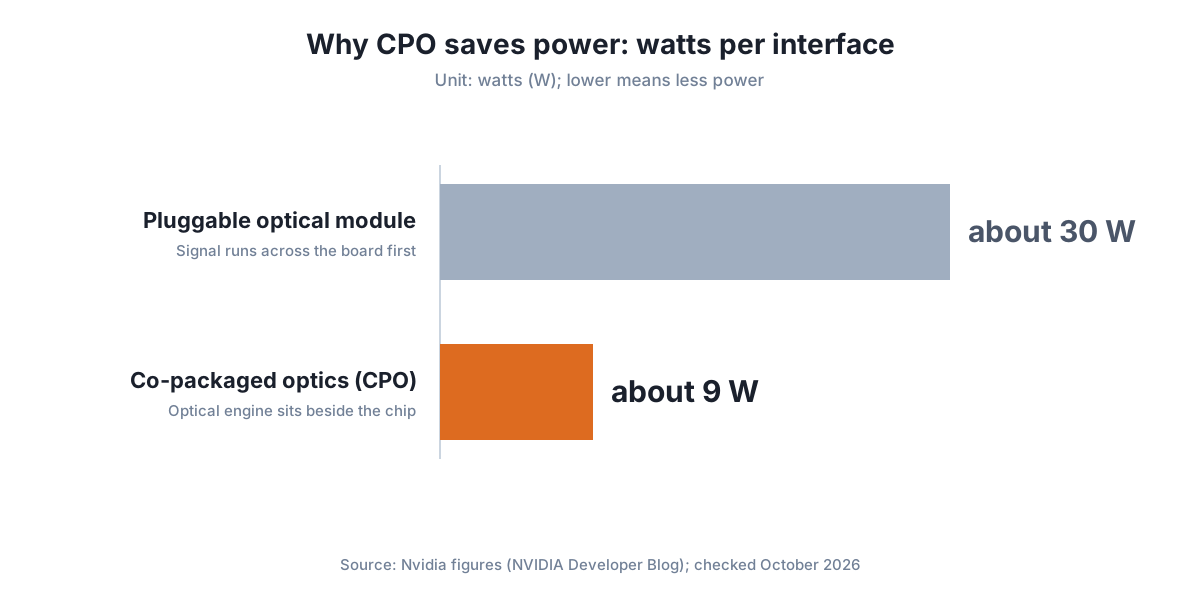
By Nvidia’s published figures, a traditional pluggable optical module uses about 30 watts per interface with about 22 dB of electrical loss; with CPO, that drops to about 9 watts and about 4 dB (the lower the dB figure, the less circuitry and power are needed to make up for signal loss). Nvidia says its silicon-photonics switches are 5x more power efficient. In a cluster with tens of thousands of ports, the power saved can go to running more GPUs.
For how CPO compares with pluggable optical modules and the details of each vendor’s products, see What Is CPO.
Where It Stands: Production Has Started, but It Is Still Early
Products that entered production in 2026 include NVIDIA’s CPO switches and TSMC’s COUPE:
- Nvidia: Its Ethernet switch, Spectrum-X Photonics, was announced as in full production in August 2026. According to Wccftech, engineering samples of the InfiniBand version, Quantum-X Photonics, reached the cloud provider Lambda in June.
- TSMC: According to Commercial Times, TSMC confirmed at its July 2026 earnings call that its silicon-photonics platform COUPE has started production.
- Broadcom: According to TrendForce, the previous-generation 51.2 Tbps Bailly CPO switch is in volume production.
But production does not mean wide adoption: TrendForce estimates CPO switches will not ship in large volume until 2027 to 2028.
Another signal is standardization. In early 2026, AMD, Broadcom, and Nvidia, together with Microsoft, Meta, OpenAI, and others, formed the optical-interconnect standards group OCI MSA. It sets specs for short optical links inside AI racks, with a roadmap reaching 3.2 Tb/s and beyond. When the giants write a standard together, optical interconnect is clearly a long-term direction.
Taiwan’s Role at This Gate
Taiwan is deeply involved at this gate:
- TSMC: COUPE combines the silicon-photonics chip and the electronic control chip into a single optical engine that can be packaged together with high-performance compute chips. According to TrendForce, Nvidia’s Spectrum-X CPO switches use COUPE.
- Nvidia’s CPO supply chain: According to StorageReview, for Spectrum-X Photonics TSMC makes the silicon-photonics chips, SPIL handles packaging and testing, and Foxconn handles system assembly. Foxconn also said in August 2026 that CPO switches are on track to ship in volume in the third quarter.
- Other links: Delta Electronics supports volume production of Broadcom’s Bailly (according to TrendForce). Taiwanese firms also work in optical-module assembly and testing, passive optical components (parts like connectors and lenses that don’t emit light themselves), and optoelectronic components.
This is only an industry map, with no investment judgment on any individual stock.
Penchan’s summary
Silicon photonics is the technology for moving data with light. As AI clusters grow and copper struggles, it has gone from a supporting part to key infrastructure. CPO then puts the optical engine next to the chip, trading big power savings for more bandwidth.
In 2026 NVIDIA’s CPO products entered production, but overall CPO penetration is still low, and wide adoption will take time. The direction is set; what to watch next is how fast it spreads.
For other stories where advanced packaging puts parts side by side, read What Is CoWoS and What Is HBM. To see how the whole chain fits together, go back to the supply-chain overview.