The earlier silicon photonics gate explained that as AI clusters grow, copper struggles, so the industry moves data with light instead. This piece goes one step further: CPO, the approach that brings light right next to the chip, plus what is happening in the optical-module market and Taiwan’s supply chain.
It extends the optical-interconnect gate of The AI Hardware Supply Chain, End to End. It only describes industry roles and is not investment advice.
What is CPO?
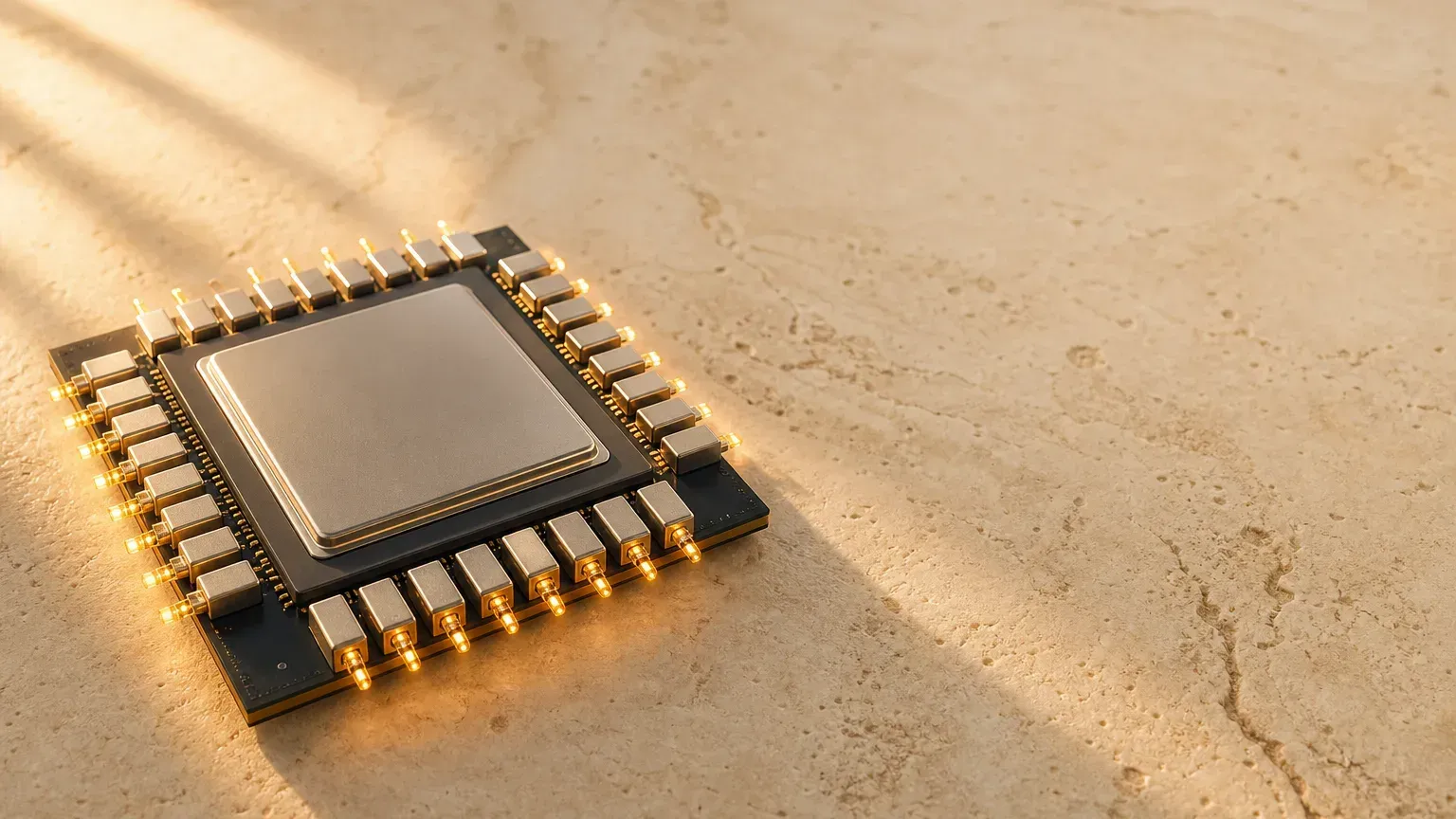
CPO stands for co-packaged optics. It packages the optical engine, the part that converts electrical signals to light, directly beside the switch chip or AI accelerator.
Traditionally, the electrical signal first travels across the circuit board to an external optical module, where it is converted to light. The faster the speed, the more power that stretch uses and the more the signal degrades. Moving the optical engine next to the chip cuts that stretch short, which saves power and fits in more bandwidth. NVIDIA says its CPO switches are about 5 times as power-efficient as the traditional approach. In one line: CPO moves the point where electricity becomes light as close to the chip as possible.
CPO vs. pluggable optical modules
CPO is challenging today’s mainstream: the pluggable optical module.
A pluggable module works like a plug-in card. When it fails you pull it out and swap it, you can mix different speeds and distances, and there are many suppliers. CPO saves power and packs in more density, but gives up flexibility: if an optical engine fails, you may have to replace the whole unit. The industry is working on this weak spot, for example by making CPO’s external laser a field-replaceable module (the OIF’s ELSFP spec).
So the two will coexist for a while. CPO goes first into high-end switches where power matters most, and pluggable modules keep handling most of the demand.
Where CPO stands (as of October 2026)
In 2026, NVIDIA’s CPO switches entered mass production:
- NVIDIA: its Ethernet switch, Spectrum-X Photonics, was announced in full production in August 2026. Its InfiniBand switch, Quantum-X Photonics, sent engineering samples to cloud provider Lambda in June, according to Wccftech.
- TSMC: confirmed at its July 2026 earnings call that its silicon-photonics integration platform COUPE has entered production. According to TrendForce, NVIDIA’s Spectrum-X CPO switch uses COUPE.
- Broadcom: announced its 102.4 Tbps Tomahawk 6-Davisson in October 2025 and was sampling it to early customers at the time. According to TrendForce research from July 2026, the previous-generation 51.2 Tbps Bailly is already in mass production.
But mass production is not the same as wide adoption. TrendForce estimates CPO’s share of AI optical-communications modules at only about 0.5% in 2026. CPO switches will not ramp in volume until 2027 to 2028, and the share may only reach about 35% by 2030.
Why the optical-module market is on fire
While CPO is still ramping, the pluggable optical-module market has already heated up, driven by AI’s demand for bandwidth. Optical-module speeds are moving from 800G to 1.6T:
| Topic | Figure | Nature |
|---|---|---|
| Share of shipments at 800G and above | About 19.5% in 2024 → over 60% in 2026 | TrendForce estimate |
| AI optical-transceiver market | About $16.5B in 2025 → about $26B in 2026 (up over 50% YoY) | TrendForce estimate |
The bottlenecks in this wave are laser chips (EML, CW lasers), optical alignment, cooling, and power, which is exactly where suppliers compete for position. These optical links ultimately feed data-center compute; for more, see AI Data Centers and Power.
What Taiwan’s optical-communications supply chain does
Taiwanese firms cluster in a few links: laser chips (the core component that generates the optical signal), passive optical components, optical-transceiver assembly and testing, and silicon-photonics foundry work. Industry coverage roughly names these roles: LandMark Optoelectronics supplies EML laser epitaxial wafers; Luxnet and Elite Advanced Laser (ELAC) work on lasers and optical modules; Browave makes passive optical components; and FOCI makes high-density fiber arrays and CPO co-packaging.
With CPO in mass production, the list has become more specific. According to StorageReview, NVIDIA’s Spectrum-X Photonics CPO supply chain has five vendors: TSMC (silicon-photonics chips), SPIL (packaging and testing), Lumentum (lasers), TFC (laser modules), and Foxconn (system assembly). In August 2026, Foxconn also said its CPO switches were on schedule for mass-production shipments in the third quarter.
Being named only reflects a public supply-chain role or market discussion. It does not mean a company has won orders, and this piece does not list beneficiary stocks or give buy/sell advice.
Opportunities and risks
For Taiwanese firms, the period around the 1.6T and CPO ramp is the key window to win a position. Whether they get designed into a top-tier customer’s product and pass certification (design-in) will strongly shape their later market share.
The risks sit in the same place. Technology transitions often bring component shortages and problems with optical-alignment yield and cooling. Pluggable, LPO (linear-drive pluggable optics), and CPO will coexist as competing routes, so betting on the wrong route or failing certification are real risks. In March 2026, NVIDIA invested $2 billion each in Lumentum, Coherent, and Marvell, tying up key optical-interconnect supply more tightly.
Penchan’s summary
CPO moves the optical engine next to the chip, saving power and raising bandwidth density, but it is harder to service than pluggable modules. NVIDIA’s products also entered mass production in 2026, but adoption is still very low, and the two will coexist for years. What is really ramping right now is the move from 800G to 1.6T optical modules.
Taiwan has roles in laser chips, passive components, module assembly and testing, silicon-photonics foundry work, and system assembly, which is why optical communications became a hot theme. But a hot theme is not a stock recommendation: understanding the roles matters more than chasing the theme.