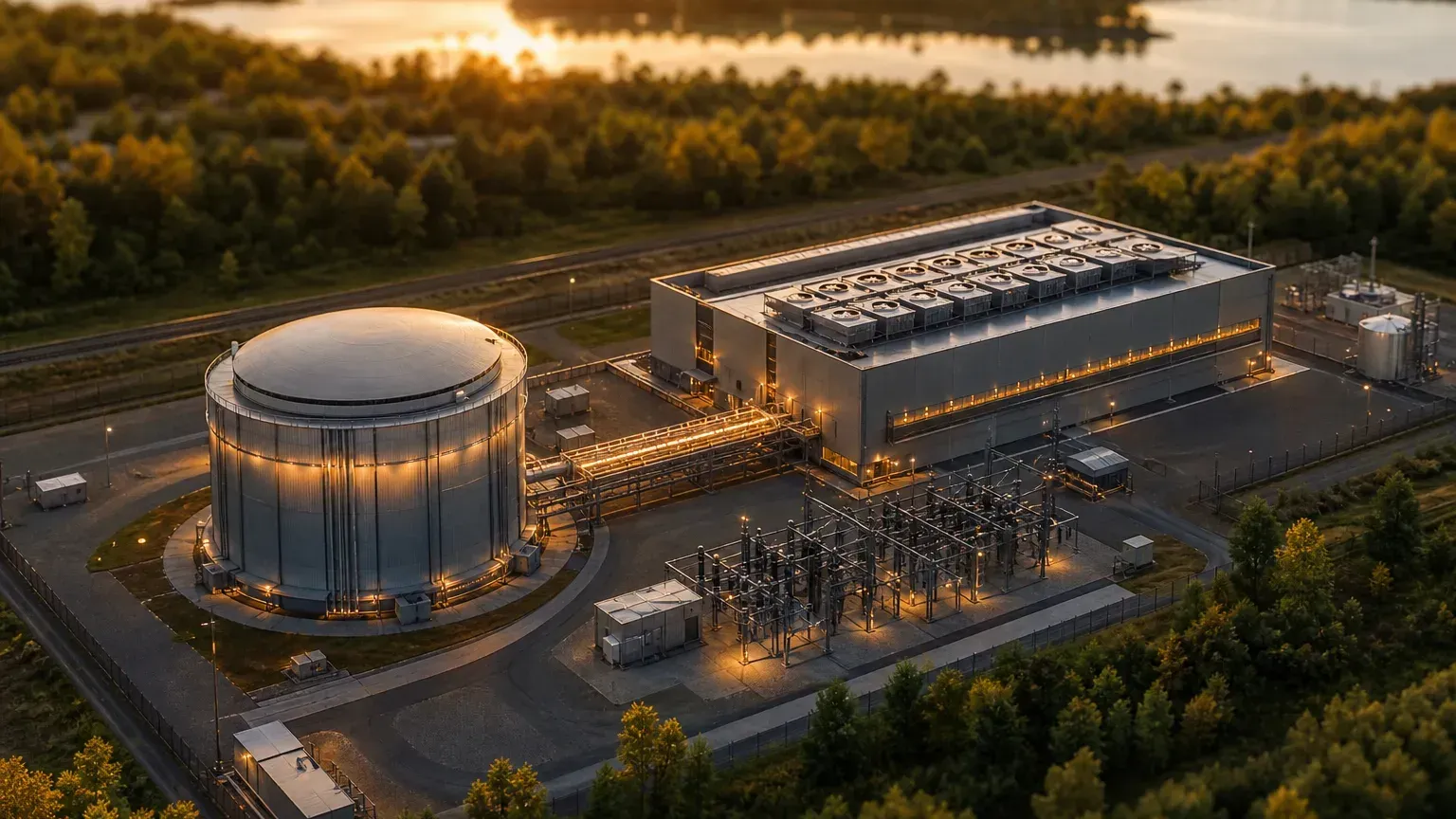
AI server rooms are using power so fast that grids in many places can’t keep up, so the tech giants are turning to nuclear. Amazon, Google, Microsoft, and Meta have all invested in or signed nuclear deals, and the keyword that comes up most is SMR.
This piece explains in plain words what an SMR is, why AI needs it, how far each player has gotten, and when power for U.S. AI demand can realistically arrive. It is the energy deep-dive of the data center and power gate.
What Is an SMR?
SMR stands for Small Modular Reactor. The International Atomic Energy Agency generally defines it as a reactor whose single module has an electrical output of no more than 300 MWe.
A conventional nuclear plant is often 1,000 MW or more per unit, custom-built on site, and takes more than a decade to finish. The SMR goes the other way: standardized modules are made in a factory, shipped to the site, assembled, and can be added in phases like building blocks.
An analogy: conventional nuclear is like building a high-rise from the ground up on site; an SMR is like shipping prefabricated container units to the site and snapping them together. But “modular means cheaper” is still an engineering assumption. It only counts once the first plants are actually built.
Why AI Data Centers Are Starting to Snap Up Nuclear Power
Start with volume. In April 2026 the International Energy Agency (IEA) estimated that global data-center electricity use was about 415 TWh in 2024 and about 485 TWh in 2025, and will reach about 950 TWh by 2030, roughly doubling again.
Then look at how picky the demand is. AI server rooms need power that never stops, is low-carbon, and can be locked in with long-term contracts. Wind and solar depend on the weather, and natural gas emits carbon. Nuclear fills that gap: stable, low-carbon, and available under long-term contracts.
SMR Developers and the Giants’ Nuclear Plays
The U.S. developers listed here are all still deploying, and none is supplying commercial power at large scale yet.
| Developer | Where it stands (as of October 2026) |
|---|---|
| NuScale | Received U.S. Nuclear Regulatory Commission (NRC) design approval in May 2025, the only SMR design to do so, at 77 MW per module; its power purchase agreement with the Tennessee Valley Authority (TVA) is not final yet |
| Kairos Power | Broke ground on the Hermes 2 demonstration plant in April 2026; it will send up to 50 MW to the TVA grid, the first power under the Google deal |
| TerraPower | The Natrium plant received its NRC construction permit in March 2026 and is expected to be finished in 2030; at about 345 MW, it is above the common 300 MW SMR threshold |
| X-energy | The construction permit for the Long Mott plant (4 Xe-100 units) is still under NRC review and has not been issued |
| Oklo | In June 2026 the U.S. Department of Energy approved the preliminary safety analysis for the Aurora-INL plant; according to Fission Today, it targets operation in 2028 |
The tech giants’ deals: Amazon invested in X-energy, targeting more than 5 GW of new nuclear by 2039; Google signed with Kairos, targeting 500 MW deployed by 2035; in January 2026 Meta signed with Vistra, TerraPower, and Oklo, targeting support for up to 6.6 GW of new and existing nuclear by 2035. Microsoft signed a 20-year power purchase agreement with Constellation to restart Three Mile Island Unit 1 (now called Crane, 835 MW, an existing large-scale plant, not an SMR). It received its final federal environmental assessment in September 2026, and Constellation targets a 2027 restart.
Most of these are investment or purchase agreements. That does not mean the power is flowing yet.
Timeline: Most U.S. Projects Target the 2030s
2026 did bring progress: by August, 5 test reactors in a U.S. Department of Energy pilot program had reached criticality (the point where the fission reaction sustains itself). But these are test units and do not feed the grid. Most U.S. SMR commercial power plans target the 2030s.
So from 2026 to 2030, the power gap for AI server rooms will still mainly be filled by grid expansion, natural gas, renewables, restarts and life extensions of existing nuclear plants, plus storage and demand management.
Taiwan’s Role
Nuclear power is a sensitive policy issue in Taiwan. Maanshan Unit 2 shut down in May 2025 when its 40-year operating license expired.
Taiwan’s National Atomic Research Institute has started SMR research. By its April 2026 assessment, even if foreign light-water SMRs reach commercial operation smoothly and Taiwan obtains a license, the most optimistic case for its first SMR electricity is 2035, and Taiwan currently cannot design the reactor itself. The more likely entry point is heavy-electrical equipment and components, such as transformers, switchgear, cables, and control systems.
The market often lumps heavy-electrical and grid companies into “nuclear theme stocks,” but this is closer to a grid and supply-chain theme. Being on such a list does not mean having nuclear orders, and this is not investment advice.
Penchan’s summary
Nuclear is back on the table because AI server rooms need power that is stable, low-carbon, and available under long-term contracts. Most U.S. SMR power plans target the 2030s; the gap over the next few years will still be filled by the grid, natural gas, renewables, and existing nuclear.
When you read related news, keep four stages apart: a signed deal, a permit, a groundbreaking, and actual power delivery.
To see the overall power ceiling of AI server rooms, read the data center and power gate; to see the whole chain, go back to the supply-chain overview.