
Bottom Line: A Private-Market Valuation, Not a Stock Price
Mistral AI is a private French company that is not listed. Its valuation comes from private funding-round negotiations, which is different from a public-market stock price. In September 2026, its CFO told Reuters that a listing has always been a future option, but there are no current discussions. This piece is for industry education and research only. It gives no buying or selling advice and presents no listed company, such as ASML or Nvidia, as a way to get exposure to Mistral.
For the full company picture, start with What Is Mistral. This piece focuses on three things: where the money comes from, where it gets burned, and what has to hold for the valuation to stand.
Funding History: From EUR 2 Billion to More Than EUR 21 Billion in Under Three Years
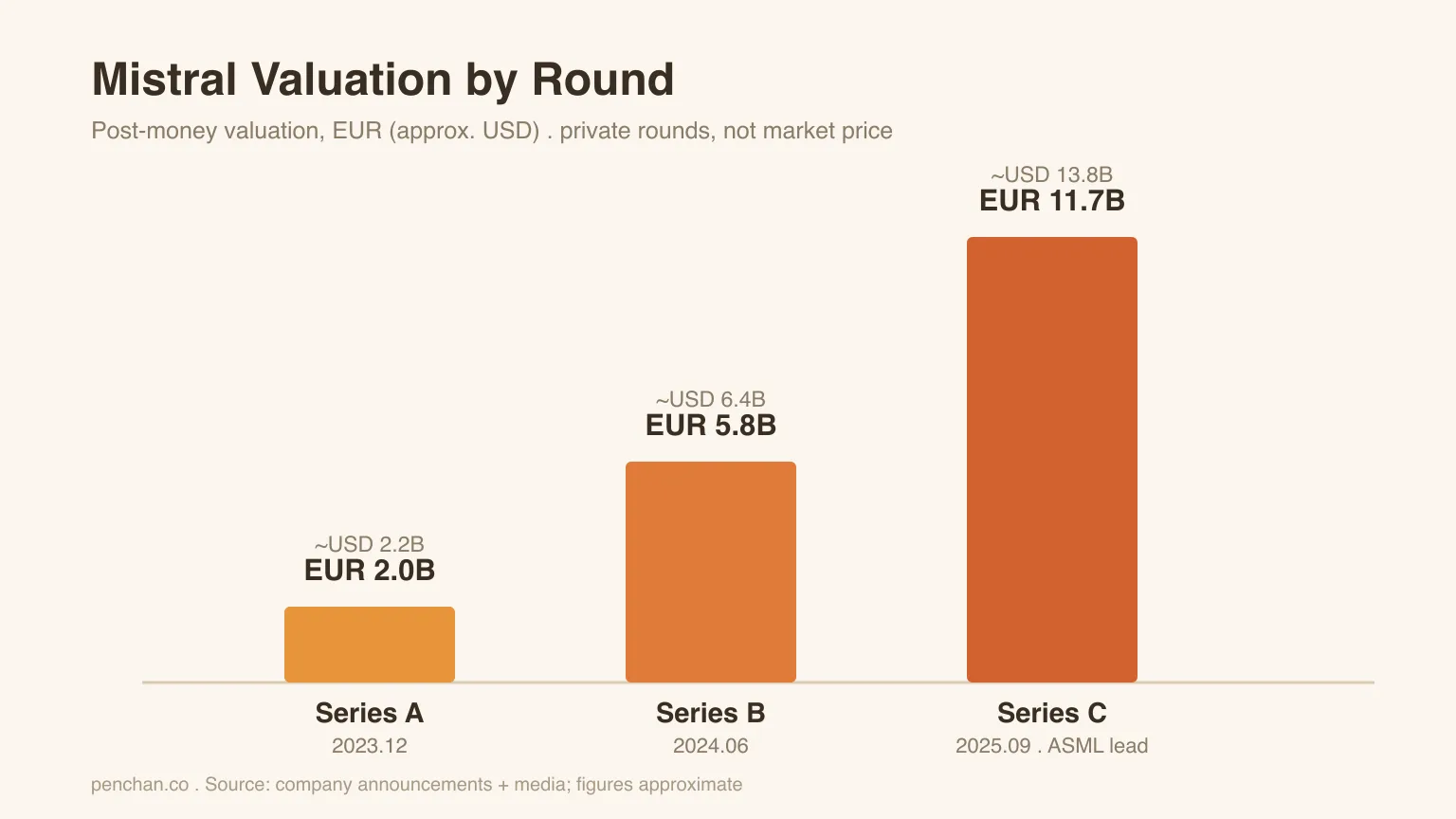
Mistral raised money fast after its 2023 founding. All valuations in the table are in euros, so euros and US dollars don’t get mixed up.
| Round | Date | Amount Raised | Post-Money Valuation | Lead Investor |
|---|---|---|---|---|
| Series A | December 2023 | EUR 385 million | About EUR 2 billion | Andreessen Horowitz |
| Series B | June 2024 | EUR 600 million (equity and debt) | About EUR 5.8 billion | General Catalyst |
| Series C | September 2025 | EUR 1.7 billion | About EUR 11.7 billion | ASML |
| Series D | September 2026 | EUR 3 billion | More than EUR 21 billion (about USD 24 billion by media conversion) | Samsung Electronics |
Mistral calls Series D the largest equity raise in European tech history. Samsung Electronics led it, with the Scaleup Europe Fund managed by EQT and existing shareholder PSG Equity as co-leads. Advent, funds managed by BlackRock, and the Grand Duchy of Luxembourg joined as new shareholders. Existing shareholders including ASML, Nvidia, a16z, General Catalyst, and Bpifrance also took part.
ASML led Series C. According to ASML’s annual report, at the end of 2025 it held about 11.1% of Mistral on a fully diluted basis, plus a strategic committee seat. That seat is advisory, not a formal board seat. The new stake after Series D has not been disclosed. For more, read ASML and Mistral’s strategic alliance.
ARR: Read It as a Run Rate, Not Audited Revenue
ARR stands for annual recurring revenue. It scales recurring revenue to a one-year figure, which differs from the revenue actually booked over a full year.
According to Reuters, CFO Johan Bergqvist said in September 2026 that ARR could reach USD 1 billion by year-end. That is a company forecast, not actual full-year revenue or an audited result; gross margin, burn rate, and renewal rate still need separate confirmation.
Own Compute: The Burn Gets Heavier
In March 2026, Mistral secured about USD 830 million in debt financing for its data center in Bruyères-le-Châtel, near Paris, to install about 13,800 Nvidia GB300 chips. Its flagship model Mistral Large 4, released as a preview in October 2026, was trained from scratch in its own European data center, according to the company. Mistral targets 200 MW of compute in Europe by the end of 2027 and 1 GW by 2030.
It is also starting to sell compute. In July 2026, Microsoft announced a multibillion-dollar commitment to use GPU compute that Mistral is building in Europe. According to Reuters, the deal includes no new equity investment.
This means Mistral is extending from models, APIs, and enterprise deployments into its own compute and Mistral Compute. Data residency and supply become easier to control, but Mistral also has to carry GPU, power, facility utilization, and debt costs. For the compute side of the ledger, read European compute sovereignty.
Whether the Valuation Holds Depends on Four Variables
The first is revenue quality. If ARR turns into renewable, collectible enterprise revenue with reasonable gross margins, the valuation can hold. If it mostly comes from short-term projects, discounts, or strategic partnerships that inflate the numbers, read it more cautiously.
The second is the open-weight strategy. Mistral releases several open-weight models under the Apache 2.0 license, but open weights are not the same as fully open source. It has to prove that community adoption flows back into paid APIs, enterprise editions, Forge custom models, and compute services. For this dual-track approach, read open weights and commercialization strategy.
The third is the European sovereign AI premium. Whether banks, governments, and manufacturers will pay more to keep data in Europe, self-host, and comply with EU rules is the core of what sets Mistral apart from closed US APIs.
The fourth is compute cost. Owning compute raises fixed costs, and revenue eventually has to cover model training, GPU depreciation, energy, and debt.
Penchan’s summary
Mistral’s valuation is a bet that Mistral can become the “European third option.” Penchan is watching two things: whether USD 1 billion in ARR becomes revenue that is visible and renews, and whether the business can absorb the cost of its own compute.