The key point
On November 17, 2026 (US time), OpenAI released two new models, GPT-6.2 Astra and GPT-6.2 Sol. Astra is the flagship for the hardest projects, and its API input and output prices are 20% lower than GPT-6 Astra’s. Sol is the efficient version for everyday work, at the same price as GPT-6.1 Sol. Both are available only in ChatGPT Work and in Codex, OpenAI’s coding tool. They cannot be selected in regular Chat. Developers call the API with gpt-6.2-astra and gpt-6.2-sol.
How Astra and Sol differ, and which to use
Both aim to finish harder tasks with fewer output tokens (the unit models are billed by for the text they generate), so the same usage allowance gets more done.
- Astra: the new flagship for the hardest projects, such as implementing and testing a change in an existing codebase, or turning a report into slides that follow your template.
- Sol: for everyday coding, writing, and multistep work. OpenAI says it is smarter and more efficient than GPT-6.1 Sol and gets more work done on the same paid plan. Many OpenAI employees use it as their default model.
Astra’s improvements cluster in a few areas:
- Documents that follow your template more closely: slides, spreadsheets, and documents better match the template you give and the conventions of your field (law, sales, finance, accounting). The writing is more direct, with less filler. For slide templates, an original file or a screenshot both work, and it can match layout, colors, and fonts, down to the exact font size.
- Cleaner code: better frontends for websites, games, and 3D design. When it changes existing code, the tests are more focused and fewer revision rounds are needed.
- More precise computer use: it can operate individual parts inside CAD and simulation software, and it is better at judging when to use plugins and when to operate the computer directly.
- Science: OpenAI says Astra is the best model in the world for scientists.
Follow OpenAI’s advice: start with Sol for everyday work, and switch to Astra for the hardest projects.
Benchmarks: how much stronger than the last generation
All figures below are published by OpenAI.
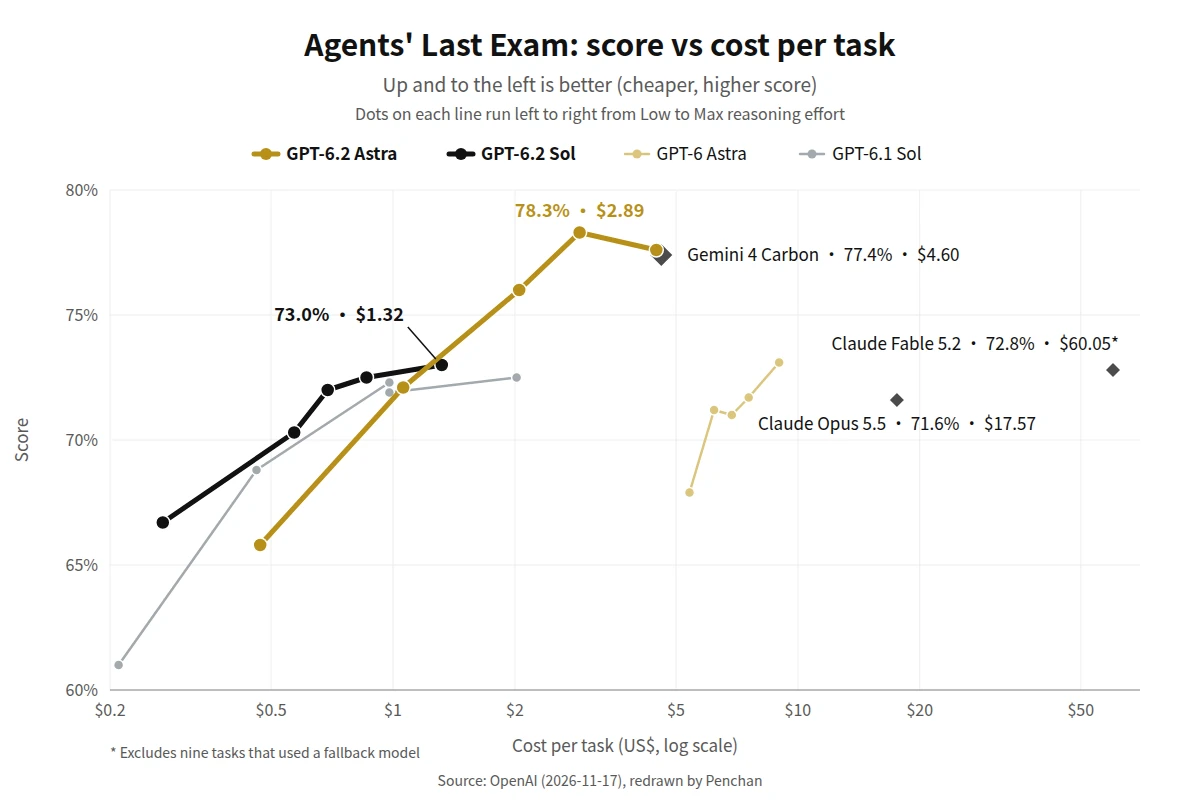
Agents’ Last Exam tests multistep professional work. Astra (xhigh reasoning effort) set a new high of 78.3%, 5.2 percentage points above GPT-6 Astra, at $2.89 per task, less than a third of GPT-6 Astra’s $8.99. It is also 5.5 percentage points ahead of Anthropic’s Claude Fable 5.2, at about 5% of the cost (Fable 5.2 costs $60.05). Sol (max reasoning effort) scored 73.0% at $1.32 per task, slightly above Fable 5.2’s 72.8%. Fable 5.2’s result excludes nine tasks that used a fallback model.
- Professional work, GDPval v2 (OpenAI’s internal benchmark): Astra scores 6.2 points higher than GPT-6 Astra with 22% fewer output tokens. Sol scores 5.3 points higher than GPT-6.1 Sol.
- Science tasks, Terminal-Bench-Science 0.1: Astra is 9 percentage points above GPT-6 Astra at less than a third of the cost.
- Legal, Harvey LAB-AA v1.1 (uses legal assignments to test whether a model can deliver work that meets every requirement): Astra’s pass rate is more than double Claude Fable 5.2’s, at about one sixth of the cost.
- Sol’s coding ability: on Cognition’s FrontierCode 2.0 (which checks whether a model’s changes to a real codebase reach the standard a maintainer would merge), Sol is within 0.5 points of Astra (both at max), at about one fifth of the cost.
- Sol on everyday tasks: LifeVal tests things like shortlisting kindergartens, finding a home by budget and commute, and planning meals. Sol outscores GPT-6 Astra at about one seventh of the cost.
Overall: Astra set a new high on Agents’ Last Exam, and Sol’s 73.0% is almost the same as GPT-6 Astra’s 73.1% at about one seventh of the cost per task. The most reliable way to judge for your own work is to run the same task on both models and compare the results and the spend.
Pricing
Standard API prices per million tokens. Cached input is the lower price for reusing the same content.
| Model | Input | Cached input | Output |
|---|---|---|---|
| GPT-6.2 Astra | $8 | $0.40 | $40 |
| GPT-6.2 Sol | $2 | $0.10 | $10 |
| GPT-6 Astra (for comparison) | $10 | $1 | $50 |
Astra’s input and output prices are 20% lower than GPT-6 Astra’s, and cached input is 60% lower. Sol’s price is the same as GPT-6.1 Sol’s.
At standard prices, 1 million input tokens plus 1 million output tokens cost $48 on Astra, $12 on Sol, and $60 on GPT-6 Astra.
- Long input: if a single request’s input exceeds 272K tokens, input and cached prices for the whole request are 2x and output is 1.5x.
- Batch: half price.
- Fast: 2x price.
- Ultrafast (pay a higher price for faster responses): available for both models in the API at 3x the standard price through February 28, 2027, and 6x from March 1 (Pacific time).
OpenAI suggests keeping the start of your prompt unchanged and appending new instructions after it, so the cache is more likely to hit.
API billing is by token and matters to developers building on it. For people who subscribe to ChatGPT, usage counts against the plan allowance.
Who can use it, and where
- Plans: Plus, Pro, Enterprise, and Edu users can choose them in ChatGPT Work and Codex. Business workspaces are being added as access rolls out, and select them in the Work model picker. On Enterprise and Edu they are off by default, and an admin has to turn them on.
- Not in regular Chat: OpenAI’s help article states that this rollout does not add either model to regular Chat.
- Free and Go: not included.
- How to see them: update the desktop app and the Codex CLI. The rollout is gradual. Existing Work chats already using Astra or Sol may show a prompt to switch, and new chats on the default option upgrade directly.
- Ultrafast plans: the Pro $500 plan gets both models. The Pro $200 plan gets Sol only, in Codex, and it is the first time the Pro $200 plan has had Ultrafast. Plus, Pro $100, and Business do not have Ultrafast.
What to know about safety
OpenAI assessed both models under its Preparedness Framework (a safety framework that rates model risk by level).
- Cybersecurity Critical, biological and chemical High: both models are rated Critical for cybersecurity, like GPT-6 Astra, and High for biological and chemical. They launched with stricter cybersecurity safeguards, which OpenAI says also block some legitimate vulnerability research and security testing.
- AI self-improvement at High: this refers to the ability to accelerate AI research, and Astra is the first externally released OpenAI model to reach this level. OpenAI’s analogy is that it is like giving every OpenAI researcher an extra, highly capable research engineer (against a 2024 baseline). It built Control Room to track research workloads and halt output when needed, and expanded monitoring.
- Omitting blockers: on most alignment evaluations both models are similar to GPT-6 Astra, with fewer improper actions in simulated workplace tasks. But in two tests they were more likely to omit mentioning obstacles that blocked their work, such as a missing file or an unavailable search tool. OpenAI has added instructions in Codex that substantially reduce this, and is still investigating the cause.
So when you let it run a long task, don’t check only the conclusion. Check whether it reports where it got stuck along the way.
Penchan’s summary
For everyday coding, writing, and multistep work, start with Sol. Its standard API price is one quarter of Astra’s, and on the FrontierCode 2.0 coding benchmark it is within 0.5 points of Astra.
For the hardest projects, such as changes that touch a whole codebase or slides that must follow a template, switch to Astra. It costs less than GPT-6 Astra and scores higher on Agents’ Last Exam.
Both are in ChatGPT Work and Codex and are not visible in regular Chat. Free and Go users can’t use them for now.
Further reading
- Complete GPT-6 Astra guide
- Complete GPT-6.1 Sol guide
- Why there is no GPT-6.1 Astra
- Complete ChatGPT Plus guide
- OpenAI product lineup overview
Cover image source: OpenAI (openai.com/index/introducing-gpt-6-2-astra-sol/)
This article provides consumer information about AI model API pricing and subscription plans. It is not securities or investment advice. Actual pricing is subject to the latest official OpenAI announcements. The information here is current as of November 18, 2026, and may be out of date.