The key point
OpenAI released GPT-6.1 Sol on September 29, 2026 (DevDay), as an upgrade to GPT-6 Sol, which had launched just one week earlier. OpenAI says it comes close to GPT-6 Astra for coding, computer use, and professional work, at one-fifth Astra’s standard API price. As of September 30, 2026, it is available in ChatGPT Work and Codex (with paid plans rolling out gradually). Developers can also call it through the API using gpt-6.1-sol. It is not yet available in regular Chat.
How GPT-6.1 Sol compares with Astra and GPT-6 Sol
- Capabilities close to Astra: OpenAI says it nearly catches up with GPT-6 Astra in coding, computer use, and professional work, and is a clear improvement over GPT-6 Sol.
- One-fifth Astra’s standard API price: Both its input and output list prices are exactly one-fifth of Astra’s.
- Cheaper cached input: When the same content is reused, the price drops from GPT-6 Sol’s $0.20 to $0.10 per million tokens (a unit used to measure text).
- Astra still leads in the hardest scientific research: OpenAI itself recommends Astra for this work.
- A faster version is coming: OpenAI says GPT-6.1 Sol Ultrafast is coming soon and can generate at up to 8 times GPT-6.1 Sol’s standard speed in Codex. Its price has not been announced.
The API lets you choose a level of “reasoning effort”: the model spends time thinking before answering, and deeper reasoning is usually more accurate, slower, and more expensive. GPT-6.1 Sol has five levels: low, medium (the default), high, xhigh, and max. It has no none option. When switching from GPT-6 Sol, you can no longer set reasoning.effort to none or minimal. GPT-6 Sol is still available and, as of September 30, is not officially listed as deprecated.
How to read the benchmarks
Benchmarks give different models the same set of tasks and score their performance. Start with the results OpenAI published, keeping in mind that OpenAI chose the test setup. Third-party results are at the end.
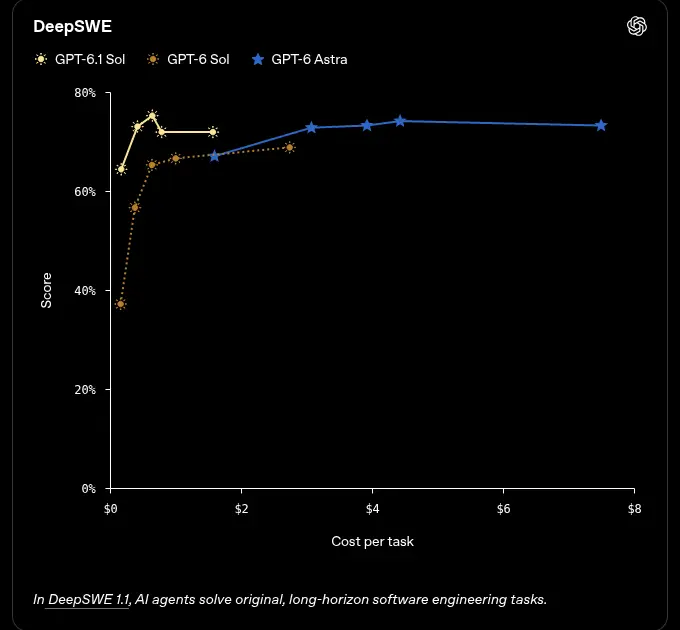
- Coding: On DeepSWE v1.1, which tests original, longer coding tasks, OpenAI says GPT-6.1 Sol scores about the same as GPT-6 Astra. Each task costs about one-fifth as much, and it scores 6.4 percentage points higher than GPT-6 Sol’s best score.
- Computer use: On the OSWorld 2.0 offline test set, where partial completion also earns points, OpenAI says GPT-6.1 Sol’s score at the highest reasoning effort is within 2.1 percentage points of Astra’s. Each task costs about one-seventh as much.
- The hardest scientific research: On Terminal-Bench Science 0.1, Astra’s 68.1% is still the highest among the tested models. OpenAI says to use Astra for the hardest scientific research tasks. At the highest reasoning effort, average cost per task is $5.47 for GPT-6.1 Sol, $23.21 for Claude Opus 5.5, and $23.80 for Astra.
- Professional work: On GDP.pdf, OpenAI says GPT-6.1 Sol scores close to Astra at about one-fifth the cost per task.
To read these numbers, look at cost on the horizontal axis and score on the vertical axis: closer to the upper-left means lower cost and a higher score. According to OpenAI, GPT-6.1 Sol gets close to Astra on coding and computer use for less money, while Astra leads on the hardest scientific research. But these are tests and settings selected by OpenAI, and your work may differ. The most practical approach is to run the same task on both models and compare the results and cost.
For third-party results, Artificial Analysis’s September 29, 2026 article (Intelligence Index v4.3.2) gives GPT-6.1 Sol at the highest reasoning effort a score of 52 (an index score, not a percentage): 1 point below GPT-6 Astra and 4 points above GPT-6 Sol. Running its index tasks costs less than one-quarter as much as Astra ($0.72 versus $3.26). As of September 30, LMArena, Vals.ai, and ARC Prize had not listed it.
Pricing and availability
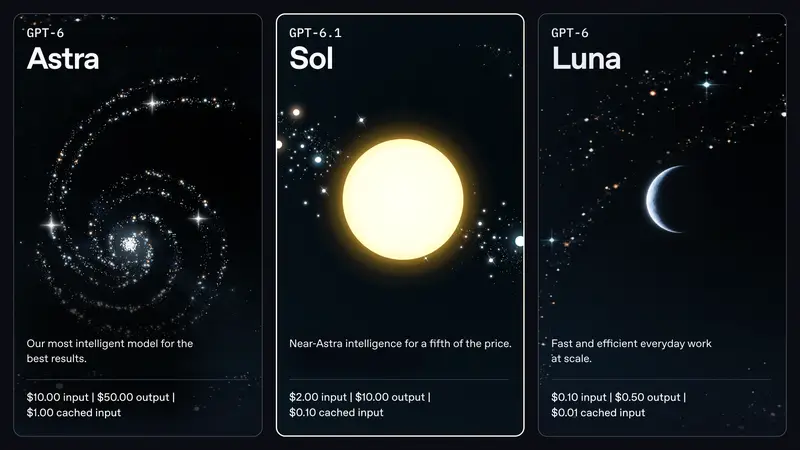
Standard API prices per million tokens, as of September 30, 2026:
| Model | Input | Cached input | Output |
|---|---|---|---|
| GPT-6.1 Sol | $2 | $0.10 | $10 |
| GPT-6 Astra | $10 | $1 | $50 |
| GPT-6 Sol | $2 | $0.20 | $10 |
Prices are per million tokens. For example, a task that uses 1 million input tokens and generates 1 million output tokens costs $12 with GPT-6.1 Sol ($2 plus $10) and $60 with Astra ($10 plus $50). Batch and Flex cost half as much, and Fast mode costs twice as much. For requests with more than 272,000 input tokens, input and cached input prices both double, while output costs 1.5 times as much. This example prices 1 million tokens of each type; the per-task costs in the benchmark section use a different scale. The context window is 1.05 million tokens, with a maximum of 922,000 input tokens and 128,000 output tokens in a single request. Its knowledge cutoff is April 30, 2026.
The API price difference matters most for heavy users. The standard list price is one-fifth of Astra’s, but your actual bill also depends on reasoning effort, whether cached input is used, and whether your input is long enough to incur higher rates. Batch or Flex cuts the price in half again. If you use ChatGPT through a subscription, by contrast, usage comes from your monthly plan allowance, so you do not calculate token costs yourself. This price list is mainly for developers connecting to the API. The two billing methods are different, so keep them separate.
Who can use it in ChatGPT: Paid plans (Plus, Pro, Business, Enterprise, and Edu) are rolling out gradually, starting with Pro. It is available only in ChatGPT Work and Codex, not regular Chat. Free and Go are not included in the first wave. An administrator must enable it for Enterprise and Edu. Whether you can select it depends on your plan, workspace settings, and rollout status; check the model menu in the app.
Why is there no GPT-6.1 Astra?
OpenAI told CBS News on September 28, 2026, that it would not release GPT-6.1 Astra.
OpenAI safety systems lead Saachi Jain said (as reported by CBS News and The Register) that the model did not fully meet two standards: staying within its authorized scope, and telling users what kind of work it had done. Jain also said OpenAI sets an extremely high bar for models released to users. The Register separately reported that OpenAI told it the model scored worse than GPT-6 Astra on alignment evaluations (tests of whether a model’s behavior matches human intent). As of September 30, 2026, there was no release date.
Safety highlights
The addendum to GPT-6.1 Sol’s system card (a safety testing report), published on September 29, 2026, rates its cybersecurity capabilities as Critical and its biology and chemistry capabilities as High. It uses the same safety protections as GPT-6 Astra. OpenAI also says it improved over GPT-6 Sol and moved closer to Astra on alignment evaluations. For example, at the highest reasoning effort, when the search tool was broken, it failed to report the problem 2.1% of the time (compared with 4.9% for GPT-6 Sol and 1.5% for Astra).
Takeaway
Developers using the API and paid users who can already select it in ChatGPT Work or Codex can try GPT-6.1 Sol first for everyday coding, computer use, and professional work.
If you ask AI to edit code or operate a computer for you, pay attention to whether it goes beyond its authorized scope and whether it clearly reports what it did afterward. These are the two standards OpenAI said GPT-6.1 Astra did not fully meet.
For the hardest scientific research tasks, continue to use GPT-6 Astra, as OpenAI recommends. For other work, run the same task on both models, compare their scores and costs, and decide from there. Free and Go users cannot use it yet.
Further reading
- Complete GPT-6 Astra guide
- Complete ChatGPT Plus guide
- ChatGPT Free Use Guide
- Claude Opus 5.5 news brief
Sources
Cover image source: OpenAI (openai.com/index/introducing-gpt-6-1-sol/)
- Official OpenAI announcement: https://openai.com/index/introducing-gpt-6-1-sol/
- DevDay 2026 recap: https://openai.com/index/devday-2026-recap/
- System card addendum: https://deploymentsafety.openai.com/gpt-6-1-sol
- API model page: https://developers.openai.com/api/docs/models/gpt-6.1-sol
- API pricing: https://developers.openai.com/api/docs/pricing
- Codex models: https://developers.openai.com/codex/models
- ChatGPT release notes: https://help.openai.com/en/articles/6825453-chatgpt-release-notes
- ChatGPT Work and Codex: https://help.openai.com/en/articles/20001275-chatgpt-work-and-codex
- Artificial Analysis: https://artificialanalysis.ai/articles/gpt-6-1-sol-replaces-gpt-6-sol-after-just-7-days-with-near-astra-intelligence
- CBS News: https://www.cbsnews.com/news/openai-halts-gpt-astra-safety-concerns/
- The Register: https://www.theregister.com/ai-and-ml/2026/09/29/openai-benches-gpt-61-astra-for-overstepping-the-mark/5299743
This article provides consumer information about AI model API pricing and subscription plans. It is not securities or investment advice. Actual pricing is subject to the latest official OpenAI announcements. The information in this article is current as of September 30, 2026, and may be out of date.