The one-sentence takeaway
Anthropic launched Claude Opus 5.5 on September 22, 2026. Anthropic says it reaches Fable 5.1-level performance on most tasks and costs about 40% less than Opus 5 with the default settings. As of September 2026, Claude is divided into the Fable, Opus, Sonnet, and Haiku families, ranked from higher to lower capability and price, with Opus in the mid-to-high range. Nearly two weeks after launch, Opus 5.5 ranks first on several third-party leaderboards. Quite a few reviewers praised it in its first week, and quite a few complaints have also appeared since the end of September.
What changed in this upgrade
- Near Fable 5.1: Fable 5.1 is a more expensive high-end model. Anthropic says Opus 5.5 reaches its level on most tasks.
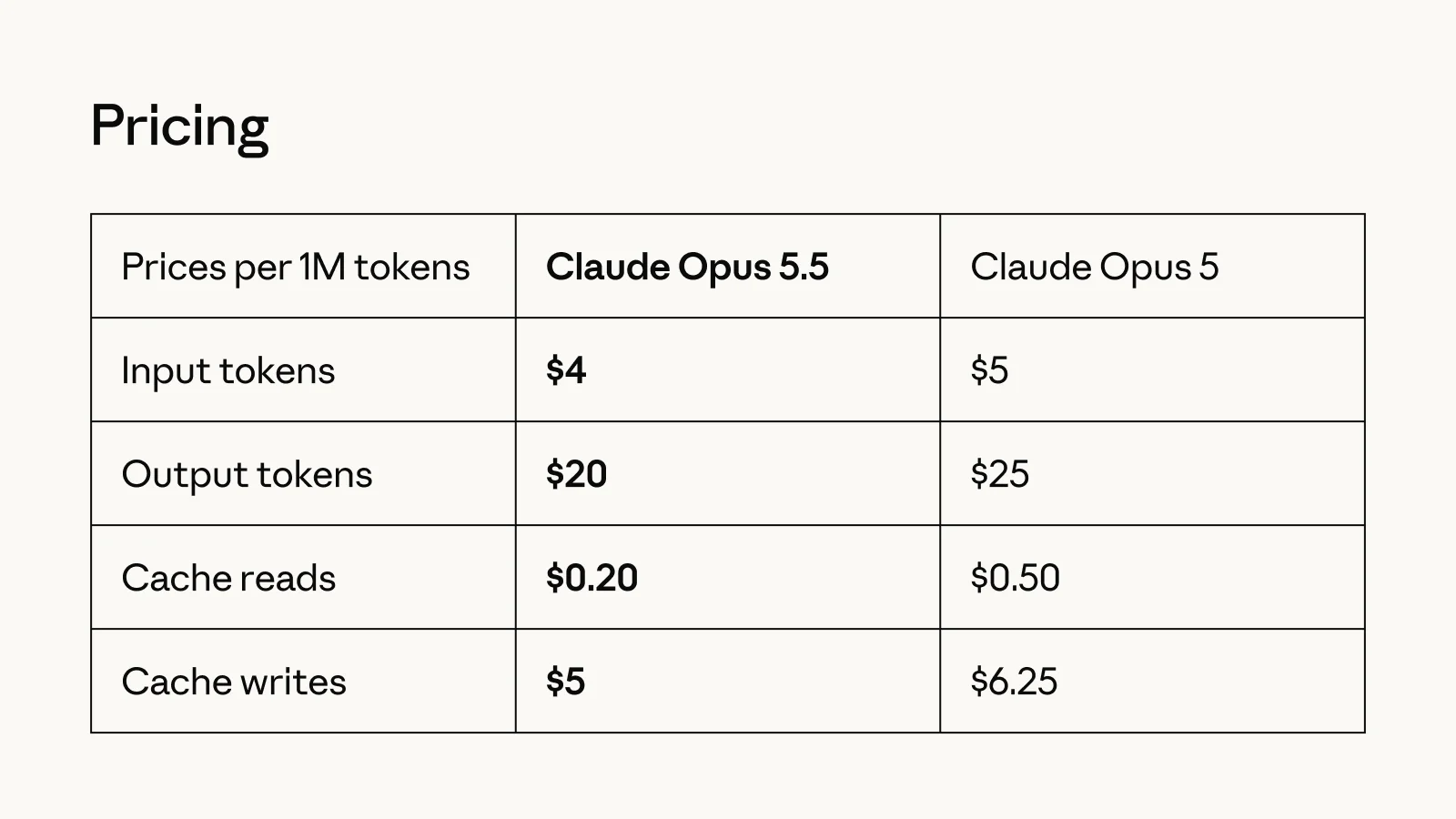
- Cheaper and faster: API input and output prices are 20% lower than Opus 5, and generation is more than 30% faster (official figure).
- Lower default thinking effort: Claude “thinks” before answering. Deeper thinking is usually more accurate, but it is also slower and more expensive. Opus 5.5 defaults to medium effort, which you can raise if needed.
- Claude Code’s default model changed: Claude Code on Pro or Team Standard now uses Opus instead of Sonnet by default.
How to read the benchmarks
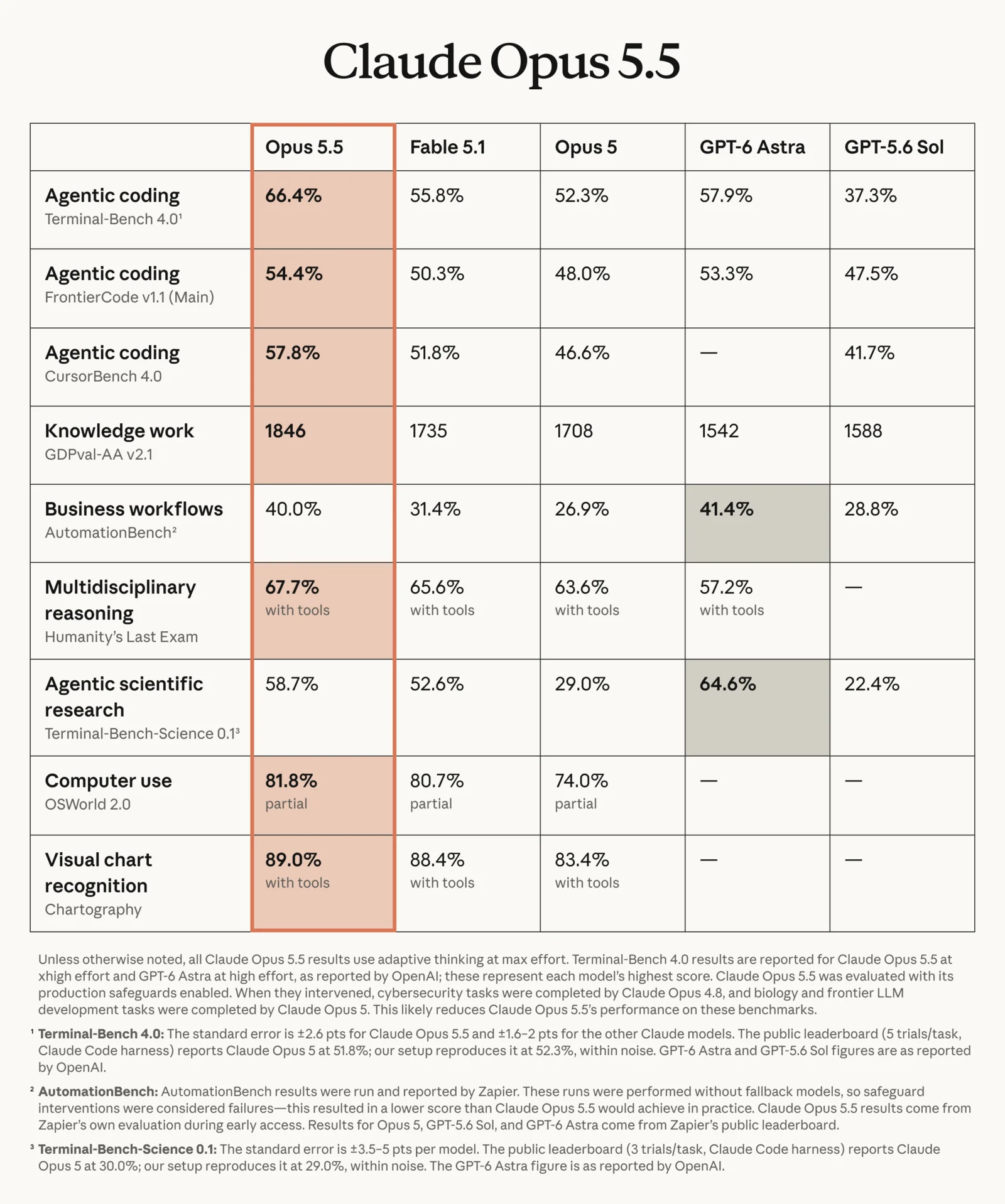
A benchmark gives different models the same tasks and scores their performance. In Anthropic’s nine published tests, Opus 5.5 had the highest score shown in seven, including three tests where GPT-6 Astra had no score. It lost the other two to GPT-6 Astra. Anthropic also cautions that at this capability level, benchmark gaps do not reflect how models feel in real use very well.
Third-party rankings after nearly two weeks
| Leaderboard | What it measures | Opus 5.5 rank and score | Data date |
|---|---|---|---|
| Artificial Analysis | Intelligence index | 1st, 58 points (max, allowing default fallback models) | Checked 2026-10-04 |
| LMArena Text Arena | Votes from human blind tests | 4th (high setting), 1504 points, with the gap from ranks 2 and 3 within the margin of error | 2026-10-02 |
| LMArena WebDev | Human blind tests of website creation | 1st (max setting), 1815 points | 2026-10-01 |
| Vals Index | Practical tasks in fields such as finance and law | 3rd (max, including tasks completed with fallback models), 66.97% | 2026-10-02 |
Effort levels and fallback rules differ across leaderboards, so scores should be read alongside their settings.
Community reviews: praise and complaints
Zvi wrote on LessWrong on September 26 that this was the most consistently positive batch of reactions he had seen (source).
Praise:
- Easy to talk to: It feels more natural than Opus 5. Simon Willison said it “looks like it has addressed the biggest complaint people had about Opus’s communication style” (source).
- Strong at coding and agent tasks: Several developers have made it their default model.
- Fast.
Complaints:
- False positives from safety classifiers: Sensitive tasks are routed to an older model (see “Safety highlights” below), which some users find disruptive.
- High token use at max effort, and tasks sometimes go unfinished: When testing at the max setting, Simon Willison twice received no result.
- Concerns that it was “nerfed”: These began appearing at the end of September. The tests found so far are not enough to confirm a decline.
These are individual impressions and cannot be converted into an overall approval rate.
Pricing and plans
| Item | Opus 5.5 | Opus 5 |
|---|---|---|
| Input | $4/MTok | $5/MTok |
| Output | $20/MTok | $25/MTok |
| Cached read | $0.20/MTok | $0.50/MTok |
MTok means one million tokens. One million input tokens plus one million output tokens costs about $24 with Opus 5.5 and $30 with Opus 5. Cached reads are charges for repeatedly reading the same content and matter most to people running long tasks.
This table shows API billing. Pro and Max subscriptions are monthly plans, so you do not calculate token costs, but usage is capped. The free plan still cannot use Opus 5.5 as of September 2026. Developers can access it through the Claude API, Amazon Bedrock, Google Cloud, and Microsoft Foundry.
Changes developers should know about
General users can skip this section. Developers connecting to the API should note four things before switching models:
- Thinking cannot be turned off; forcing it off returns an error.
- Forcing the model to select a specific tool causes an error; automatic selection works.
- Opus 5.5 cannot read thinking blocks left by Fable.
- The old computer-use tools on the Claude API and Google Cloud have been retired.
Safety highlights
Anthropic publishes a “system card” with each new model to describe its safety tests. The main points this time:
- Good alignment-test results: In the official behavior tests, most misalignment measures were better than those of recent Claude models.
- Prompt-injection regression: If pasted text contains malicious instructions, Opus 5.5 is more likely than before to follow them. With the official safeguards enabled, it generally does not.
- Sensitive questions are routed to another model: In the Claude app, sensitive cybersecurity or biology-related questions are routed to Opus 4.8 or Opus 5, and the interface tells you.
Penchan’s take
Honestly, after spending a day with Opus 5.5, Penchan was a little moved. It finally feels easy to talk to again, like Opus 4.6, rather than sounding like a robot as Opus 5 did. It is also especially smooth for orchestrating other agents. At last, it can spawn subagents to split up the work on its own, something Opus 4.6 handled more awkwardly. It also uses fewer tokens. The most noticeable thing is that those strange “—” marks have finally disappeared from its replies 😭
Penchan will keep testing Opus 5.5 and share more impressions when there are new ones.
The first week’s reviews and the third-party rankings broadly match Penchan’s first-day impression. Keep an eye on safety-based model routing and the cost and reliability of max effort. If you are on a budget, compare it with Sonnet 5.5, whose API input and output prices are half as much.
The people who benefit most directly are those paying Opus 5 prices through the API and people using Claude Code on Pro or Team Standard. Developers should retest the effort level instead of carrying over their old settings.
This article provides consumer information about AI model API billing and subscription plans; it is not securities or investment advice. Actual pricing is determined by Anthropic’s latest official announcements. The information in this article is current as of October 4, 2026 and may become outdated.
Further reading
- Complete Claude Fable 5.1 guide
- Complete Claude Sonnet 5.5 guide
- Claude Opus vs Sonnet: Which one should you use?
- Complete Claude Code guide
- Introduction to Claude Opus 4.8
Cover image source: Anthropic (anthropic.com/claude-opus-5-5)