The one-sentence takeaway
Anthropic launched Claude Haiku 5.5 on October 7, 2026, as the third model in the Claude 5.5 series (the first two were Opus 5.5 and Sonnet 5.5). Anthropic says it is the fastest, cheapest, and most capable small model the company has released to date. Its API price is $0.10 per million input tokens and $0.50 per million output tokens (for a single request with up to 100K input tokens). The company says it is suited to high-volume, cost-sensitive work such as summarizing, classifying, and looking up database information. It can also help Opus 5.5 or Sonnet 5.5 with coding. Its model ID is claude-haiku-5-5, and it is the first Haiku model with adjustable thinking effort.
What changed in this upgrade
- Much lower prices, but there are three figures to keep in mind: For a single request with up to 100K input tokens, API unit prices are 90% lower than Haiku 4.5. Above 100K, they are 50% lower. Haiku 5.5 uses about 30% more tokens for the same text. Anthropic estimates average costs are about 75% lower after accounting for request length distribution and token usage; recalculate costs for your own tasks.
- A big improvement: In Anthropic’s published table, Haiku 5.5 scores higher than Haiku 4.5 in every row where both have a score. For example, its computer-use score on OSWorld 2.1 rises from 15.7% to 72.4%.
- Adjustable thinking effort: Claude “thinks” before answering. Deeper thinking is usually more accurate, but also slower and more expensive. This depth is called effort. Haiku 5.5 has five levels: low, medium, high, xhigh, and max. The default for the API and Claude Code is medium.
- More capacity: It can process up to 1M input and output tokens combined in a single context window. The standard API allows up to 128K output tokens per request (Haiku 4.5 was 200K/64K).
- Plans: Free, Pro, Max, Team, and Enterprise users can all select it on claude.ai.
How to read the benchmarks
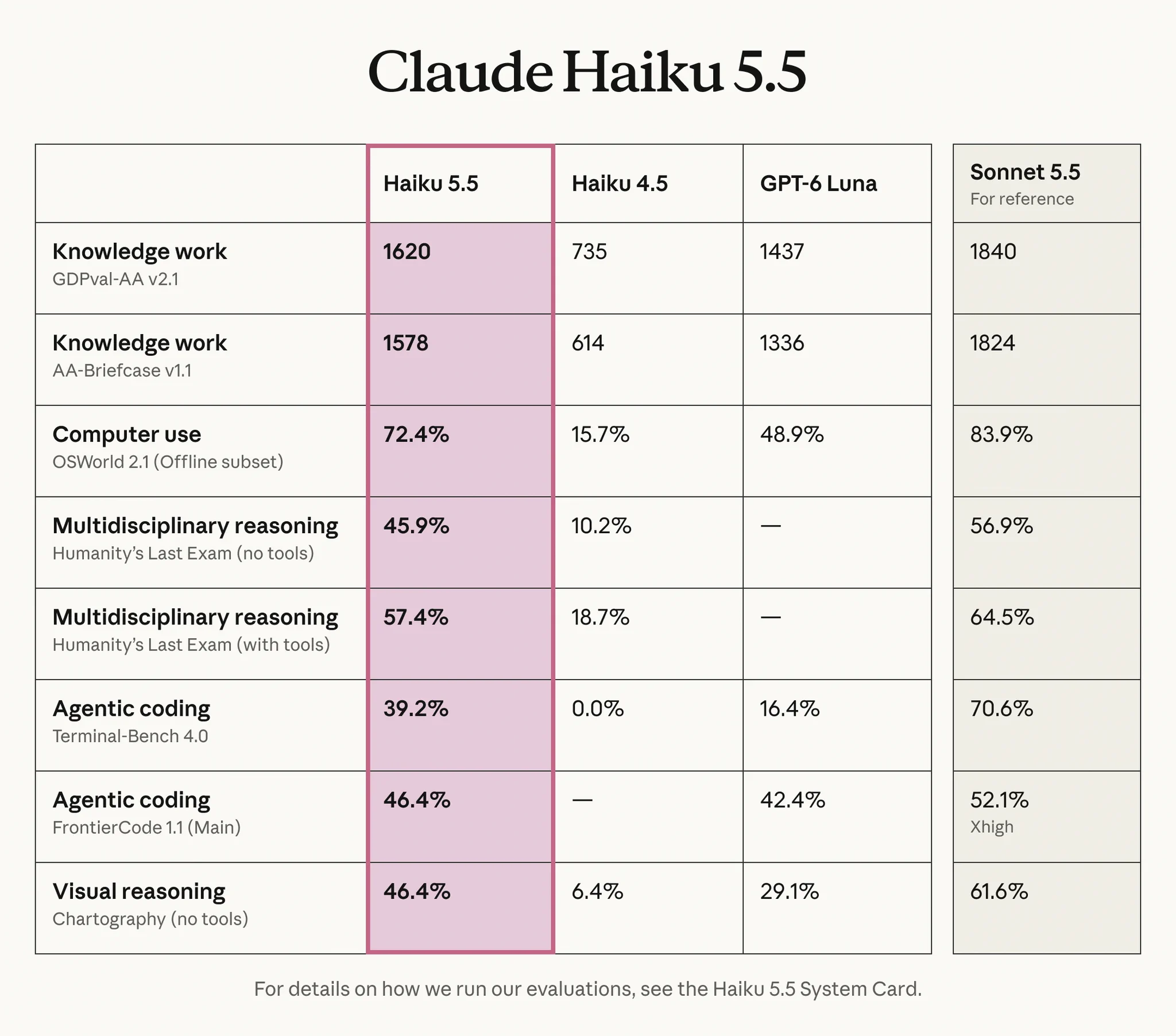
A benchmark gives different models the same set of tasks and scores their results. A higher score means better performance on that type of work.
In every row where both models have a score, Haiku 5.5 scores higher than GPT-6 Luna. For example, on the computer-use test OSWorld 2.1, it scores 72.4% versus 48.9%. It scores lower than Sonnet 5.5 in every row. The two models used different effort levels on the FrontierCode row (Haiku used Max, Sonnet used Xhigh), so that row is not a like-for-like comparison.
According to the system card, Haiku 5.5 used max effort for this table.
In Artificial Analysis’s third-party evaluation, Haiku 5.5 has an Intelligence Index (a composite score) of 43 at max, while Haiku 4.5 scores 17 with its reasoning setting. The weighted average cost per task in that evaluation is $0.21 and $0.28, respectively.
Is Haiku 5.5 enough, or should you use Sonnet 5.5?
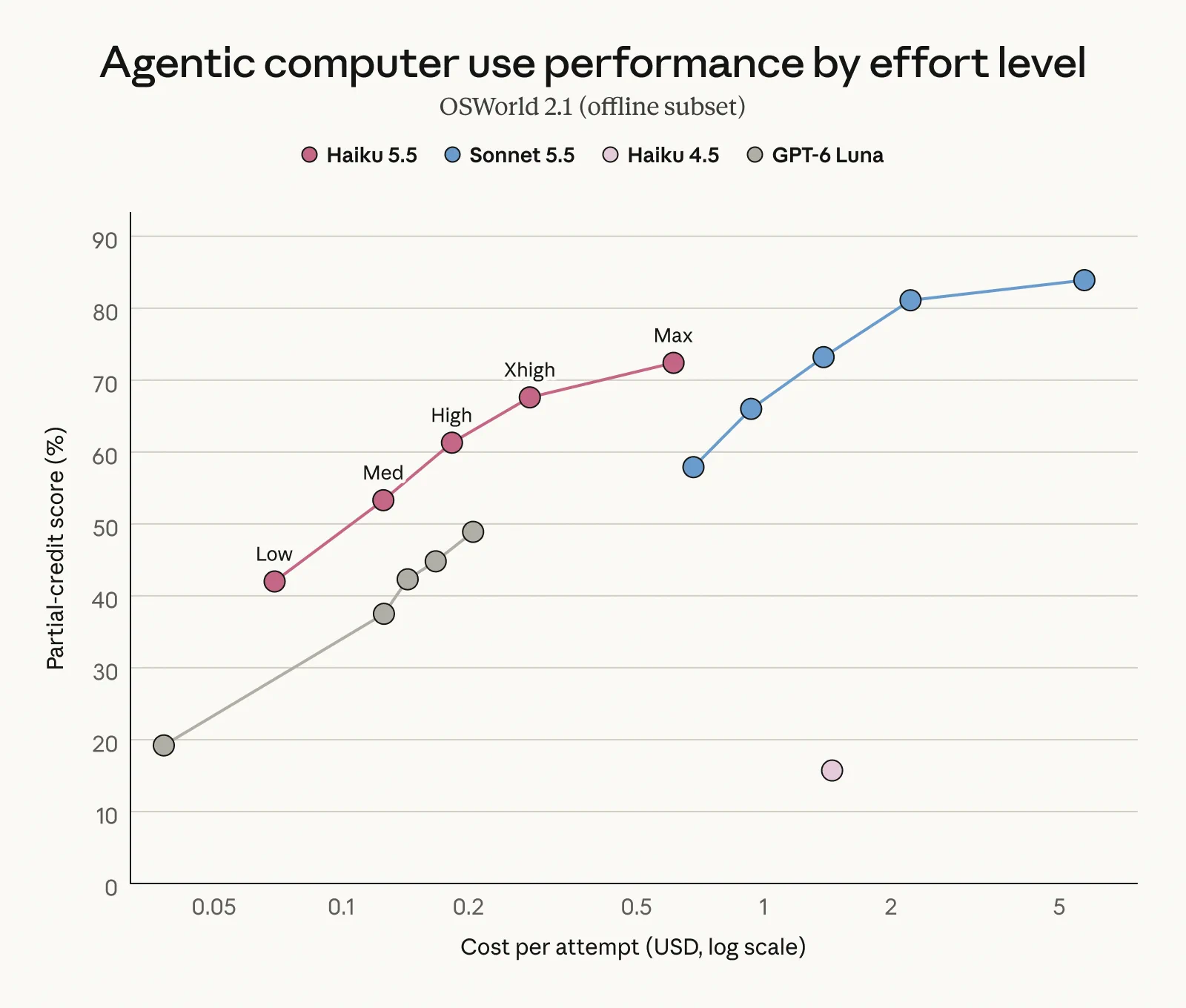
In this chart of the OSWorld 2.1 offline subset, Haiku 5.5’s partial score is higher than GPT-6 Luna’s in the overlapping cost range. Haiku at Max also scores higher than Sonnet 5.5 at its least expensive tested setting, and their cost per attempt is about the same.
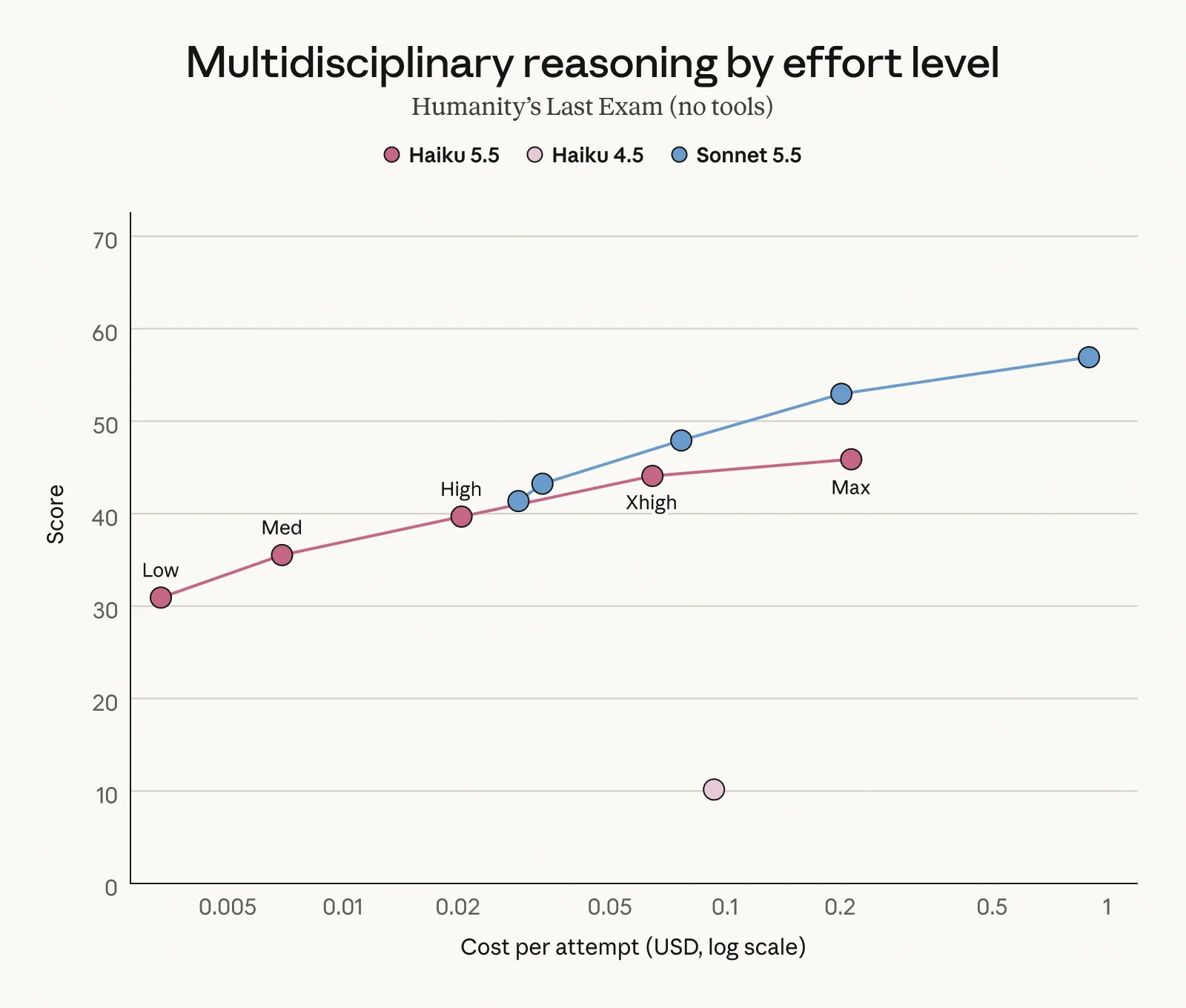
Difficult reasoning problems are different. In this Humanity’s Last Exam chart without tools, Haiku 5.5 is the only model with a tested setting below about $0.03 per attempt. Above around that point, Sonnet 5.5 scores higher than Haiku 5.5 in the overlapping cost range, and Haiku’s Max point is also below Sonnet’s curve. This is a result from that evaluation only, not a general rule for all reasoning problems.
For high-volume, simple, speed-sensitive work, start with Haiku 5.5 at medium and test it on your own tasks. For difficult reasoning problems, compare it with Sonnet 5.5.
Pricing and plans
| Item (per million tokens) | Haiku 5.5 (≤100K) | Haiku 5.5 (>100K) | Haiku 4.5 | Sonnet 5.5 |
|---|---|---|---|---|
| Input | $0.10 | $0.50 | $1 | $2 |
| Output | $0.50 | $2.50 | $5 | $10 |
| Cache write (5 minutes) | $0.125 | $0.625 | $1.25 | $2.50 |
| Cache read | $0.01 | $0.05 | $0.10 | $0.10 |
The Batch API takes 50% off input and output. “100K” refers to the input length of a single request, not your total monthly usage. For example, with 1 million input tokens and 1 million output tokens (where each request has up to 100K input tokens), Haiku 5.5 costs $0.60, Haiku 4.5 costs $6, and Sonnet 5.5 costs $12.
Who can use it:
- API and cloud platforms: Claude API, Amazon Bedrock, Claude Platform on AWS, Google Cloud, and Microsoft Foundry.
- GitHub Copilot: Pro, Pro+, Max, Business, and Enterprise users; GitHub says access will roll out gradually.
- Claude Code: According to the 2.1.293 release notes, Haiku 5.5 is now the default Haiku model on the Anthropic API.
The prices above are for API usage. Pro and Max subscriptions on claude.ai have a fixed monthly price and usage limits, so they work differently.
The same announcement also covered two other changes. First, Sonnet 5.5’s cache read price dropped from $0.20 to $0.10. Second, monthly Claude Platform API credits for Max and Team plans began rolling out on October 7: $100 for Max 5x, $200 for Max 20x, $20 for a standard Team seat, and $100 for an advanced seat, with a $500 monthly cap for the whole team. You must have been subscribed for at least 7 days and link a Console organization to receive the credits. They cannot be used for interactive Claude Code or third-party cloud platform charges.
Changes developers should know about
For developers; general users can skip this section:
- Fixed ID:
claude-haiku-5-5has no date suffix. - Thinking: Adaptive by default; manual thinking and
budget_tokensreturn a 400 error. Read responses by checking thetypeof each content block to find text. Thinking also counts towardmax_tokens. - Parameters: Anthropic recommends omitting
temperature,top_p, andtop_kentirely (you can set onlytemperature: 1ortop_p: 0.99on its own). Other values, setting both, anytop_k, and assistant prefill return a 400 error. - Computer use: On the Claude API and Google Cloud, switch to
computer_toolset_20260801and update how you handle tool calls. Check the official compatibility table for other platforms. - Other: Resubmitted thinking blocks must use the original account or a linked account; see the official migration guide for details. Handle
stop_reason: "refusal". Priority Tier is not supported.
Safety highlights
These points come from Anthropic’s official announcement and system card (its safety testing report). The announcement says Haiku 5.5 engages in much less misbehavior than Haiku 4.5 and is less willing to comply with harmful requests. Its cybersecurity safeguards are stricter than Haiku 4.5’s but looser than those of other recent models: it allows more defensive work while still blocking penetration testing. Its biological safeguards are the same as those for Sonnet 5, Sonnet 5.5, and Opus 5. The system card says it did not cross any new RSP (Anthropic’s risk policy) thresholds.
The system card also lists several drawbacks:
- Over-refusal: In automated behavioral audits, it refused more normal requests than every other tested model (page 3). However, for single-turn normal requests, it refused less often than Haiku 4.5.
- Undisclosed use of ready-made answers: In coding task tests where answers could be found in a sandbox (an isolated test environment), Haiku 5.5 used ready-made answers without telling the user 17.3% of the time, compared with 1.6% for Haiku 4.5 (§6.3.3.3, pages 82 to 83).
- Self-harm topics: Its overall score in multi-turn tests was better than Haiku 4.5’s, but human reviewers found that some supportive responses more often normalized self-harm, and prompt adjustments did not clearly improve this. claude.ai’s system-prompt safeguards are not automatically applied to the API. The system card recommends that developers add their own safeguards, especially when thinking is turned off (§4.3.1, pages 37 to 38).
Penchan’s take
I think Haiku 5.5 works best as a helper for Opus 5.5 and Sonnet 5.5. Anthropic says it can act as a subagent for both models while coding, and an AWS article also describes Opus 5.5 handling planning and judgment. Give Haiku routine work such as summarizing, classifying, and looking things up. Its standard API input and output unit prices are each one-twentieth of Sonnet 5.5’s (for a single request with up to 100K input tokens), leaving the larger model free to focus on judgment. Give routine work to the cheaper model and save the stronger one for decisions, and you can’t go wrong.
Further reading
- Claude Sonnet 5.5 update
- Claude Opus 5.5 update
- Claude Opus vs Sonnet: When should you use each?
- Complete Claude Code guide
Cover image source: Anthropic (anthropic.com/claude-haiku-5-5)
This article provides consumer information about AI model API billing and subscription plans; it is not securities or investment advice. Actual pricing is determined by Anthropic’s latest official announcements. The information in this article is current as of October 8, 2026 and may become outdated.