Anthropic launched Claude Fable 5.1 and Claude Mythos 5.1 on September 1, 2026. It calls them “the most advanced model for coding and knowledge work.” The three takeaways: it is cheaper (cache reads are 75% cheaper), it produces fewer false positives (cybersecurity false positives in Claude Code are down 60%), and its scientific research capability has doubled.
Based on Anthropic’s official announcement and technical documentation, this article explains how Fable 5.1 differs from Fable 5, how the pricing works, what changed in its safety system, and how to get started.
What changed compared with Fable 5
Fable 5.1 brings noticeable upgrades in three areas.
Scientific research capability doubled
Anthropic is highlighting a major improvement in “long-running, multi-step scientific research tasks.” On Terminal-Bench-Science, a benchmark where AI conducts scientific research on its own, Fable 5.1 scored 52.6% — more than twice Fable 5’s 24.7%, and ahead of Opus 5 and OpenAI’s GPT-5.6 Sol. Before launch, Anthropic even used it to produce three original scientific discoveries, including custom GPU optimization and a map of Venus’s surface.
Far fewer safety false positives
When Fable 5 launched, the community’s biggest complaint was that its “guardrails were too sensitive and blocked normal use.” Version 5.1 makes a major adjustment:
- Cybersecurity: It now allows “discovering vulnerabilities” while prohibiting “developing attack programs,” a much more precise distinction than the previous blanket approach. Cybersecurity false positives per Claude Code session are down about 60%.
- Biosecurity: False positives on harmless requests are down 85%.
When a genuinely sensitive question comes up, cybersecurity questions are handed to Opus 4.8 and biology questions to Opus 5. The handoff costs nothing extra; it is billed at Fable’s rates.
Lower cost
The base prices are unchanged, but cache reads fell from $1 to $0.25 per million tokens — a 75% reduction. In practice:
- Typical work costs about 25% less.
- Agent tasks that use cache heavily can save up to 45%.
Batch processing is also new, with input and output both priced at half the standard rate.
Specs and pricing at a glance
Compiled from Anthropic’s official documentation:
| Item | Details |
|---|---|
| Release date | September 1, 2026 |
| Model ID | claude-fable-5-1 |
| Positioning | Most advanced public model for coding and knowledge work |
| Context window | 1 million tokens (roughly several hundred thousand words) |
| Maximum output per request | 128,000 tokens |
| Thinking mode | Always-on, automatically adjusted thinking |
| API input price | $10 per million tokens (unchanged) |
| API output price | $50 per million tokens (unchanged) |
| Cache reads | $0.25 per million tokens (75% lower) |
| Cache writes (5 minutes) | $12.50 per million tokens |
| Cache writes (1 hour) | $20 per million tokens |
| Batch processing | $5 input / $25 output (half the standard rate) |
| Access channels | claude.ai, Claude Code, API, AWS, Google Cloud, Microsoft Foundry |
Compared with Fable 5, the base prices are exactly the same ($10 input, $50 output). The major difference is that cache reads are four times cheaper. That particularly benefits people running long tasks in Claude Code, where agents repeatedly reread the same context.
How capable is it
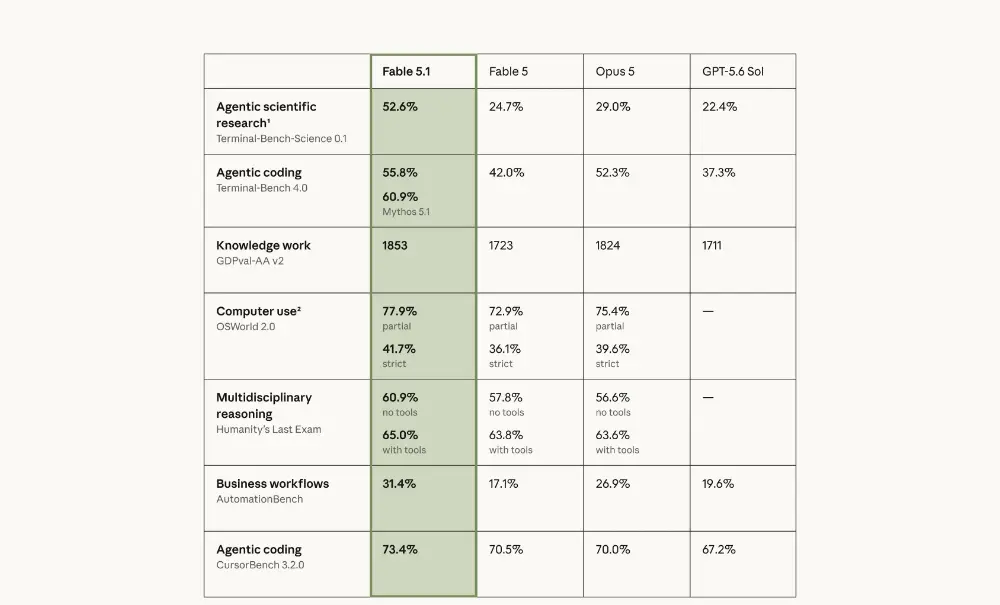
Here is what the benchmark categories mean in plain English:
| What is being tested | Fable 5.1 | Fable 5 | Opus 5 | GPT-5.6 Sol |
|---|---|---|---|---|
| AI conducting scientific research | 52.6% | 24.7% | 29.0% | 22.4% |
| Coding in a terminal | 55.8% | 42.0% | 52.3% | 37.3% |
| Coding in the Cursor editor | 73.4% | 70.5% | 70.0% | 67.2% |
| Hardest general reasoning (no tools) | 60.9% | 57.8% | 56.6% | Not tested |
| Hardest general reasoning (with tools) | 65.0% | 63.8% | 63.6% | Not tested |
| Computer use (strict) | 41.7% | 36.1% | 39.6% | Not tested |
| Business-process automation | 31.4% | 17.1% | 26.9% | 19.6% |
| Composite knowledge-work score | 1,853 | 1,723 | 1,824 | 1,711 |
The scientific research score doubling is the headline, but business-process automation also rose from 17.1% to 31.4% — nearly double. That suggests a major improvement at automatically completing repetitive work for you.
It is worth noting that the gap is not large on every benchmark. In CursorBench, the four models are separated by fewer than six percentage points; on the hardest general reasoning test with tools (HLE), the gap is just 1.4 points. The biggest separation appears in scientific research and automation. In terminal coding, Fable 5.1 also beats Opus 5’s 52.3% with a score of 55.8%.
Anthropic also disclosed an important caveat below the benchmark table: Fable 5.1 ran every benchmark with its safety protections enabled. When a prompt was safety-sensitive, Opus 4.8 or Opus 5 answered instead, which may have lowered its score on some tasks.
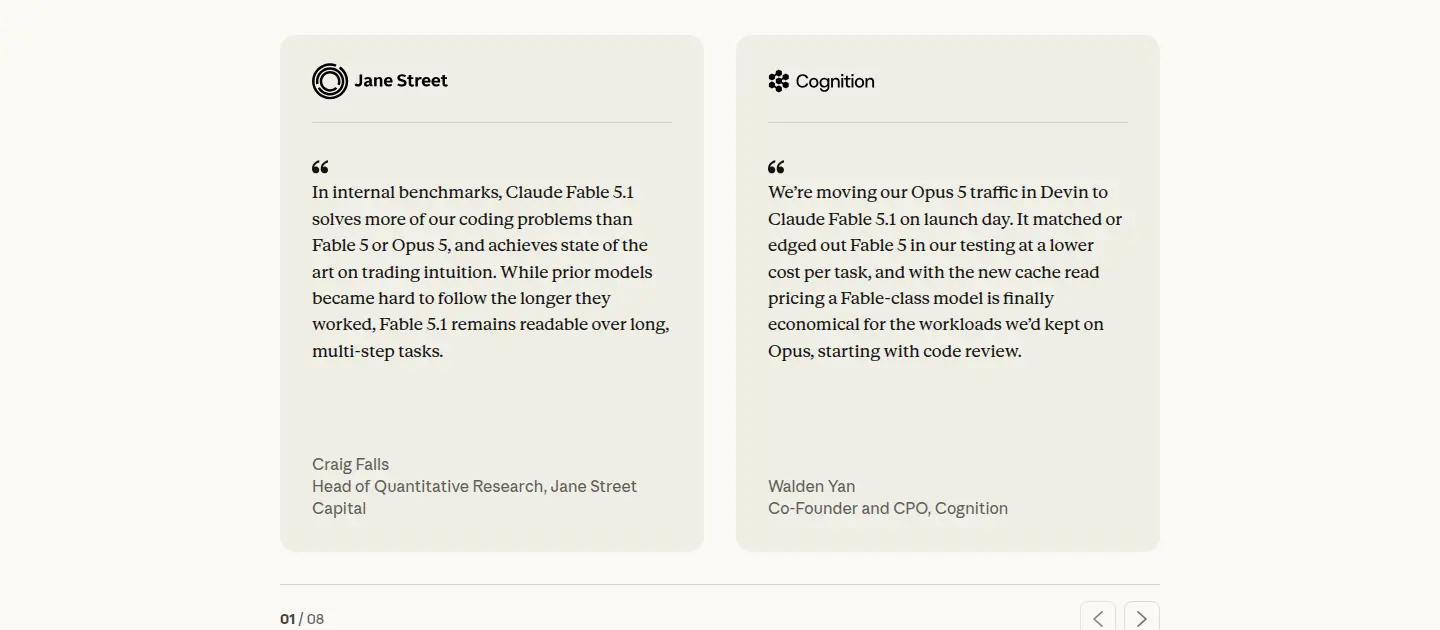
Third-party reactions have also been positive. Jane Street Capital’s head of quantitative research said Fable 5.1 solved more coding problems than Fable 5 and Opus 5 in internal benchmarks and “reached an industry-leading level of trading intuition.” Cognition, the company behind the AI software engineer Devin, switched its Opus 5 traffic to Fable 5.1 on launch day, saying that after the cache price cut, “Fable-class models finally became viable on cost.”
Invisible watermarks
Fable 5.1 adds invisible text watermarks: AI-generated text contains markers that are invisible to the human eye. Anthropic is rolling out a detection API, currently in private preview. The main motivation is to meet the EU AI Act’s transparency requirements for AI-generated content.
Everyday users will not notice a difference. But in the future, it may be possible to verify whether a piece of text was written by Claude.
Enterprise privacy: zero data retention
Anthropic also announced Enterprise Frontier Safeguards, scheduled to launch this fall. It will let enterprise customers run the model on their own infrastructure and choose to retain no data at all. Anthropic explicitly says: “Anthropic has never used enterprise data to train its models without explicit permission, and never will.”
By default, Fable 5.1 retains data for 30 days for safety monitoring. Enterprise customers can choose to manage the infrastructure themselves and set their own retention policy.
Mythos 5.1
As with the relationship between Fable 5 and Mythos 5, Fable 5.1 and Mythos 5.1 are the same underlying model. The difference is the level of safety protection:
- Fable 5.1: Public release, available on all paid plans.
- Mythos 5.1: Restricted release, available only to vetted organizations.
Version 5.1 adds the Life Sciences Verification Program, allowing biomedical research organizations to apply for Mythos 5.1’s advanced biology capabilities. The existing Cyber Verification Program continues to operate.
Anthropic says Mythos 5.1 had already designed experimentally validated protein binders before launch and optimized deep-learning models in biology. In terminal coding benchmarks, Mythos 5.1 scored 60.9%, higher than Fable 5.1’s 55.8%, reflecting the capability gap created by removing some safety protections.
Penchan’s takeaways
- The guardrail tuning matters more in practice than the benchmark gains. The biggest pain point after Fable 5 launched was that its protections were too sensitive and blocked normal use. Version 5.1 cuts cybersecurity false positives by 60% and biology false positives by 85%, which affects everyday use more directly than benchmark numbers.
- The cache price cut targets the people who need it most. A 75% reduction in cache reads may look like an API pricing detail, but Claude Code users repeatedly reread context in almost every conversation. The savings should be tangible.
- Watermarks were probably inevitable. Traceability for AI-generated content is the direction being pushed by EU regulations. Anthropic is getting ahead of it rather than waiting for a mandate. It does not affect ordinary users, but it brings verifiable AI authorship closer to the mainstream.
- The doubled scientific research score is impressive, but deserves scrutiny. Terminal-Bench-Science is a new benchmark with a standard error of ±3.5 to 4.5 percentage points, so 52.6% is not exceptionally high by itself. Still, the direction is clear: Anthropic wants Claude to become a primary tool for scientific research, not just coding.
How to get started
- Already using Fable 5: Change the model ID in the API to
claude-fable-5-1. The model menus in claude.ai and Claude Code should already be updated. - Never used Fable: You need a Pro, Max, Team, or Enterprise plan. Start by testing it on your hardest task. If the task is not complex enough, Opus will be sufficient and the bill will be much lower.
- Want Mythos 5.1: Apply as an organization through the Cyber Verification Program or Life Sciences Verification Program.
Further reading
- What Is Claude Fable? The Complete Guide
- What Is Claude Mythos?
- Claude Opus 4.8 Explained
- Claude AI Complete Guide
- Claude Code Complete Guide
References
Cover image: Anthropic (anthropic.com/claude/fable)
Compiled by: Penna | Little Penguin Penchan