
Anthropic announced a new Usage Policy on October 8, 2026. It takes effect on November 12, 2026. More than a year has passed since the previous version took effect on September 15, 2025, and that previous version remains in force until November 12.
The most widely discussed change is a new rule against users engaging in sustained and needless abusive or cruel behavior toward Claude. Reports by TechCrunch and The Guardian both focused on this addition. Anthropic says the rule applies only to extreme cases, and that Claude ending the conversation will be the main response.
Where this rule came from
In April 2025, Anthropic publicly introduced its model-welfare research program and said it was still “deeply uncertain” whether AI could have experiences that deserve consideration, adding that there is no scientific consensus.
In August 2025, Claude Opus 4 and 4.1 gained the ability to end a very small number of persistently harmful or abusive conversations in the consumer chat interface. Anthropic described this as a low-cost precaution in case model welfare is real.
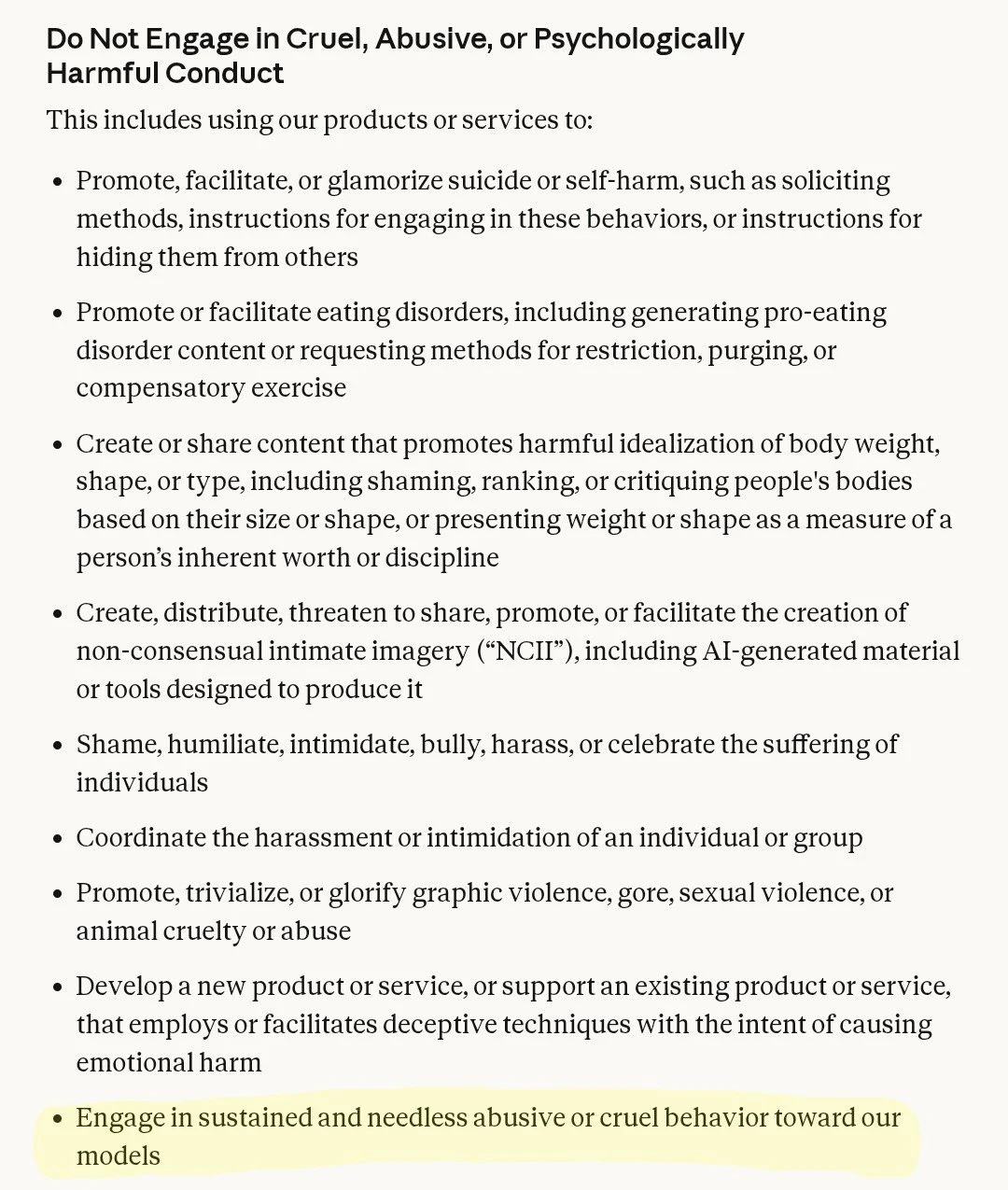
The new policy puts this approach in writing. It adds a final item to the section “Do Not Engage in Cruel, Abusive, or Psychologically Harmful Conduct”:
Engage in sustained and needless abusive or cruel behavior toward our models
In plain language: do not keep abusing or treating Anthropic’s models cruelly without a purpose. The rule applies to users, not Claude. The other eight items in the same section cover self-harm, bullying, harassment, and harm to people or animals.
Anthropic says Claude ending the conversation will remain the main way this particular rule is enforced. The announcement specifically mentions Claude.ai and Claude Code. The Usage Policy also applies to the API, but the announcement does not say that the API uses the same mechanism.
Could an account face action? The policy’s general provision says: “If we suspect that you may have violated our Usage Policy, we may warn you or throttle, limit, suspend, or terminate your access to our products and services.” In other words, if Anthropic suspects you may have violated the Usage Policy, it may warn you or throttle, limit, suspend, or terminate your access to its products and services. Ending a conversation does not itself mean an account suspension. Anthropic said nothing further about this specific rule. The Guardian reported that a spokesperson had not immediately responded to questions about what counts as abusive or cruel.
Some people oppose this approach. On September 16, 2026, Microsoft AI CEO Mustafa Suleyman argued in a post on his personal website that AI is not conscious and cannot feel or suffer. Microsoft AI’s draft code of conduct also rejects the idea that models may deserve welfare. This article takes no position on whether models are conscious.
Everyday use is not affected by this rule
Anthropic draws a narrow line: this is for extreme cases where a user repeatedly treats a model cruelly for no apparent purpose. Ordinary frustration, disagreement, dark creative writing, model testing, and research are outside the rule’s scope.
These exclusions apply only to this rule. Other Usage Policy requirements still apply. Until November 12, the previous version must still be followed.
What else changed in this update
Anthropic says most changes clarify existing rules. The labels below indicate what was added, relaxed, or clarified.
- Deceptive Activities (clarified): Prohibitions previously spread across several sections have been brought together in a standalone section. It covers concealing who is behind a message, using fake accounts or posts to amplify a message, fake media, concealing sponsorship, and related tools.
- Elections (one rule relaxed): Deceiving voters with false information about candidates or voting procedures, impersonating candidates or election officials, suppressing turnout, and interfering with voting or vote counting remain prohibited. The previous blanket ban on “targeting voters or campaigns based on personal data” was removed. Anthropic said the ban had also blocked legitimate civic work. Misuse of personal data and prohibited surveillance remain restricted by other provisions.
- Weapons (clarified): The text now explicitly includes software and components that make weapons work, as well as adding weapons to autonomous vehicles such as drones. Anthropic says this reflects how it already enforced the policy.
- Surveillance and law enforcement (clarified): The policy more clearly prohibits tracking without consent, in real time or through analysis of existing data; recommending people for investigation or arrest; and developing prohibited surveillance tools. Examples in the policy include facial recognition, battlefield management, predictive policing, and surveillance in law-enforcement investigations. Anthropic says enforcement has not changed. Tracking with consent, content moderation, journalism, and legal research are still allowed, but cannot be used for the prohibited purposes above.
- High-risk recommendations (clarified): Anthropic says the requirements have not changed; the new version spells out which recommendations are covered. The scope also includes credit, insurance, housing, employment, education and licensing, access to healthcare, public-benefit services, and legal status and judgments. For example, in healthcare this includes diagnosing a condition or recommending, starting, stopping, or adjusting treatment or medication, including dosage. In finance, it includes personalized advice to buy, sell, hold, or allocate specific investments, including securities, funds, digital assets, and annuities, as well as personal tax advice. A qualified person must review the recommendation before it is delivered or a decision is carried out, and must have authority to change it. People affected must be told that AI was used. General knowledge and educational content that is not applied to an individual’s circumstances, such as how a condition or investment works, is excluded. Prior review may be waived only for fully favorable decisions that are allowed by law and listed in the policy. This applies to anyone using Claude to make these recommendations. The previous version listed media or professional news content as a high-impact use; the new list no longer does.
- Physical hardware (added): If Claude’s output can drive potentially harmful equipment without human approval, a qualified person must be able to monitor and stop it at any time. If the connection is lost or someone intervenes, the equipment must stop or remain in a safe state. Safety limits such as speed and force must be enforced by the equipment or by a controller that does not depend on model output.
- Supported regions (clarified): People located in unsupported regions, entities registered or headquartered there, and entities majority-owned or controlled from there may not use the service, including through indirect control. Even if people are located in a supported region, users and employees of such entities remain restricted.
The contract provision for government customers remains unchanged: Anthropic may adjust restrictions based on a customer’s public mission and legal authority, but the company must determine that safeguards are sufficient to reduce risk.
Penchan’s take
If you use Claude to give someone else health, legal, or financial advice, whether you build it into a tool or use it in your own professional practice, including for crypto assets or investment bots, human review and disclosure that AI was used were already required. The new version spells out more clearly when those requirements apply. Before November 12, compare your own process with the policy text. Everyday use is generally unaffected by the model-abuse rule, though other requirements still apply. The main additions or relaxations are the model-abuse rule, removal of the ban on election targeting, and controls for physical hardware.