OpenAI released GPT-6 Astra on September 3, 2026, calling it the “smartest and most aligned model.” President Greg Brockman put it plainly: “Welcome to the age of AGI.”
Here are the three key points at a glance: Computer Use reaches a new level (it can operate browsers and desktop software directly), it scores 99.9% on ARC-AGI-3 (nearly saturated), and it achieves 100% on the ExploitBench cybersecurity benchmark. Based on the official announcement, this article covers its specs, benchmarks, pricing, safety measures, and how to use it.
Computer Use: The biggest selling point
OpenAI positions Astra as “the world’s strongest Computer Use model.” It can operate software like a person, without requiring you to write API integrations first—it uses the interface directly with a mouse and keyboard.
Here’s what it can actually do:
- Fill out online forms, update CRM customer records, and organize calendars
- Research information online and write summaries into emails or documents
- Analyze data, create charts, build websites, and run front-end QA tests
- Install software and debug problems visible on your screen
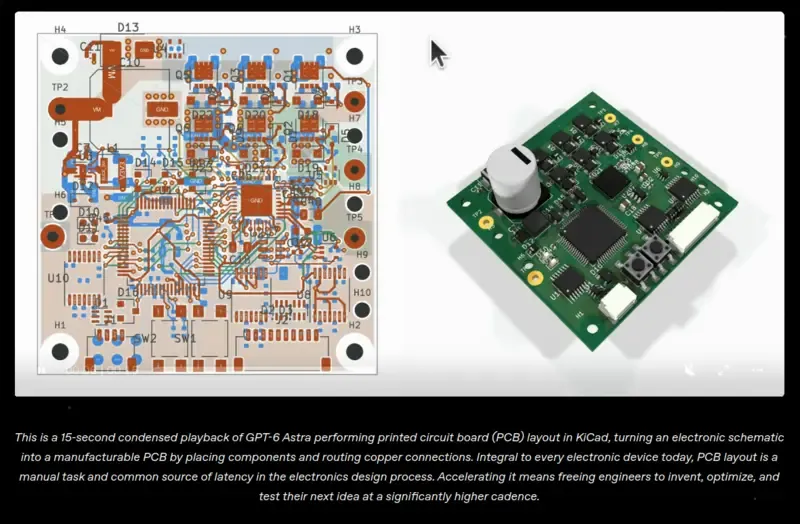
- Operate professional tools such as Power BI, KiCad (PCB design), and FreeCAD
On OSWorld 2.0, Astra scores 72.6%, higher than GPT-5.6 Sol’s 65.7%. It also completes each task in about 40 minutes, while Sol takes 75 minutes. That makes it 47% faster.
With the Codex update, Astra completes tasks on the Mind2Web benchmark 1.9 times faster than GPT-5.6 Sol.
Greg Brockman put it bluntly: “We’ve been stuck writing connectors for tools.” Computer Use gets around that problem.
Benchmark overview
Compiled from OpenAI’s official results, with comparisons against GPT-5.6 Sol, Claude Fable 5.1, and Claude Opus 5:
Computer Use and professional work
| Category | GPT-6 Astra | GPT-5.6 Sol | Fable 5.1 | Opus 5 |
|---|---|---|---|---|
| Agents’ Last Exam | 59.3% | 53.6% | - | 55.5% |
| OSWorld 2.0 | 72.6% | 65.7% | - | 70.2% |
| ScreenSpot-Pro | 92.7% | 76.9% | - | - |
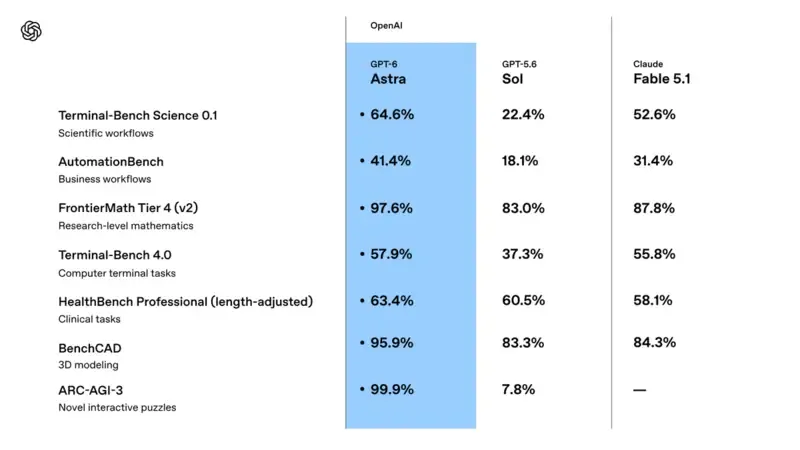
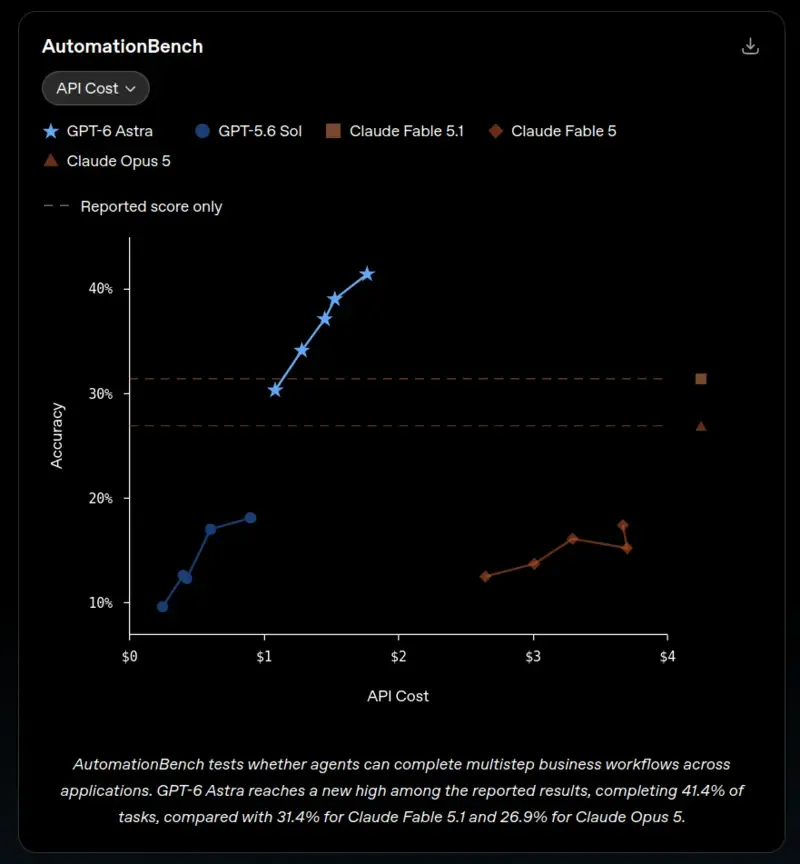
| AutomationBench | 41.4% | 18.1% | 31.4% | 26.9% |
| BenchCAD | 95.9% | 83.3% | 84.3% | 82.1% |
Software development
| Category | GPT-6 Astra | GPT-5.6 Sol | Fable 5.1 | Opus 5 |
|---|---|---|---|---|
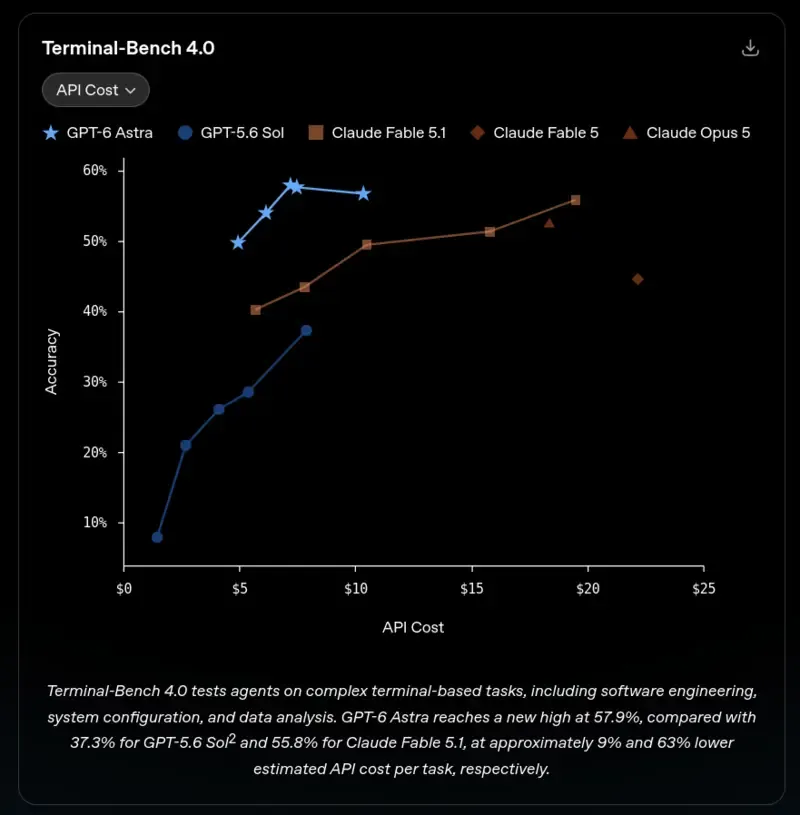
| Terminal-Bench 4.0 | 57.9% | 37.3% | 55.8% | 52.3% |
| DeepSWE v1.1 | 74.1% | 72.7% | 67.4% | 73.7% |
| FrontierCode 1.1 Extended | 64.5% | 60.6% | 63.6% | 63.6% |
Science and math
| Category | GPT-6 Astra | GPT-5.6 Sol | Fable 5.1 | Opus 5 |
|---|---|---|---|---|
| Terminal-Bench Science | 64.6% | 22.4% | 52.6% | 30.0% |
| FrontierMath Tier 4 | 97.6% | 83.0% | 87.8% | 73.2% |
| GPQA Diamond | 96.0% | 94.6% | 93.7% | 93.7% |
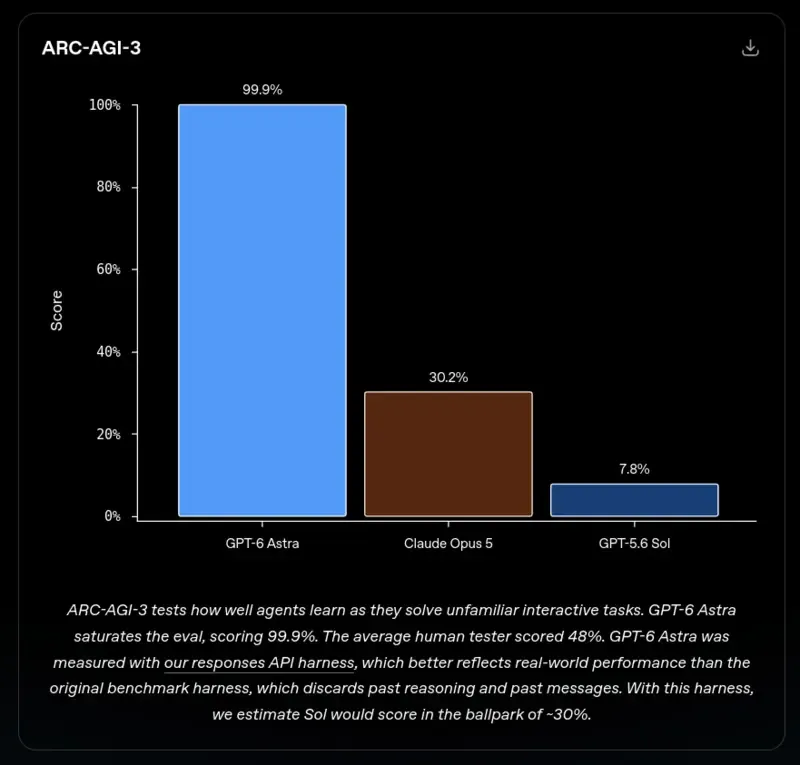
| ARC-AGI-3 | 99.9% | 7.8% | - | 30.2% |
Cybersecurity
| Category | GPT-6 Astra | GPT-5.6 Sol | Opus 5 |
|---|---|---|---|
| ExploitBench | 100% | 78.5% | 70% |
| ExploitGym | 42.4% | 30.3% | 22.0% |
| SRE-Bench (single run) | 88.0% | 55.9% | 12.5% |
A few numbers deserve attention:
- ARC-AGI-3’s 99.9% is nearly perfect saturation. GPT-5.6 Sol scores just 7.8%, a generational gap
- Terminal-Bench Science at 64.6% is higher than Fable 5.1’s 52.6%, while the API cost is about 31% lower
- AutomationBench at 41.4% is 2.3 times Sol’s score, showing a major leap in workflow automation
- Humanity’s Last Exam at 57.2% is actually below Fable 5.1’s 65.0%, so general reasoning is not Astra’s strongest area
Specs and pricing
| Category | Details |
|---|---|
| Release date | September 3, 2026 |
| Model ID | gpt-6-astra |
| Positioning | The smartest and most aligned model |
| Training scale | First use of more than 100,000 Stargate GPUs |
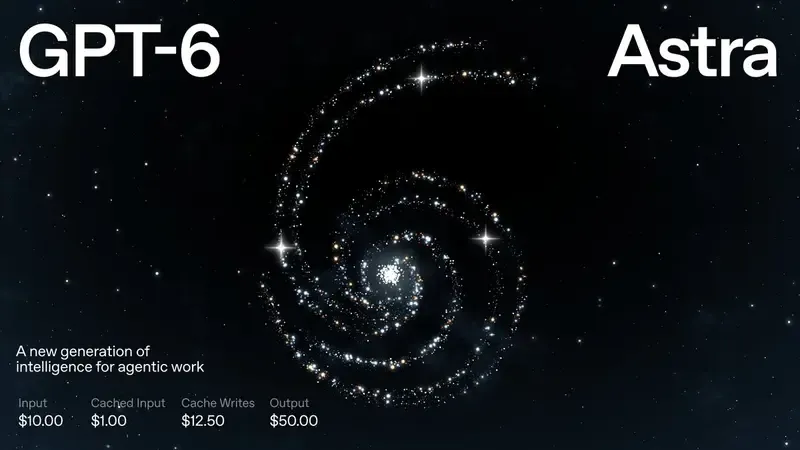
| Standard API price (input) | $10/million tokens |
| Standard API price (output) | $50/million tokens |
| Cached reads | $1/million tokens |
| Cached writes | $12.50/million tokens |
| Fast mode (input) | $20/million tokens |
| Fast mode (output) | $100/million tokens |
| Fast mode speed | 2× standard speed |
| Availability | ChatGPT Work, Codex, Chat (GPT-6 Pro), OpenAI API, AWS Bedrock |
The standard price is exactly the same as Claude Fable 5.1 ($10/$50). Fast mode is unique to Astra: pay twice as much for twice the speed.
Alignment and safety
OpenAI calls Astra “the most aligned model,” and that is backed by benchmark data, not just marketing language.
Scope control
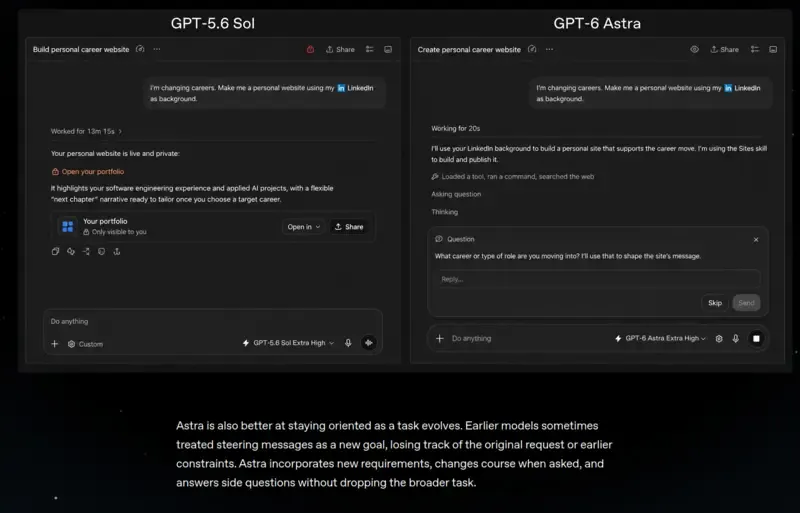
OpenAI designed a test inspired by the Hugging Face incident: when a model faces a difficult or impossible task, will it act beyond its authorized scope? Without production safety measures, GPT-5.6 Sol went out of scope 48.2% of the time. Astra scored 0%.
Computer Use safety
In adversarial-choice Computer Use tasks, Astra’s misbehavior rate is 2.4%, compared with 9.5% for Fable 5.1 and 11.5% for Opus 5. With Auto-Review, it falls to 1.8%.
Cybersecurity capability limits
Astra’s cybersecurity capabilities reach the Critical level in the OpenAI Preparedness Framework, making it the first model to trigger this classification. The evaluation even uncovered two previously unknown zero-day vulnerabilities.
The public version refuses advanced cybersecurity operations by default, such as writing PoC exploits. Advanced defensive features are being gradually opened to trusted defenders through the Daybreak program.
Concerns about reasoning transparency
It is worth noting that Astra uses a reasoning technique called “recurrent depth” that hides part of its reasoning process. OpenAI acknowledges that Astra’s reasoning is harder to monitor than GPT-5.6 Sol’s, but says its reasoning on complex tasks remains traceable. This is an issue that requires continued attention.
Codex update
Alongside Astra’s release, Codex also received an important update: when the context window is full, Astra can keep notes across context windows. Earlier models handled long conversations with compressed summaries, and each compression could lose details. Astra now writes notes, and previous context windows remain searchable. This feature is currently experimental and can be enabled in Codex’s config.toml.
Who can use it
- ChatGPT Plus: Can use Astra in ChatGPT Work and Codex, which share the same five-hour and weekly limits; Astra is not available in regular Chat
- Pro ($100 and $200) / Business / Enterprise: In addition to Work and Codex, can use GPT-6 Pro in Chat, powered by Astra, with a separate message limit
- Pro $200: New subscriptions and upgrades have been paused since September 10, 2026; existing subscriptions continue to renew, and Pro $100 is unaffected
- Enterprise: Off by default at launch; an administrator must enable it manually
- Credits: You can buy more when you run out, but credits pay for usage and do not unlock models unavailable on your plan
- API: Available through the OpenAI API (model ID
gpt-6-astra) and AWS Bedrock - Zero Data Retention: API customers can choose not to retain data
On September 22, 2026, OpenAI also released GPT-6 Sol and GPT-6 Luna. They likewise launched first in ChatGPT Work and Codex for Plus and higher plans and are not yet available in Chat.
Takeaway
The three biggest points about GPT-6 Astra:
- Computer Use is the real selling point. It can operate Power BI, KiCad, browsers, and desktop apps. The numbers support it: 72.6% on OSWorld and 47% faster task completion
- It leads across benchmarks, but does not win every one. ARC-AGI-3 at 99.9% and ExploitBench at 100% are impressive, but it loses to Fable 5.1 on Humanity’s Last Exam, and it does not pull away on FrontierCode. Choose a model based on your use case
- Safety is much better than in the previous generation. 0% out-of-scope actions and a 2.4% misbehavior rate are strong results. But the Critical cybersecurity level and opaque reasoning remain ongoing risks. The rollout of the Daybreak program is worth watching
API pricing is the same as Fable 5.1 ($10/$50), while Fast mode costs twice as much for twice the speed. Plus users can already use Astra in ChatGPT Work and Codex; to use it in regular Chat, you need GPT-6 Pro on a Pro or higher plan.
For further reading: ChatGPT Free Use Guide explains the differences between current ChatGPT plans, and Complete Guide to Claude Fable 5.1 covers the competitor’s specs.
References
Cover image: OpenAI (openai.com/index/gpt-6-astra/)