The key point
OpenAI released GPT-6.1 Terra on October 26, 2026, as a midrange model between small models and Sol. It is good at reading images and screens, then operating a computer on its own. Its API price is half that of GPT-6.1 Sol, and it completed computer-use tasks more than 3 times as fast on average in OpenAI’s Agents’ Last Exam benchmark. As of October 27, 2026, paid plans can use it in ChatGPT Work and Codex. Developers can call it with gpt-6.1-terra.
How GPT-6.1 Terra compares with Sol, Astra, and GPT-5.6 Terra
- Good at seeing and doing: It can view screens, engineering drawings, and images, then operate a computer on its own. Computer use means the AI looks at the screen and clicks or types to complete a task. OpenAI’s examples include drafting proposals, reading technical drawings, filling out forms, and editing videos.
- Half the price of GPT-6.1 Sol: Its standard input and output prices are both half of Sol’s.
- Less than half the price of GPT-5.6 Terra: Input is half the price, and output drops from $12 to $5. OpenAI says it is a major improvement over GPT-5.6 Terra.
- One-tenth the price of Astra: Astra’s input and output prices are both 10 times Terra’s.
- Use a larger model for the hardest tasks: For the most complex coding, OpenAI recommends GPT-6.1 Sol or GPT-6 Astra.
The API offers “reasoning effort” levels. The model spends time thinking before it answers. Deeper reasoning is usually more accurate, but also slower and more expensive. Terra has six levels: none, low, medium (the default), high, xhigh, and max. Sol has no none level. Terra’s knowledge cutoff is June 1, 2026.
How to read the benchmarks
Benchmarks give different models the same tasks and score their results. The numbers below come from charts in OpenAI’s announcement. OpenAI chose the tests and settings.
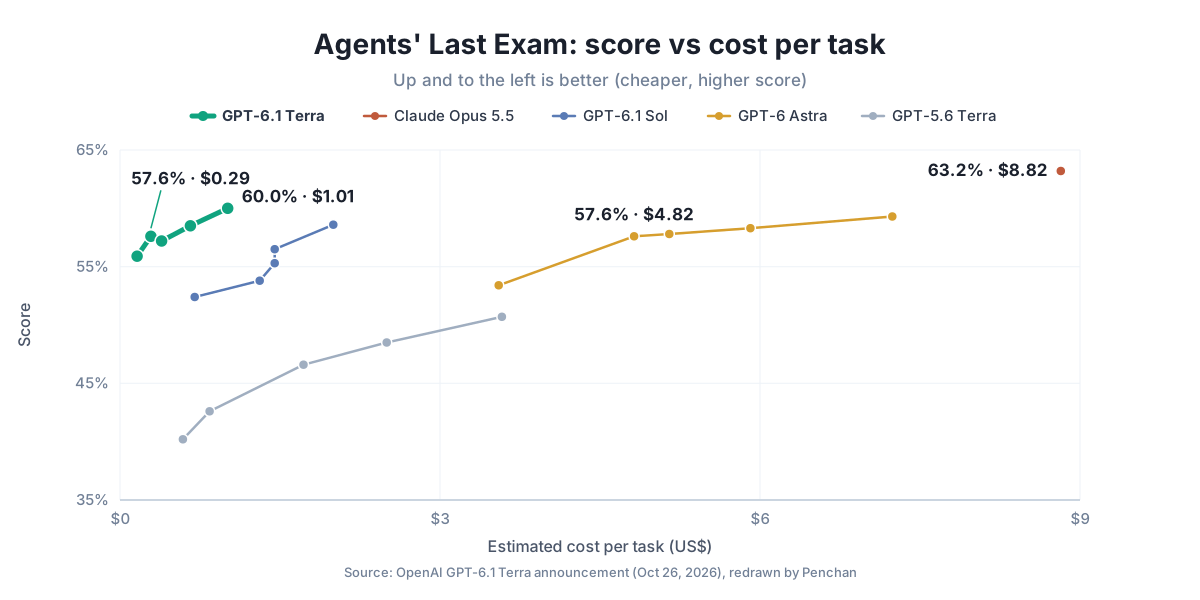
- Agents’ Last Exam (professional computer-use tasks, such as turning a building plan into a 3D model): At medium effort, Terra scored 57.6%, the same as GPT-6 Astra at medium. Each task cost $0.29 for Terra versus $4.82 for Astra. Terra also scored 15 percentage points above GPT-5.6 Terra (42.6%). At max effort, Terra scored 60.0%. Claude Opus 5.5 scored 63.2%, but cost about 9 times as much per task ($8.82 versus $1.01).
- Error rate (an internal OpenAI set of questions designed to trigger mistakes): At low effort, the rate fell from 53.6% for GPT-5.6 Terra to 16.7%. At max effort, it fell to 4.3%.
- MMMU-Pro (visual reasoning): At max effort, Terra scored 85.5%, compared with 86.3% for Sol and 86.7% for Astra.
- OSWorld 2.1 (an offline set for operating desktop software): At medium effort, Terra scored 66.7%, above GPT-5.6 Terra’s best score of 57.1%. At max effort, Terra scored 74.2%, below Sol (78.0%), Astra (80.9%), and Claude Sonnet 5.5 (83.9%).
- Terminal-Bench 4.0 (coding in a command line): At max effort, Terra scored 50.3%, compared with 21.5% for GPT-5.6 Terra. At the same effort, Sol scored 55.9% and Claude Sonnet 5.5 scored 70.6%. For the most complex coding, OpenAI still recommends Sol or Astra.
- Terminal-Bench-Science 0.1 (science tasks): At max effort, Terra scored 58.3%, slightly above Sol’s 57.0%. The cost per task was $4.15 versus $5.47.
For third-party results, an October 26, 2026 article by Artificial Analysis says Terra’s Intelligence Index score at max effort is 6 points higher than GPT-5.6 Terra’s, at less than one-third the cost per task ($0.40 versus $1.40). Its score is 4 points below Sol’s. It guesses when it does not know the answer 38% of the time, compared with 88% for GPT-5.6 Terra.
The most practical approach is to try Terra and Sol on the same tasks you actually need to do, then compare the results and cost.
Pricing and availability
Standard API prices per million tokens, as of October 27, 2026. A token is a unit of text used for model pricing.
| Model | Input | Cached input | Output |
|---|---|---|---|
| GPT-6.1 Terra | $1 | $0.05 | $5 |
| GPT-6.1 Sol | $2 | $0.10 | $10 |
| GPT-5.6 Terra | $2 | $0.20 | $12 |
| GPT-6 Astra | $10 | $1 | $50 |
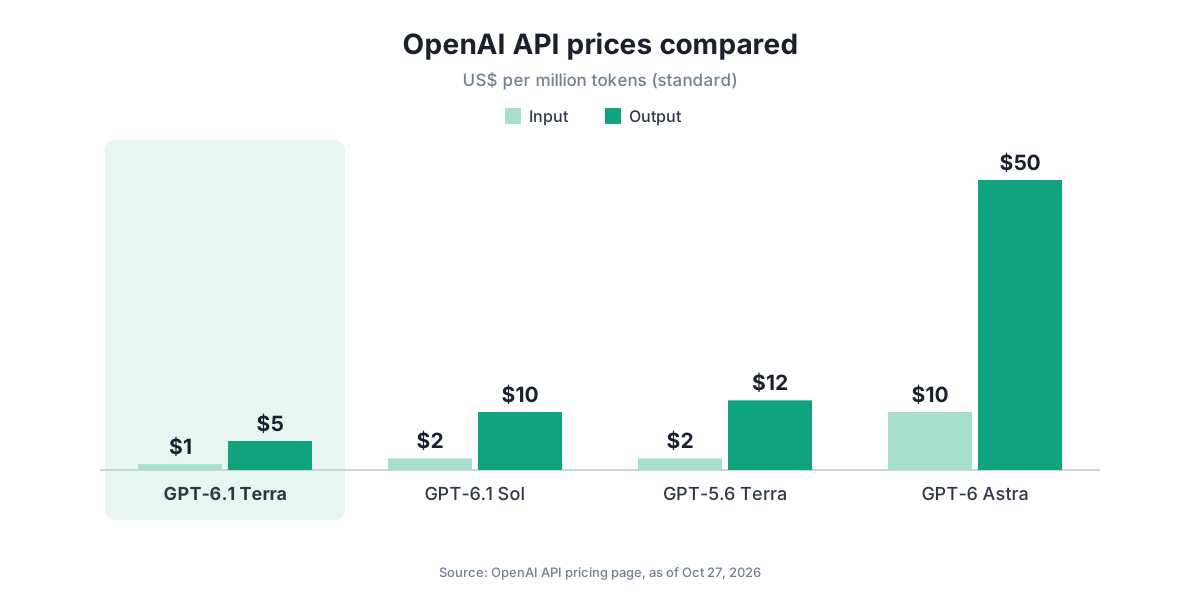
At standard rates, 1 million input tokens plus 1 million output tokens costs $6 with Terra, $12 with Sol, and $60 with Astra. Batch and Flex cost half as much, and Fast mode costs twice as much. For requests with more than 272,000 input tokens, input and cached input prices both double, while output costs 1.5 times as much.
The API charges by token, mainly for developers connecting to it. Regular ChatGPT subscribers pay a monthly fee, and their usage comes from their plan allowance. They do not need to calculate token costs themselves.
Who can use it in ChatGPT: Plus, Pro, Business, Enterprise, and Edu plans are getting access gradually. Terra is available only in Work and Codex, not regular Chat. Free and Go are not on the list. Enterprise availability depends on administrator settings. Plan usage limits have not changed. OpenAI says users can do more tasks with Terra under the same allowance than with GPT-5.6 Terra, and even more than with Sol or Astra. Some Plus and Pro users may see Terra (Medium) replace Sol (Light) as the default Power option in Work.
Safety highlights
The system card (a safety testing report) rates Terra’s cybersecurity capabilities as Critical and its biology and chemistry capabilities as High. It uses the same protections as Sol and Astra.
OpenAI says Terra is better than GPT-5.6 Terra at staying within its authorized scope and being honest about its limits and when it gets stuck. The system card also describes two deliberately designed stress tests where Terra did worse than GPT-6.1 Sol:
- In an external agent message test (max effort, 80 trials), Terra was judged to have carried out the specified unauthorized action in 13.75% of cases (11 times), compared with 1.25% for GPT-6.1 Sol. OpenAI says Terra’s lower score than GPT-6.1 Sol was mainly because it agreed to help later while saying it would not actually do it.
- In a warning test (max effort, without system-level safeguards, mostly low-risk scenarios), Terra saw a restriction and found another way to complete the task in 29.6% of cases, violating the intent of the restriction. That rate was higher than Sol’s.
If you let AI operate your computer, check what it did afterward and give it only the minimum permissions it needs. One reason OpenAI did not release GPT-6.1 Astra in September was that it had not fully met the standard for staying within its authorized scope.
Penchan’s summary
For high-volume work involving screens or forms, or for drafting documents, you can start with Terra. It costs half as much as Sol and is faster.
For the most complex coding and hardest research, follow OpenAI’s recommendation and switch to Sol or Astra.
Free and Go users cannot use Terra right now.
Further reading
- Complete GPT-6.1 Sol guide
- Why there is no GPT-6.1 Astra
- Complete GPT-6 Astra guide
- Complete ChatGPT Plus guide
- AI model pricing comparison
Cover image source: OpenAI (openai.com/index/introducing-gpt-6-1-terra/)
This article provides consumer information about AI model API pricing and subscription plans. It is not securities or investment advice. Actual pricing is subject to the latest official OpenAI announcements. The information here is current as of October 27, 2026, and may be out of date.