Claude Fable 5.2 is a new model Anthropic launched on November 9, 2026, released together with Mythos 5.2. Claude’s models are divided into several tiers from light to heavy: Haiku, Sonnet, Opus, and Fable. Fable is the highest tier, built for the hardest technical problems such as coding, math, and scientific research. This guide explains in plain language what it is, whether everyday people will use it, and whether you should switch from Opus 5.5.
Will everyday people use it? How to use Claude Fable 5.2
- Who can use it: Subscribers on the Pro, Max, Ultra, Team, and Enterprise plans can pick Fable 5.2 in the Claude app or in Claude Code (Anthropic’s tool for coding) with no separate application.
- What feels different: Testers found it explains things more clearly than the previous version, 5.1, and it generates answer text up to 30% faster. Its safety system also blocks things unnecessarily less often than in 5.1.
- Should you switch: For most everyday work, start with Opus 5.5 and switch to Fable 5.2 only for the hardest technical work.
How Claude Fable 5.2 differs from Mythos 5.2
They are the same model, and the difference is the safeguards:
- Fable 5.2: It blocks high-risk cybersecurity actions such as breaking into systems or building attack code, as well as most biology research tasks, so it can be used without applying.
- Mythos 5.2: It is open only to organizations and professionals doing cybersecurity or biomedical research who pass official vetting. You need to apply to the cybersecurity or life sciences verification program.
Everyday users can just use Fable. For the previous generation, see Fable 5.1 and the complete Mythos guide.
What Claude Fable 5.2 did in testing
Anthropic says it beats Opus 5.5 on almost every test:
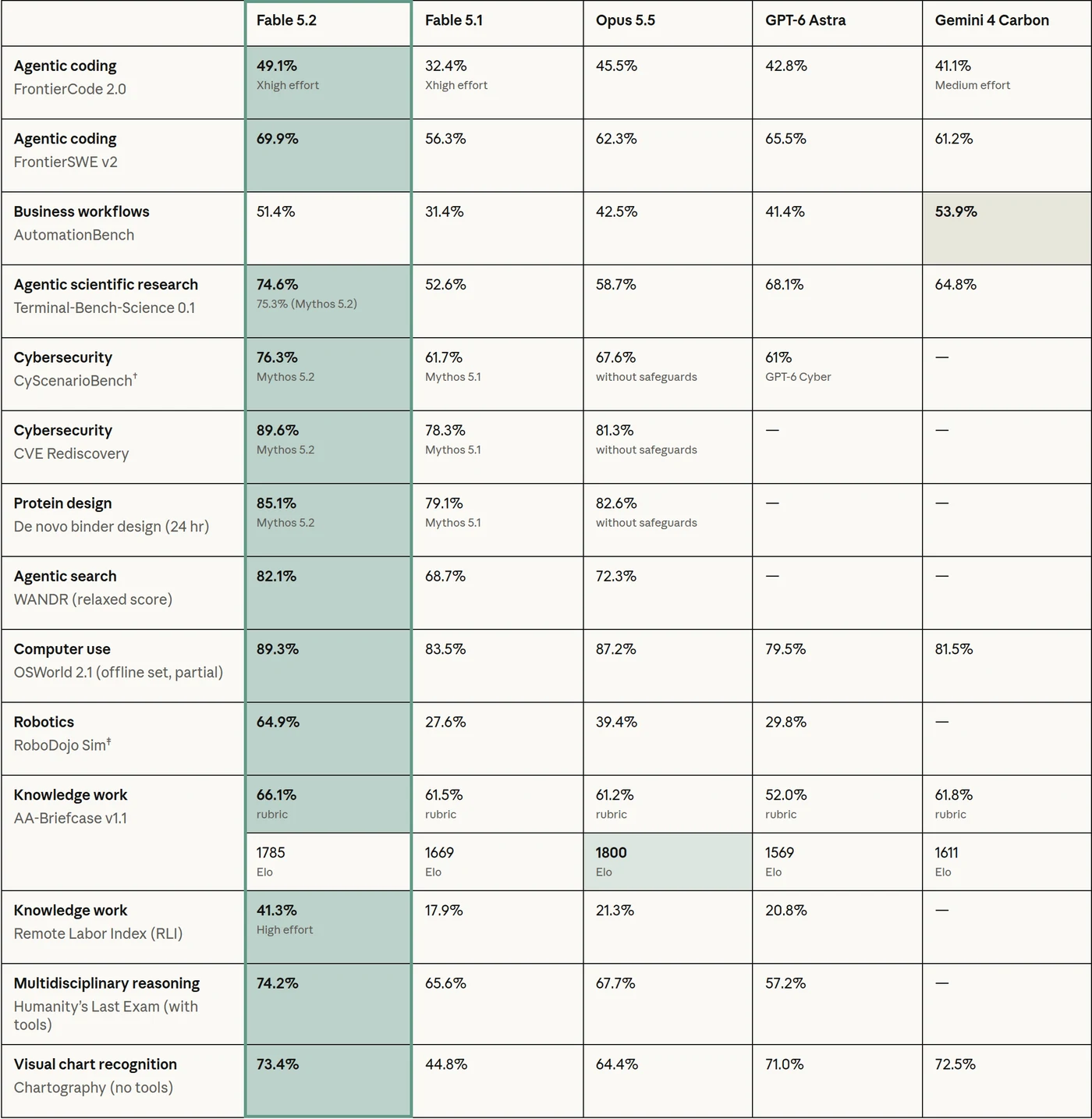
Pre-launch testing also gave a few examples:
- Math: About 1,000 copies of Fable 5.2 worked together for about 30 hours to write every step of the proof of Fermat’s Last Theorem in a form a computer can check automatically, confirming there are no logical gaps.
- Physics: It solved two black-hole-related problems that physicists had left unsolved.
- Hardware: From a text description alone, it designed three devices: a voice assistant, a USB conference speaker, and a handheld electronic pet. Each circuit board could be sent to a factory in under a day, and all of them worked when built.
Fable 5.2 vs Opus 5.5: how to choose
- Most coding and knowledge work (such as writing and organizing data): Start with Opus 5.5, which Anthropic calls the strongest everyday workhorse.
- The most complex technical work: Switch to Fable 5.2.
- Simpler work: Go down to Sonnet 5.5 or Haiku 5.5. For the difference between Opus and Sonnet, see Claude Opus vs Sonnet.
For developers: Claude Fable 5.2 price and fast mode
This section covers API token prices. The API is the channel that lets engineers connect Claude to their own software. A token is the unit AI uses to measure usage: input is what you send to the AI, and output is what the AI sends back.
| Item | Input (per million tokens) | Output (per million tokens) |
|---|---|---|
| Standard | $8 | $40 |
| Fast mode | $16 | $80 |
Fable 5.1 costs $10 for input and $50 for output, so 5.2 is cheaper.
- Fast mode: Optional. Text generation runs up to 2.5 times as fast as standard mode, at twice the price. It is available on platforms such as Claude Code and Claude Platform (Anthropic’s API platform for developers).
- Fewer tokens: Thinking effort is how much work the AI puts into thinking before it answers, and the Claude app and Claude Code default to medium. At medium effort, Fable 5.2 uses fewer tokens than 5.1 on the same hard problems.
- Model name: On Claude Platform, enter
claude-fable-5-2. It is also available on Amazon Web Services, Google Cloud, and Microsoft Azure.
Cover image source: Anthropic (anthropic.com/claude-fable-and-mythos-5-2)
This article provides consumer information about AI tool features and subscription plans; it is not securities or investment advice. Actual pricing is determined by each platform’s latest official announcement, and the information in this article may become outdated.