Who is Gemini 3.7 Flash for?
Gemini 3.7 Flash fits teams seeking low-cost code output and document work. It leads tests for production code, web development, expert PDF comprehension, and long-content understanding.
Developers can use it in Google Antigravity or access the Gemini API through Google AI Studio and Android Studio. Enterprises get the Gemini Enterprise Agent Platform and app; individuals can use Gemini Spark with Google AI Pro or Ultra.
Strong code output, weaker autonomous coding
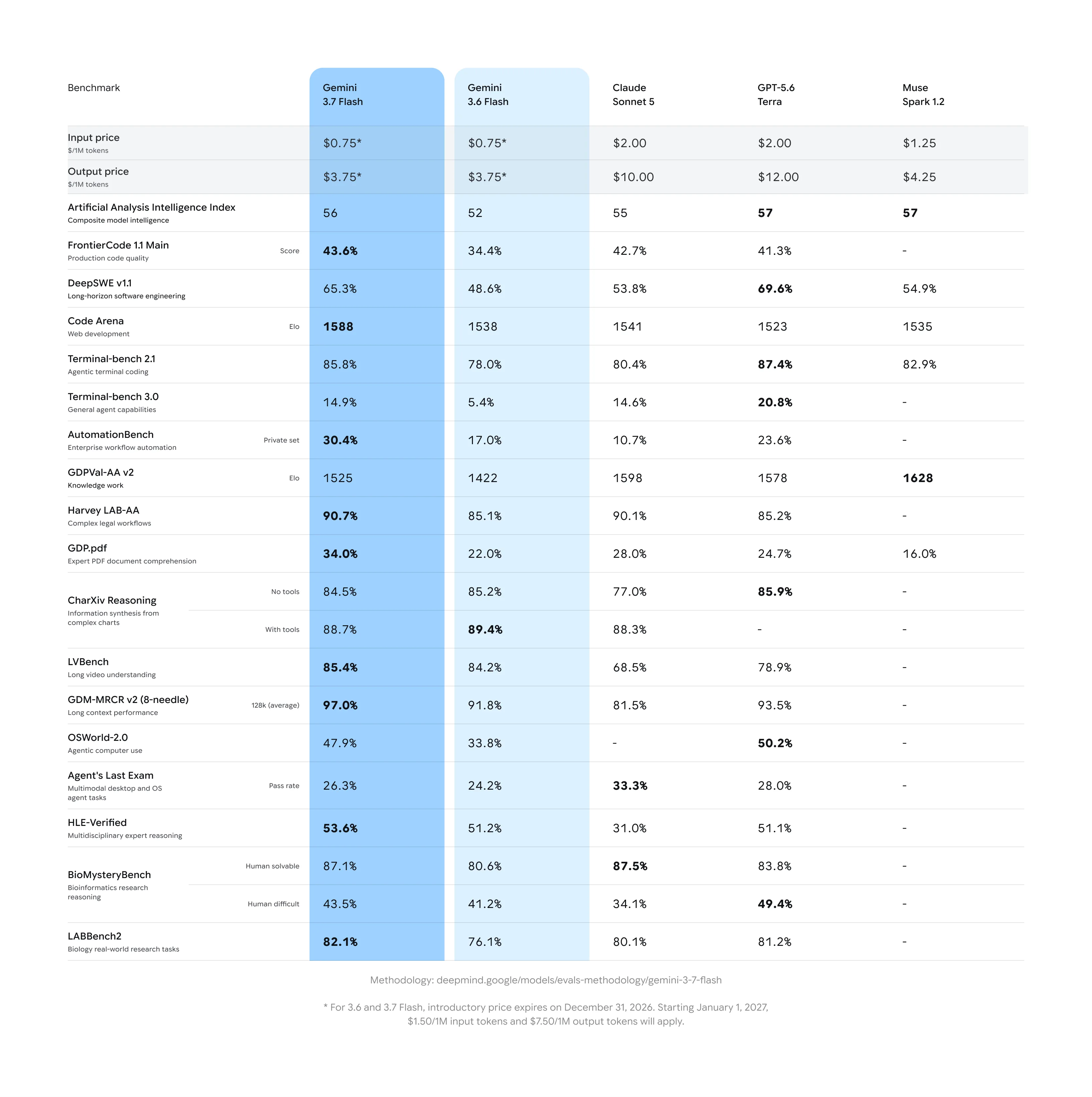
Google compares Gemini 3.7 Flash with its predecessor, Claude Sonnet 5, GPT-5.6 Terra, and Muse Spark 1.2. These rows show where it stands:
| Benchmark | 3.7 Flash | 3.6 Flash | Claude Sonnet 5 | GPT-5.6 Terra | Muse Spark 1.2 |
|---|---|---|---|---|---|
| Artificial Analysis Intelligence Index | 56 | 52 | 55 | 57 | 57 |
| FrontierCode 1.1 Main | 43.6% | 34.4% | 42.7% | 41.3% | – |
| DeepSWE v1.1 | 65.3% | 48.6% | 53.8% | 69.6% | 54.9% |
| Code Arena (Elo) | 1588 | 1538 | 1541 | 1523 | 1535 |
| AutomationBench | 30.4% | 17.0% | 10.7% | 23.6% | – |
| GDPVal-AA v2 (Elo) | 1525 | 1422 | 1598 | 1578 | 1628 |
| CharXiv Reasoning (no tools) | 84.5% | 85.2% | 77.0% | 85.9% | – |
| CharXiv Reasoning (with tools) | 88.7% | 89.4% | 88.3% | – | – |
Across the full table, its leading results cluster around producing something useful: building working code and web pages, reading PDFs or video, and turning long, complex material into professional work. Coding splits more sharply. Gemini 3.7 Flash leads FrontierCode and Code Arena for production code quality and web development; GPT-5.6 Terra leads DeepSWE v1.1 and Terminal-bench 2.1 for long-horizon autonomous coding.
CharXiv Reasoning is one step back. Without tools, the score falls from 85.2% to 84.5%; with tools, from 89.4% to 88.7%.
Low price now, double in 2027
Gemini 3.7 Flash costs roughly one-third to one-quarter as much as Claude Sonnet 5 or GPT-5.6 Terra. Through December 31, 2026, input and output cost $0.75/$3.75 per million tokens; the two rivals cost $2.00/$10.00 and $2.00/$12.00 respectively.
| Effective period | Input per 1M tokens | Output per 1M tokens |
|---|---|---|
| Through 2026-12-31 | $0.75 | $3.75 |
| From 2027-01-01 | $1.50 | $7.50 |
The current rate is a discount through year-end. Input and output prices for both 3.6 and 3.7 Flash double on January 1, 2027.
If a project will run into 2027, budgeting at $0.75/$3.75 accounts for only half of the lasting rate. I would model costs at $1.50/$7.50 and treat the difference through year-end as a temporary discount.
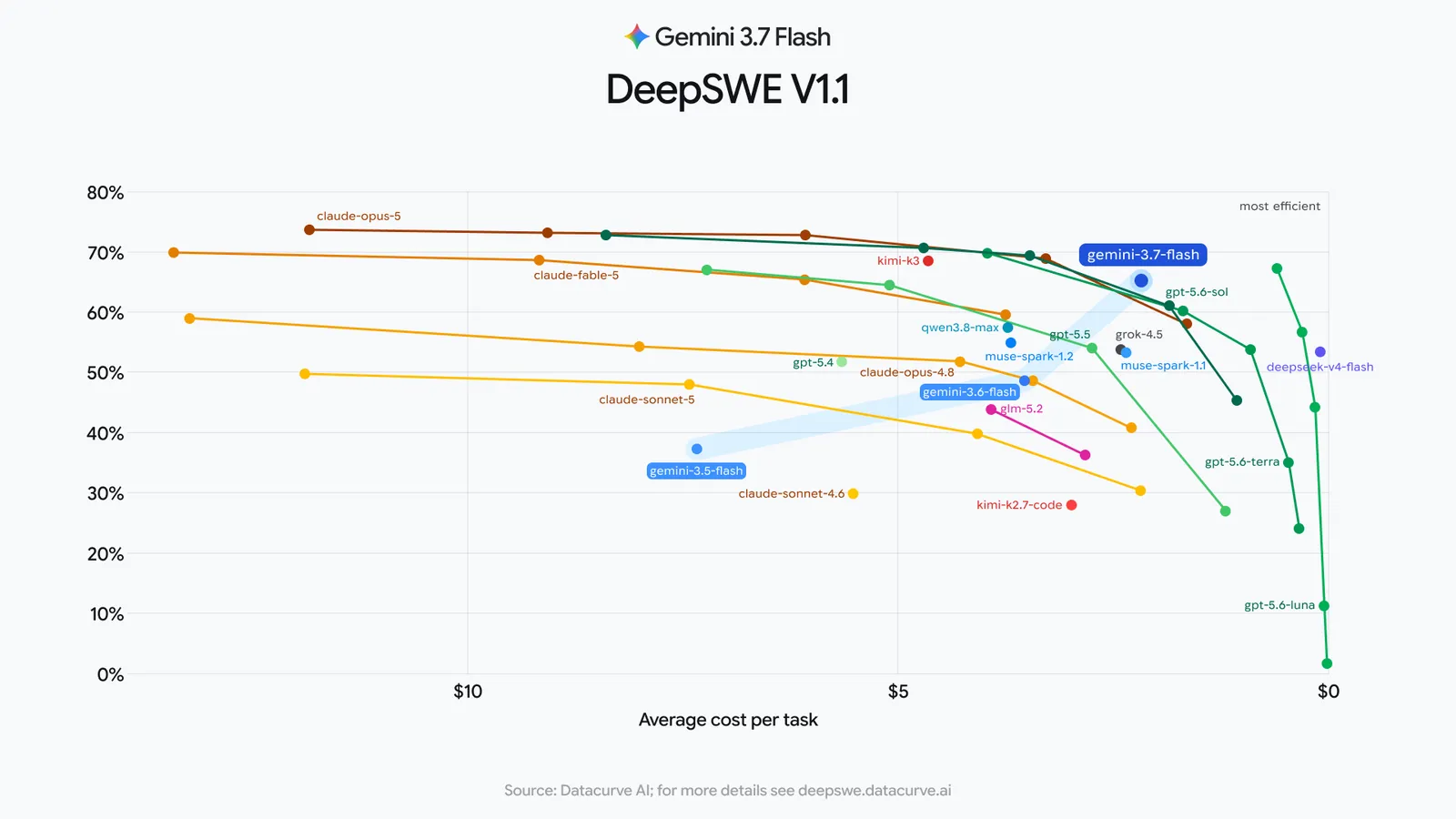
The tradeoff is plain: Gemini 3.7 Flash buys near-frontier capability at a lower cost. The highest score costs more.
Speed and context are still undisclosed
The Flash name suggests speed, yet Google publishes no latency or throughput figure. There is no time-to-first-token number and no tokens-per-second result. Real-time products still need testing with their own prompts and deployment region.
The context window is undisclosed. A technical launch would normally state how much the model can read at once. This announcement does not.
My take
I would try Gemini 3.7 Flash first for components, web pages, PDFs, and long-content work. For long-horizon autonomous coding or jobs with repeated tool calls, I would compare it with other models; for long-term budgets, I would use the doubled 2027 rates.