The key point
Google released Gemini 4 Hydrogen on November 12, 2026 (US time). It calls Hydrogen the “daily driver” for agentic workflows (where the AI breaks a task into steps and calls tools on its own). It is not only for paying users: free Gemini app users and Google Search users worldwide can use it now. The higher-end Gemini 4 Argon and Carbon in the same family handle hard, long reasoning. Hydrogen handles everyday coding and agent tasks, and its selling points are speed and low price.
Who can use it, and where?
- Gemini app: Free users get Hydrogen in Auto mode when it fits the question. Paid users can pick it from the model menu.
- Google Search: Available to all users worldwide.
- Google AI Studio and the Gemini API: There is a free tier. Google uses free-tier content to improve its products. It does not do this on the paid tier.
- Antigravity (Google’s AI coding tool): Requires Google AI Pro or Ultra.
- Google Sheets: Available first to Google AI Pro and Ultra subscribers.
The model accepts text, image, audio, video, and PDF input. The context window is 1 million tokens (a token is the text unit models use for pricing).
How much does the API cost?
$1.50 per million input tokens and $7.50 per million output tokens. Output includes the tokens used for thinking. Filling the full 1 million token context costs the same, with no surcharge. Reusing input that was already processed (caching) costs $0.075 per million tokens.
For comparison, Gemini 4 Argon has a promotional price of $2 and $10 that ends November 30, then goes to $4 and $20. Hydrogen costs less than half of Argon’s regular price.
Hydrogen has four thinking levels: low, medium, high (the default), and the new xhigh. A thinking level controls how long the model thinks. For simple tasks, pick a lower one: you wait less and pay less.
Benchmarks: where it wins and loses
The table below is Google’s own testing. It compares Hydrogen with Anthropic’s Claude Sonnet 5.5 and OpenAI’s GPT-6.1 Terra.
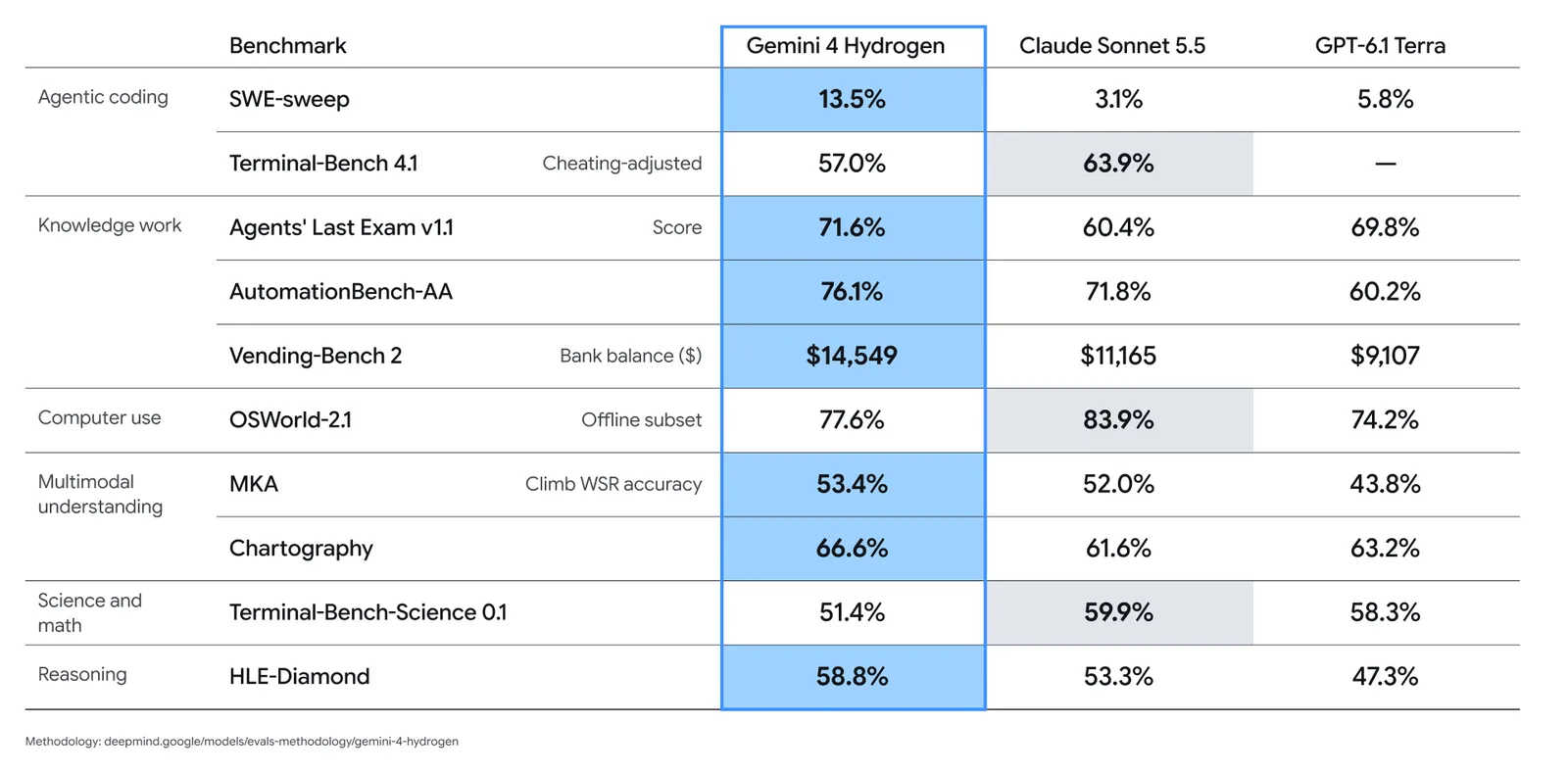
Hydrogen is highest on 7 of the 10 tests. The 3 that Sonnet 5.5 wins are:
- Terminal-Bench 4.1 (finishing tasks in the command line): Sonnet 5.5 scores 63.9%, Hydrogen 57.0%.
- OSWorld-2.1 (AI operating a computer desktop): Sonnet 5.5 scores 83.9%, Hydrogen 77.6%.
- Terminal-Bench-Science (scientific command-line tasks): Sonnet 5.5 scores 59.9%, Hydrogen 51.4%.
Hydrogen’s biggest leads are on Agents’ Last Exam (which tests full professional workflows: 71.6% versus Sonnet 5.5’s 60.4%) and SWE-sweep (finding and fixing code bugs). Google picked the tests in this table, and Google also compiled the competitors’ numbers.
On the Artificial Analysis Intelligence Index, from the third-party evaluator Artificial Analysis, Hydrogen scores 51 at its default (high) setting, a bit above Argon’s 50, and reaches 54 at xhigh.
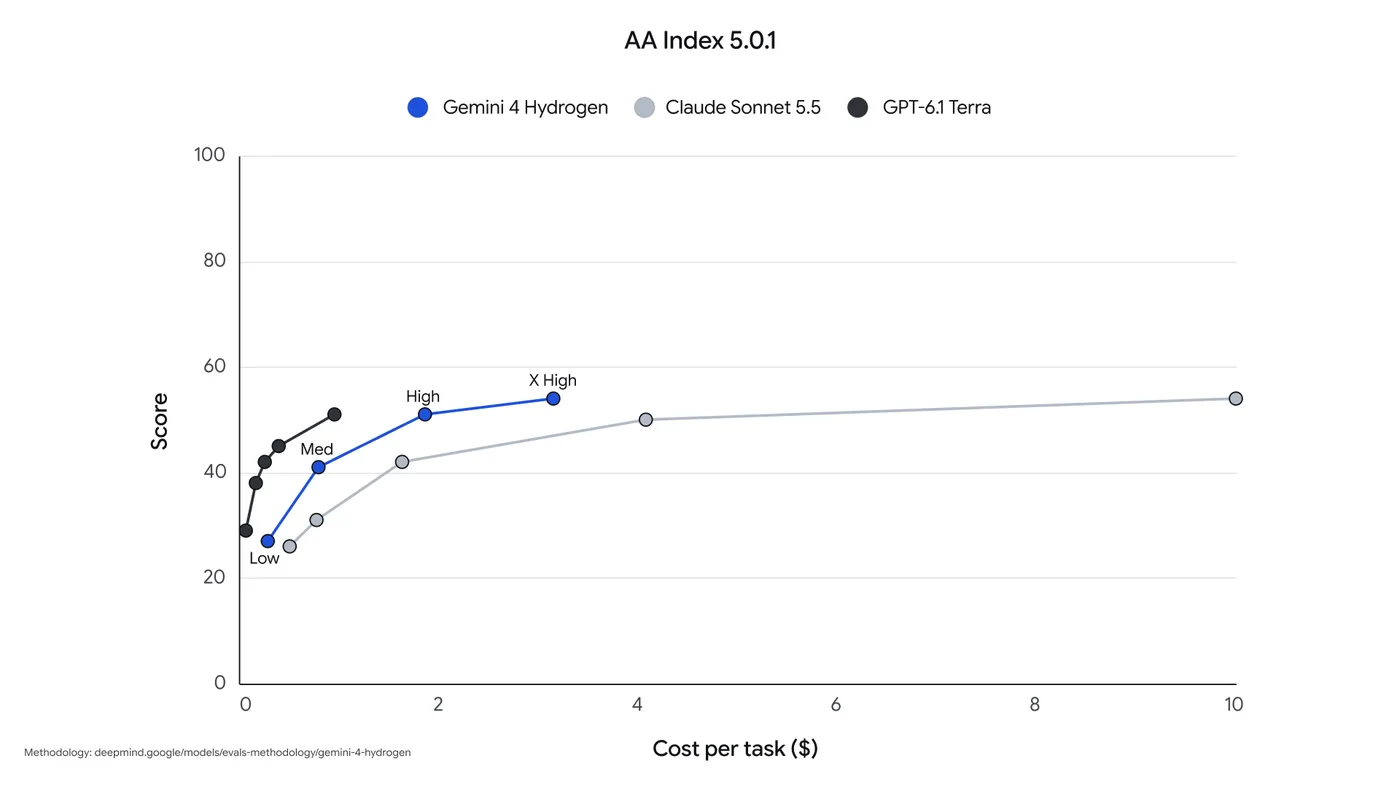
The chart shows that Hydrogen reaches a similar score at a much lower cost per task than Sonnet 5.5. GPT-6.1 Terra is cheaper still, but its score tops out around Hydrogen’s high level.
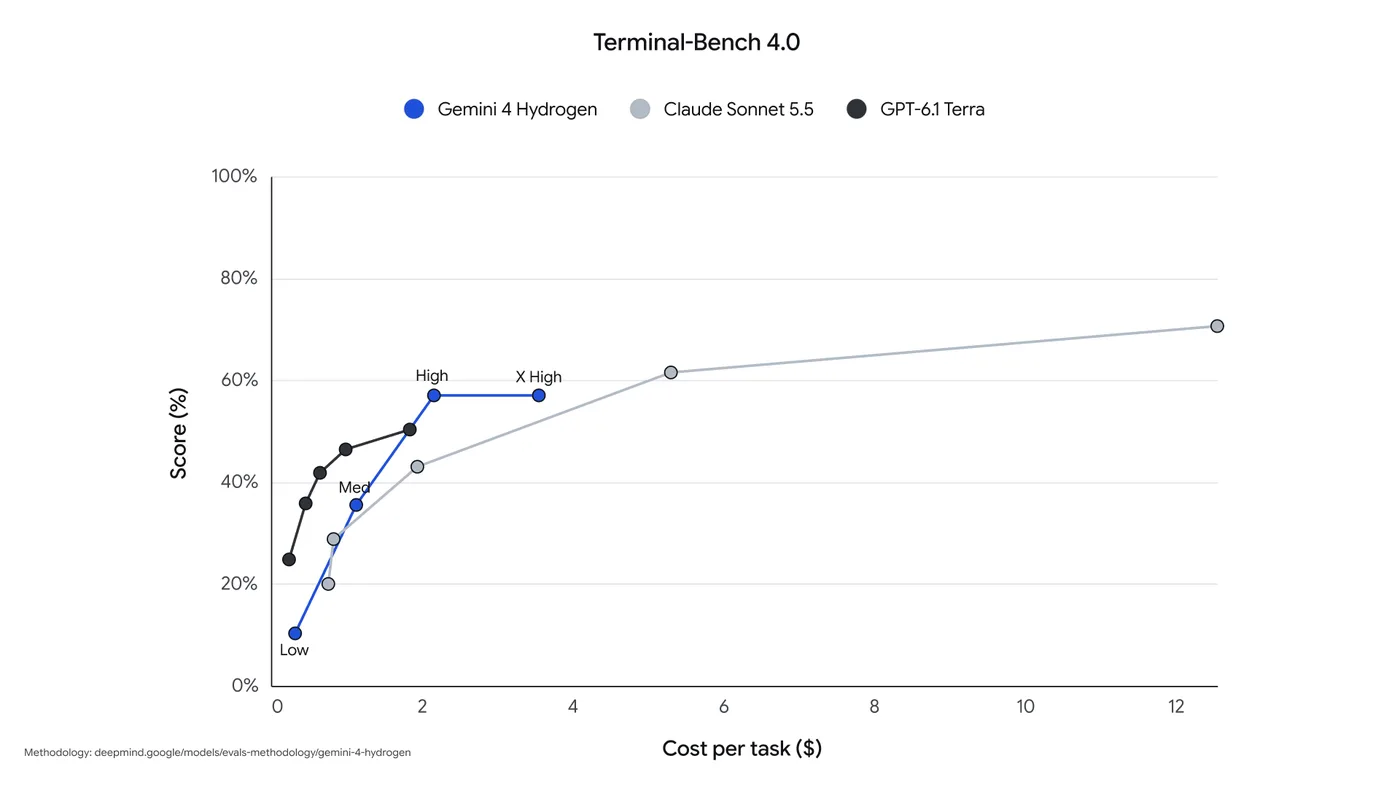
The coding chart tells the same story. Sonnet 5.5 reaches higher, and it costs a lot more per task. Pick Sonnet 5.5 for the highest score, and Hydrogen for the best value.
How much better than Gemini 3.8 Flash?
Compared with the previous fast model, Gemini 3.8 Flash, Google reports:
- 2.5 times faster at the default setting.
- On the command-line test Terminal-Bench 4.1, the score rises from 18.2% to 57%, more than triple.
- Fabricated content (AI hallucination) falls by more than 5 times. When a tool call fails or a search returns nothing, the model changes its approach on its own.
When coding, its edits are more precise. It does not rewrite unrelated files, and it reads multiple files and runs searches at the same time.
Antigravity also has an Orchestrator feature that switches between Carbon and Hydrogen in one session. In Google’s Terminal-Bench 4.0 test, the success rate was close to Carbon’s, with 24% less quota used on average and 19% faster. When several agents work together, Carbon acts as the coordinator, and Hydrogen runs the worker and verifier agents.
What changed in Google Search?
Google says this is the biggest model upgrade in Search yet. In Google Search’s “AI Mode,” the changes are:
- Better understanding of multi-part questions, typos, and very specific requests.
- More visual answers, with images, comparison tables, and custom tools.
- A wider search, which finds a more diverse range of links.
- Better answers in every language AI Mode supports.
The next two are comparison images from Google, showing Gemini 3.5 Flash and Hydrogen answering in AI Mode.
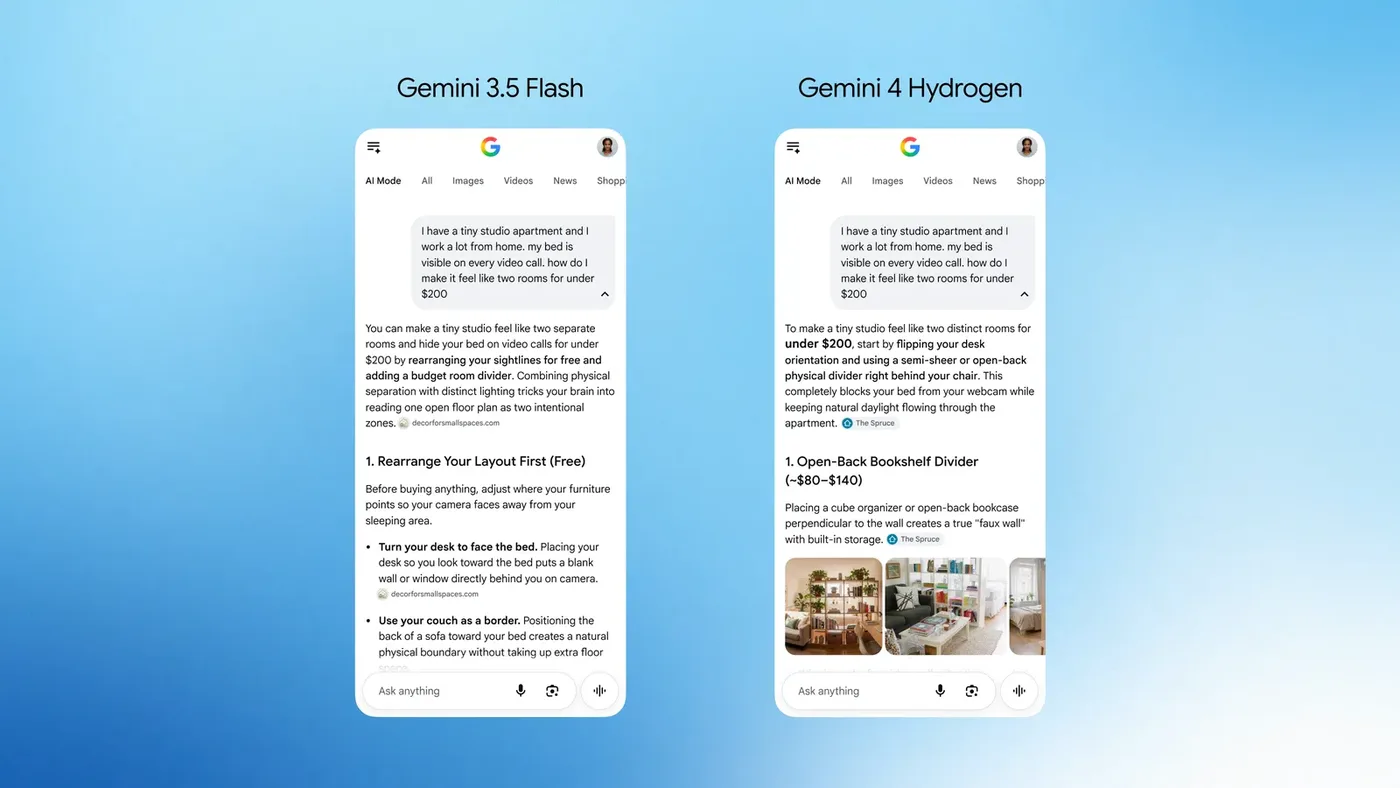
For the studio apartment question, Hydrogen gives a concrete plan: turn the desk around and put a semi-sheer or open-back divider behind the chair. It also shows open-back bookshelf dividers with photos, at about $80 to $140.
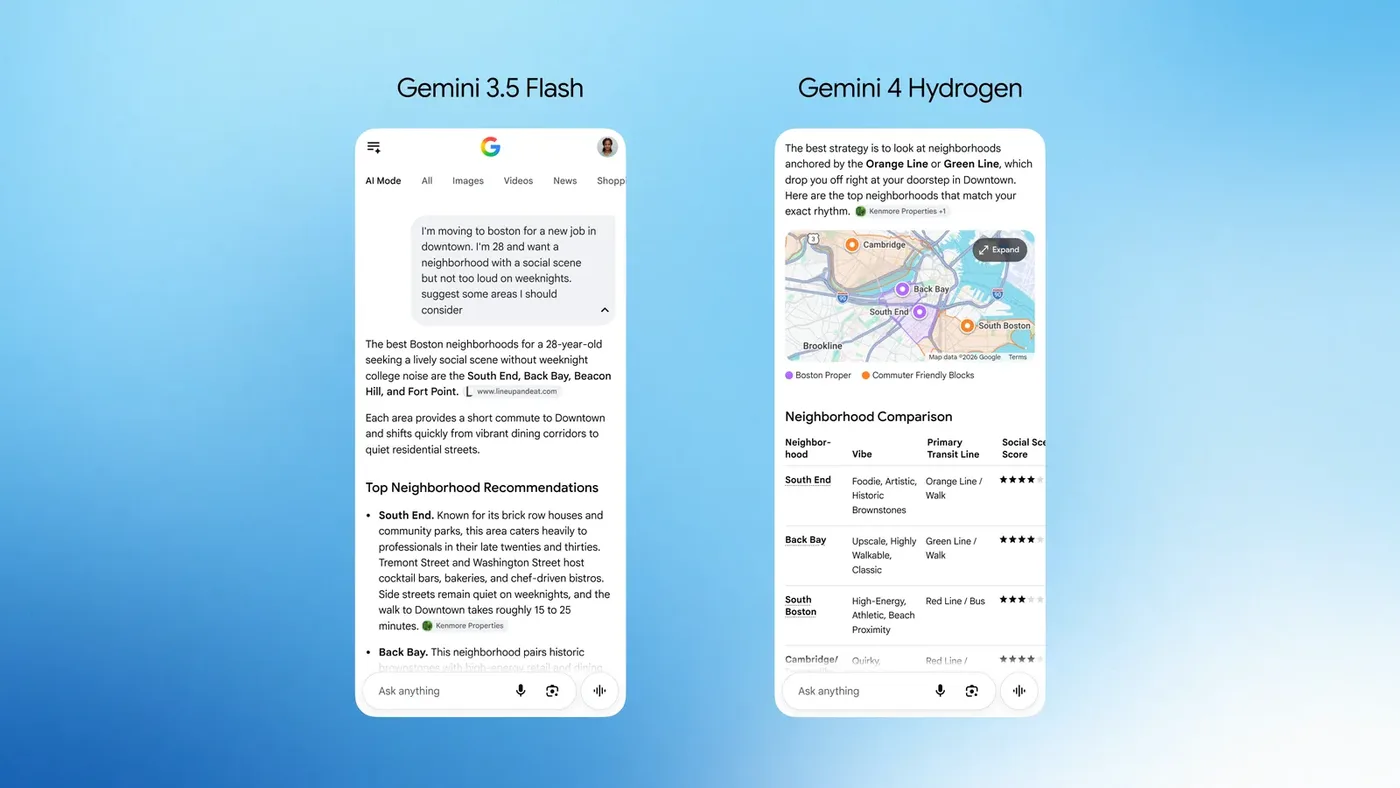
For the question about moving to Boston, Hydrogen starts with a map, then uses a table to compare each area’s vibe, transit line, and social score.
What improved on safety?
These are all Google’s own tests against Gemini 3.8 Flash:
- Overreaching behavior falls by up to 81%, and shortcut-taking and off-goal actions fall by 12 times.
- On tasks that are impossible or blocked, the chance of bypassing permission boundaries falls by up to half.
- Against indirect prompt injection (hiding malicious instructions in data the model reads), its resistance on the Gray Swan test is more than 2.3 times as high.
The model card also lists limitations: it may produce false content, it is occasionally slow or times out, and higher thinking levels may use more tokens.
Penchan’s Take
Hydrogen brings Gemini 4’s abilities to everyone. Regular users get it just by opening the Gemini app or Google Search, with no extra payment. Developers can start with the free tier in Google AI Studio and run their own tasks. For everyday coding and agent work, it costs less than Argon. For very hard, long reasoning, switch to Argon or Carbon.
Further reading
Cover image source: Google
This article provides consumer information about AI model API pricing. It is not securities or investment advice. The information here is current as of November 13, 2026. For actual pricing, see Google’s latest announcements.