
The key point
Gemini 4 Argon is Google’s most capable Gemini model currently available to the public. Google opened it to everyone on October 13, 2026 (US time), or 12:00 a.m. on October 14 in Taipei. On September 30 (US time), access was limited to people who applied through the Fairwind Program, Google’s program for trusted cybersecurity defenders. The Gemini app requires AI Pro or Ultra for Argon. Plus and free plans do not include it. The API has no free tier, and the promotional price ends on November 30.
Gemini 4 Carbon was announced on October 28 (US time), or early October 29 in Taipei. Its overall benchmark score is higher than Argon’s. It is taking the same route as Argon: first access for cybersecurity defenders, with no public release as of October 29. Argon took about two weeks to move from limited access to a full release.
Who can use it and what it costs
Gemini app: Google’s plan comparison, checked on October 29, lists these models for personal accounts.
| Plan | Monthly price (Taiwan) | Argon included? |
|---|---|---|
| Free | NT$0 | No, use Auto or Flash-Lite |
| Google AI Plus | NT$165 | No, includes Flash-Lite, Flash, and Pro |
| Google AI Pro | NT$650 | Yes |
| Google AI Ultra | NT$3,300 or NT$6,500 | Yes |
Pro includes 4 times the free plan’s usage. Ultra includes 5 times Pro’s usage at NT$3,300, or 20 times at NT$6,500. Google has not published the number of Argon messages allowed on each plan. Pro and Ultra subscribers can also use Argon in Google Search’s AI Mode. At launch, Argon in Antigravity, Google’s AI coding tool, was available only to Ultra subscribers.
Developers: There is no free Gemini API tier for Argon, so you need the paid tier. Its model ID is gemini-4-argon. The paid API works in Google AI Studio and Android Studio. AI Ultra subscribers can also try it in AI Studio. Enterprise customers have been able to use it in Vertex AI since October 13.
API prices per million tokens. A token is a unit of text used to price the model.
| Stage | Input | Output (including thinking) | Cached input |
|---|---|---|---|
| Standard, through November 30 | $2 | $10 | $0.10 |
| Standard, from December 1 | $4 | $20 | $0.20 |
| Batch / Flex, through November 30 | $1 | $5 | $0.05 |
Batch lets you submit many requests together without waiting for results in real time. It costs half the standard rate. Flex costs the same, but requests may take longer to process. Cached input costs less when the same content is reused. Argon supports implicit caching only: the system detects repeated input automatically, so you do not create a cache yourself. Argon has no separate higher price tier for very long inputs.
At standard rates, a total of 1 million input tokens and 1 million output tokens across multiple requests costs $12 at the promotional price and $24 from December 1. Gemini 3.1 Pro Preview lists input at $2 and output at $12 for prompts up to 200,000 tokens. Above 200,000 tokens, the prices are $4 and $18. So from December, Argon costs more than 3.1 Pro.
Specifications
- Context length: 1,048,576 tokens shared between input and output.
- Output length: Up to 65,536 tokens by default, or 1,048,576 with long decode, a mode for producing very long outputs. Google calls this an industry-leading limit. The previous limit was 64K.
- Input formats: Text, images, video, audio, and PDFs. Output is text only.
- Thinking levels: Low, medium, and high control how long the model reasons before answering. Medium is the default.
- Knowledge cutoff: March 2026.
Google says Argon is not a modified or fine-tuned version of an existing model.
How to read the benchmarks
Benchmarks give different models the same set of tasks and score their results. The table below is the comparison Google published when it announced Argon. It compares Argon with GPT-6 Astra, Claude Fable 5.1, and Claude Opus 5.5.
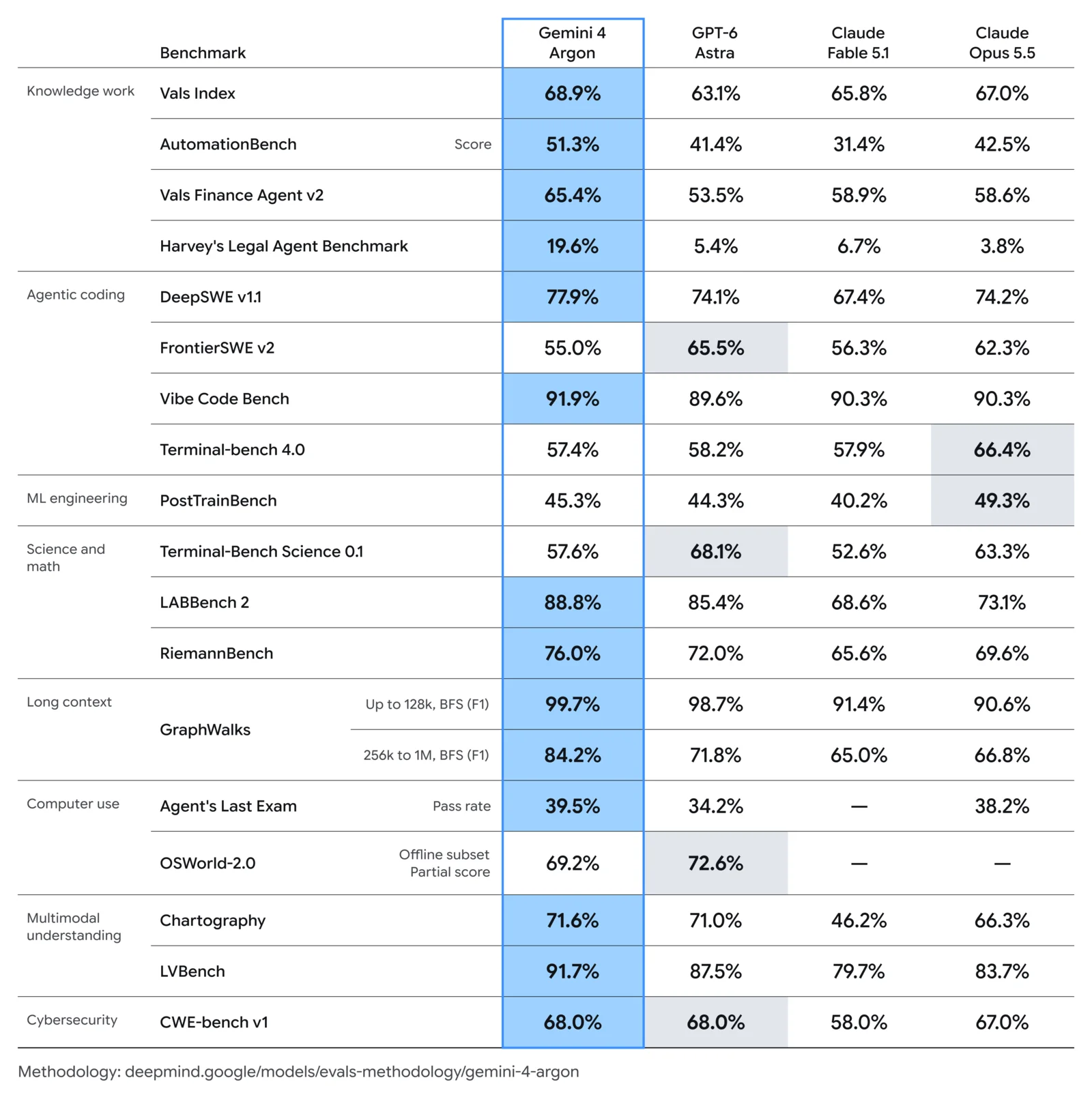
Among the models in Google’s table, Argon has the top score in 13 of 19 tests, ties on 1 (CWE-bench, where Argon and GPT-6 Astra both score 68.0%), and trails on 5. Its clearest leads are in three areas:
- Legal and finance AI agents: Argon scores 19.6% on Harvey’s Legal Agent Benchmark. The next-highest model, Claude Fable 5.1, scores only 6.7%. On Vals Finance Agent v2, Argon scores 65.4%, 6.5 percentage points above Fable 5.1’s 58.9%.
- Reasoning about relationships in long text: GraphWalks tests reasoning across relationships, like a map of who knows whom, made of points and lines (a graph, not a picture). It describes nodes and links in a long text. The model follows those links to find a target node; it does not search a document. In the test set with prompts from 256,000 to 1 million tokens, Argon’s F1 score, which measures both completeness and accuracy, is 84.2%. GPT-6 Astra scores 71.8%, a gap of 12.4 percentage points. In the set up to 128,000 tokens, Argon scores 99.7%.
- Long videos: Argon scores 91.7% on LVBench. GPT-6 Astra scores 87.5%, 4.2 percentage points lower.
Argon trails on these 5 tests. The model listed after it has the top score in each case:
- FrontierSWE v2 (software engineering): Argon scores 55.0%, and GPT-6 Astra scores 65.5%.
- Terminal-bench 4.0 (command-line coding): Argon scores 57.4%. Claude Opus 5.5 scores 66.4%, 9.0 percentage points higher.
- PostTrainBench (tests whether AI can take over training and adjusting another model): Argon scores 45.3%, and Claude Opus 5.5 scores 49.3%.
- Terminal-Bench Science 0.1 (using a command line to complete research tasks): Argon scores 57.6%, and GPT-6 Astra scores 68.1%.
- OSWorld-2.0 (tests AI control of desktop software, using only tasks that do not need internet access): Argon scores 69.2%, and GPT-6 Astra scores 72.6%.
Argon does not lose on every coding test. It has the top score on DeepSWE v1.1, at 77.9%, compared with Opus 5.5 at 74.2%. It also leads on Vibe Code Bench at 91.9%. Its weaker results are concentrated in command-line work and computer use.
Keep two things in mind when reading this table. First, it combines third-party rankings, Google’s own tests, and rival scores that are mostly self-reported by the companies that make those models. Test settings are not always the same. Second, Google ran Argon at its highest thinking setting. When Google announced Carbon, its newer table reran some Argon tests with updated benchmarks. The numbers differ, so do not mix results from the launch table and the newer table.
Cybersecurity
Google also published two cybersecurity tests comparing Argon with its own security-focused Gemini 3.8 Flash Cyber.
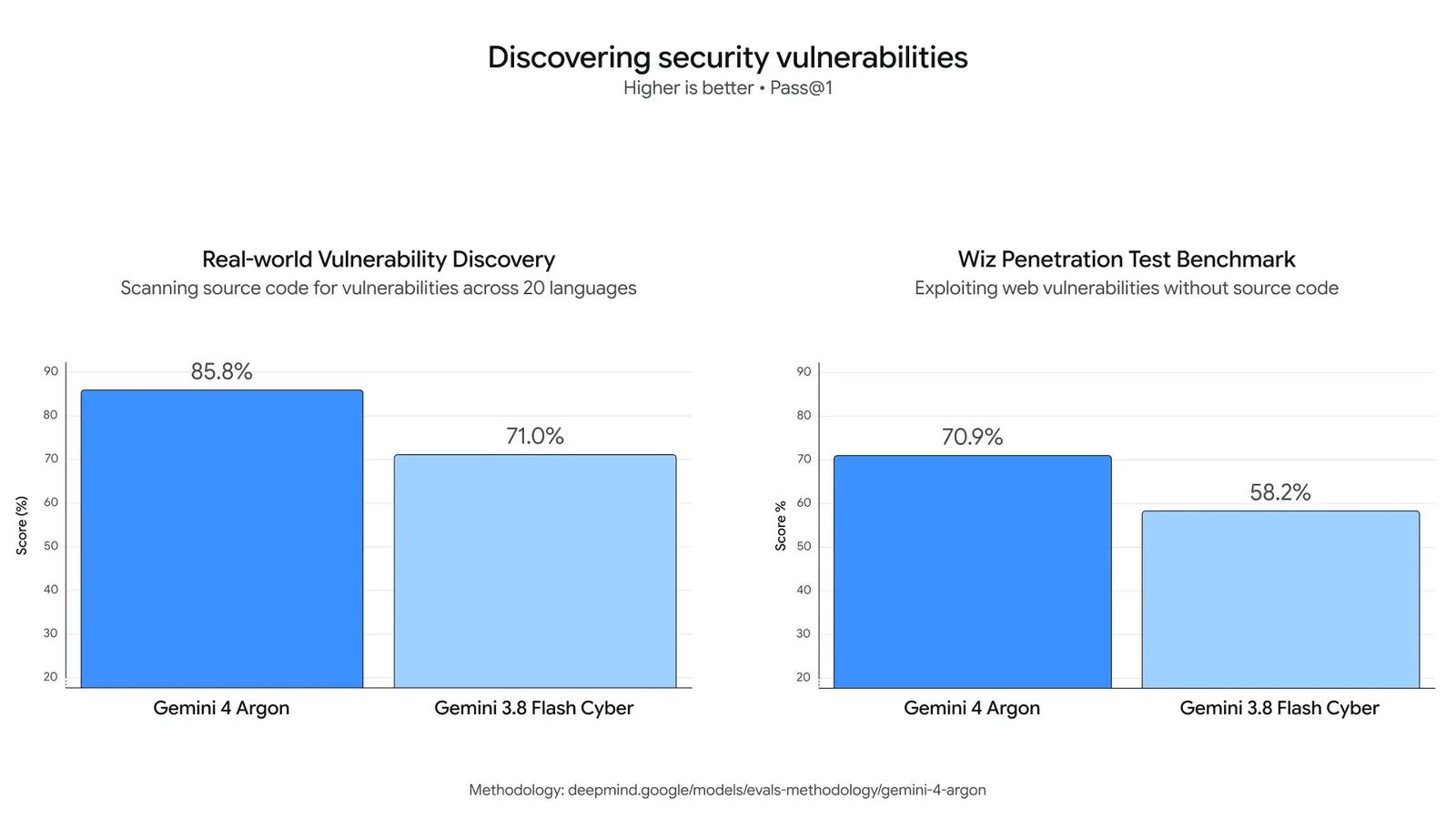
- Real-world Vulnerability Discovery (finding vulnerabilities in real code across 20 programming languages, in a Google internal test): Argon scores 85.8%, and 3.8 Flash Cyber scores 71.0%.
- Wiz Penetration Test Benchmark (Wiz’s internal black-box penetration test, where the tester cannot see the source code): Argon scores 70.9%, and 3.8 Flash Cyber scores 58.2%.
Another test came from Gray Swan. It tests prompt injection, where malicious instructions are hidden in content the model reads to trick it into following them. Each test allowed up to 15 attempts. A lower attack success rate is better: Argon scores 0.7%, Claude Opus 5.5 and Claude Fable 5.1 each score 1.0%, GPT-6 Astra scores 8.5%, and GPT-6 Sol scores 10.1%.
Google also offers a less restricted cybersecurity version, gemini-4-argon-cyber-permissive. It is available only to people on the Fairwind list, not through the regular API.
Gemini 3.1 Pro and Carbon
Gemini 3.1 Pro: It is still available. Google has not announced a retirement date for the gemini-3.1-pro-preview API model. Google’s Gemini app plan page lists both models. Google has not said Argon replaces 3.1 Pro.
Carbon: Its overall benchmark score is higher, but its public release date has not been set. Its promotional price matches Argon’s: $2 for input and $10 for output. On the Artificial Analysis Intelligence Index v5, a third-party overall intelligence score, Argon scores 50 and Carbon scores 59. Artificial Analysis measured Argon’s output speed at about 82 tokens per second and described it as “slower than average and rather verbose.” Output is the more expensive half of the price, so factor that wordiness into cost estimates.
Safety
Google’s Argon safety report says it cannot rule out the unprotected model reaching the critical capability level (CCL) in cybersecurity and CBRN (chemical, biological, radiological, and nuclear) areas. CCL is an internal red line for high-risk AI in Google’s Frontier Safety Framework. If a model reaches it, Google must add stronger safeguards. Google has deployed safeguards, including monitoring the model’s reasoning and actions, and stopping execution when needed. External testers included the UK’s AISI, the US NIST’s CAISSI (spelled this way in the report), Gray Swan, and Trajectory Labs.
Penchan’s summary
If you already have Pro or Ultra: Select Argon in the model menu and try it on your own legal documents, financial reports, or long PDFs, and compare it with the model you use now. Argon’s strengths are legal and finance AI agents. GraphWalks tests relationships, not ordinary long documents.
If you have Plus or the free plan: I would not upgrade just for Argon. The difference between Plus and Pro is NT$485. AI Pro is the lowest monthly plan that lets you try Argon in the Gemini app.
If coding is your main use: Argon trails rivals on command-line tasks and FrontierSWE v2. For this work, I would first look at Claude Opus 5.5 and GPT-6 Astra.
Developers: Use the paid Gemini API and estimate costs at the $4 and $20 rates that start on December 1. Treat the promotional price as a short-term discount. Use Batch for work that can wait. Argon tends to produce long outputs, and output is the more expensive half of the price, so first run a round with your own workload to see the real cost.
When Carbon’s API opens, compare it again using the same set of tasks.
Further reading
- What is Gemini 4 Carbon?
- Complete Google Gemini guide
- Gemini free vs. Pro: what’s the difference?
- How to use Google AI Studio
- Gemini 3.8 Flash and its cybersecurity version, Cyber
- Claude Opus 5.5 review and ranking
- Complete GPT-6 Astra guide
Cover image source: Google
This article provides consumer information about AI model plans and API pricing. It is not securities or investment advice. Actual prices and features are subject to Google’s latest official announcements. The information here is current as of October 29, 2026, and may be out of date.