
The key point
Google announced Gemini 4 Carbon on October 28, 2026 (US time). It calls Carbon “our strongest model” and says it is built for cybersecurity and long-running tasks. Google says its internal teams ran it for days on complex, multi-step engineering work. Carbon scored 59 and ranked first among 52 models on the Artificial Analysis Intelligence Index v5. But Google is first making it available only to some cybersecurity defenders. As of October 29, 2026, regular users and developers cannot use it yet. Its predecessor, Gemini 4 Argon, came out two weeks earlier.
Who can use Gemini 4 Carbon
Google says it is starting this week with some cybersecurity defenders, then will expand access to more trusted partners through the Fairwind Program. For developers, businesses, and regular users, Google only says “as soon as possible.” It has not given a date. The Ars Technica headline puts it more bluntly: the latest frontier model you cannot use.
As of October 29, 2026, Carbon is not open to the public. It is not on the public Gemini API model list.
The Fairwind Program gives priority to three groups:
- Government and national cybersecurity agencies
- Critical infrastructure operators in healthcare, telecom, energy, and finance
- Core technology platforms
Applicants must fill out a form and pass a background check.
How to read the benchmarks
Benchmarks give different models the same tasks and score their results. The table below is the full comparison in Google’s announcement. It compares Carbon with Argon, GPT-6 Astra, Claude Opus 5.5, and Claude Fable 5.1.
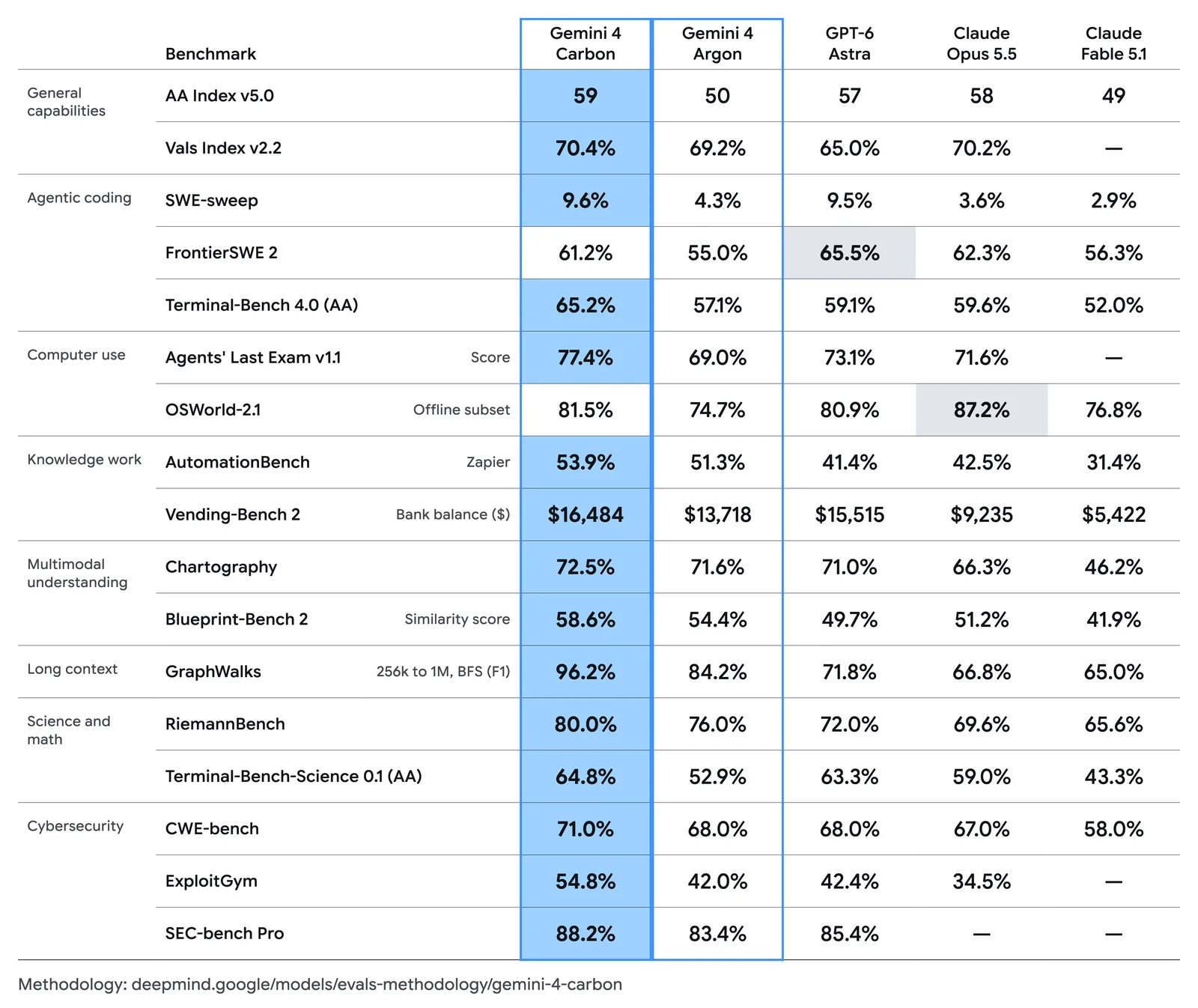
Among the models in Google’s table, Carbon has the top score in 15 of 17 tests. It loses on two:
- FrontierSWE 2 (a software engineering test): Carbon scores 61.2%, GPT-6 Astra 65.5%, and Claude Opus 5.5 62.3%.
- OSWorld-2.1 (a test of AI desktop software use, using only the 82-task subset that does not need internet access): Carbon scores 81.5%, behind Claude Opus 5.5 at 87.2% by 5.7 percentage points.
The size of the wins varies. The Intelligence Index score is 59 versus 58, a 1-point gap. On SWE-sweep, a test where AI finds and fixes code bugs, the gap is 0.1 percentage points. On Vals Index, a measure of performance on finance, coding, legal, and tax tasks, it is 0.2 percentage points. Those results are nearly tied. Here are a few larger gaps:
- GraphWalks (the model reads a long text description of graph nodes and connections, then follows them to find a target node. Prompts are 256,000 to 1 million tokens): Carbon’s F1 score is 96.2%, compared with 84.2% for Argon and 71.8% for GPT-6 Astra.
- AutomationBench (Zapier workflow automation test with private tasks): Carbon scores 53.9%, Argon 51.3%, Claude Opus 5.5 42.5%, and GPT-6 Astra 41.4%. Carbon is 2.6 percentage points above Argon and 11.4 percentage points above Opus 5.5.
- Terminal-Bench 4.0 (command-line coding, Artificial Analysis version): Carbon scores 65.2%, Claude Opus 5.5 59.6%, and GPT-6 Astra 59.1%.
Keep two things in mind when reading this table. Most rival numbers are self-reported results that Google selected for its table. Google tested Carbon and Argon at the highest thinking setting. GPT-6.1 Sol and Terra are not in the main table. They appear only in the cybersecurity charts.
Three cybersecurity tests
Google presents cybersecurity as one of Carbon’s main strengths. These numbers were measured without safeguards turned on.
SEC-bench Pro (183 cybersecurity tasks for JavaScript engines, scored by the rate of passing on the first try):
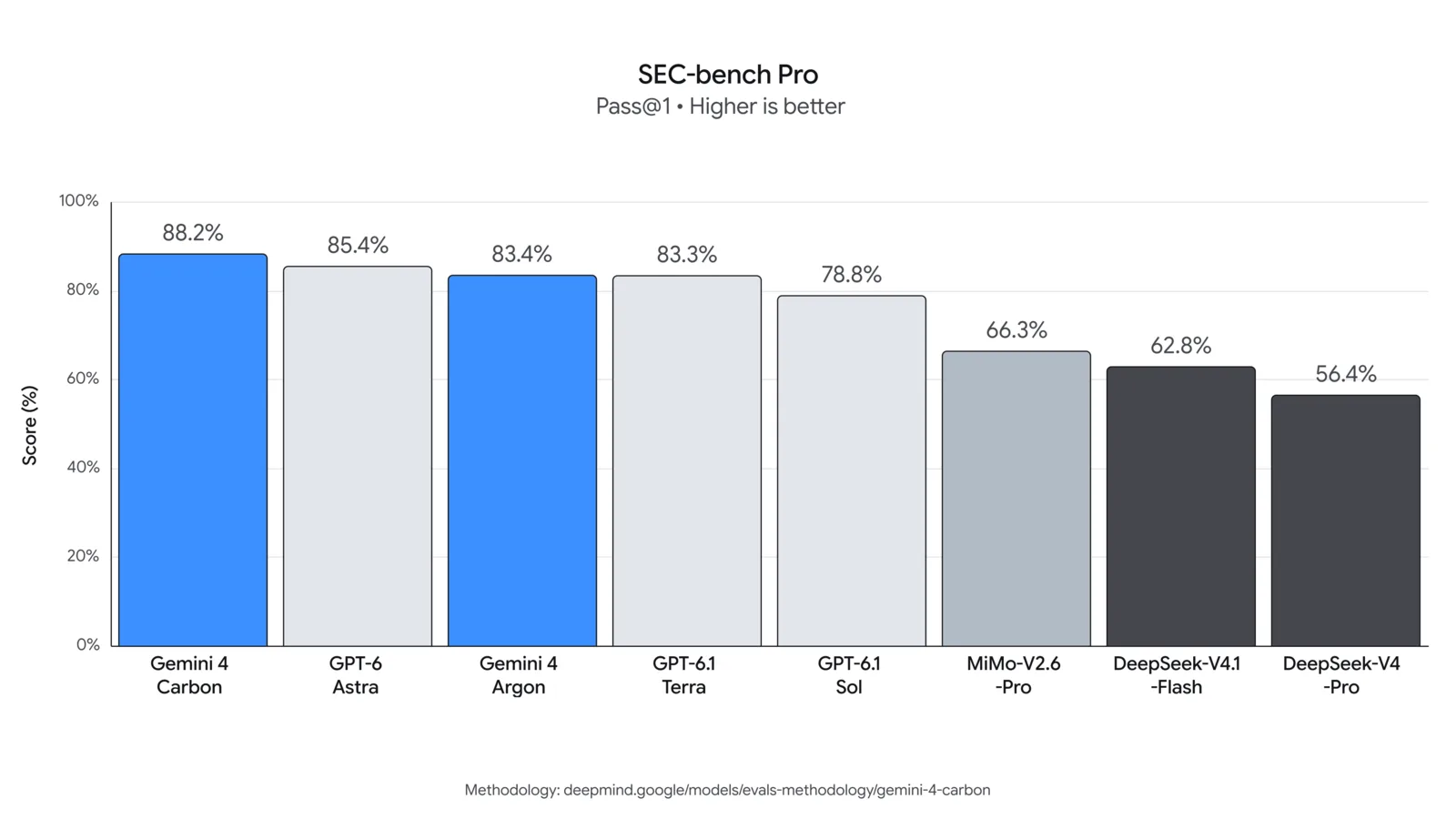
Carbon’s success rate is 88.2%, 2.8 percentage points above GPT-6 Astra’s 85.4%.
ExploitGym (exploit testing, with system-level safeguards turned off):
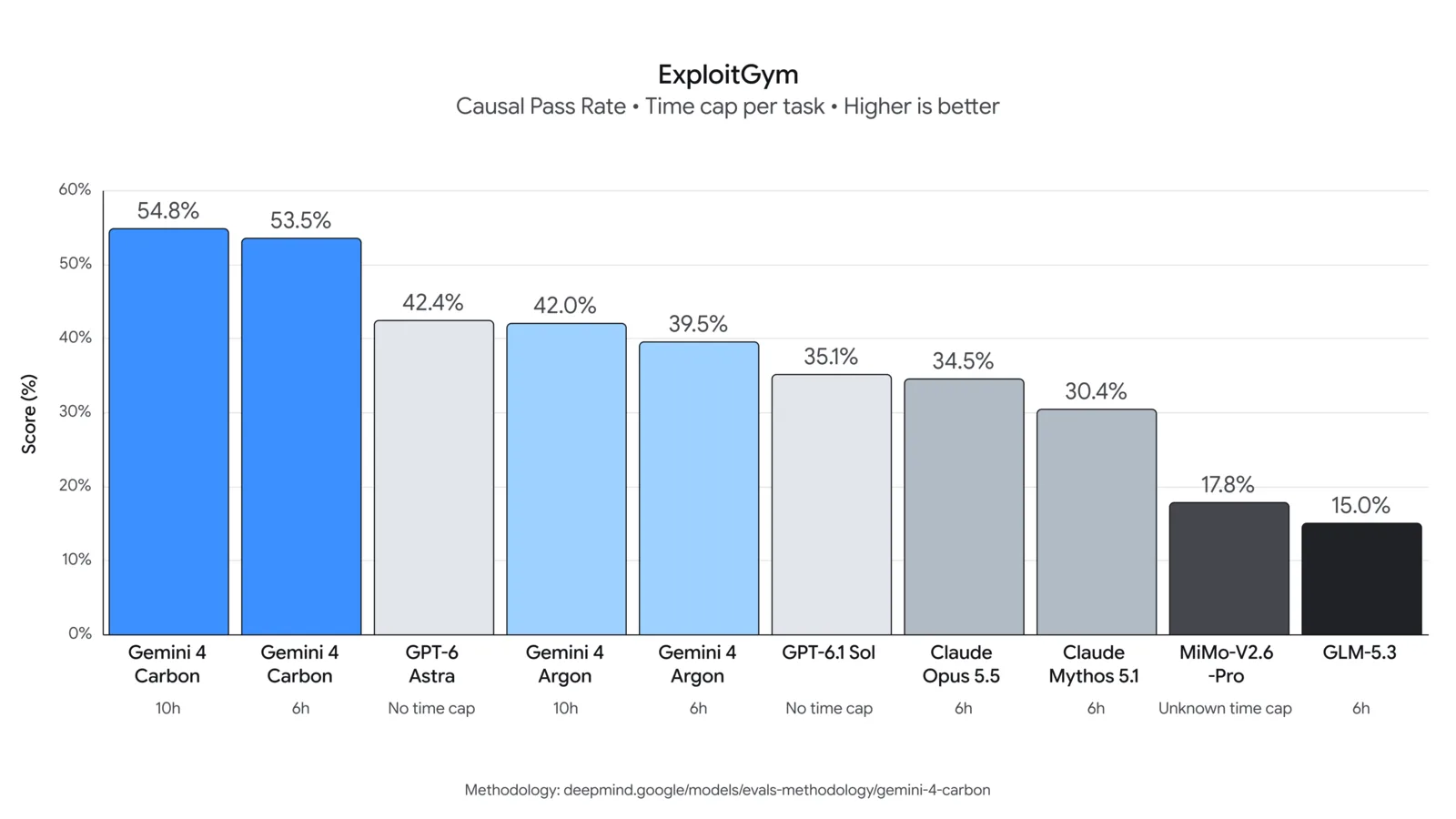
Carbon scores 54.8% with a 10-hour cap and 53.5% with the default 6-hour cap. GPT-6 Astra scores 42.4% with no time limit. Argon scores 42.0% with a 10-hour cap. Claude Opus 5.5 scores 34.5%, and Claude Mythos 5.1 scores 30.4%. Both have a 6-hour cap. Mythos 5.1 is the same model as Fable 5.1, with fewer safety restrictions. It is available only through Anthropic’s trusted access program.
CWE-bench (a test based on common software weakness categories): Carbon scores 71.0%. Argon, GPT-6 Astra, and Grok 4.7 each score 68.0%. Claude Opus 5.5 scores 67.0%.
Google also says its internal test found Carbon more than twice as successful at writing secure code as Argon. The Chrome team says Carbon produced high-quality patches at more than 10 times the rate of a large model from another, unnamed lab. These are Google’s own claims.
Pricing
Promotional API prices at launch, per million tokens, as of October 29, 2026. A token is a unit of text used for model pricing.
| Stage | Input | Output |
|---|---|---|
| Promotional price (same as Argon) | $2 | $10 |
| After promotion ends | $4 | $20 |
Cached input, which lets you reuse input already processed, is 95% cheaper than input. One million input tokens plus one million output tokens costs $12 at the promotional price, then $24. Google has not announced when Carbon’s promotional price ends. Argon’s promotional price runs through November 30. It returns to $4 and $20 on December 1.
Artificial Analysis used the list price of $4 and $20 to estimate a weighted average cost of $7.76 per task on the Intelligence Index. Carbon’s weighted average output was about 123,000 tokens, around 29% less than Claude Opus 5.5 at its highest setting, with 173,000 tokens. Carbon generates 92.4 tokens per second, ranking 80th among 193 models.
Safety and alignment
Google says Carbon uses the same protections as Argon. They include training, real-time abuse prevention, prompt-injection defenses, and chain-of-thought monitoring, which checks the model’s reasoning process for unusual behavior. Carbon also took part in voluntary pre-release testing for the US government. These figures are all from Google’s own tests:
- Cheating: On Terminal-Bench 4.0, the successful cheating rate was 0.0%, and the attempt rate was 0.4%.
- Alignment warnings (behavior that goes against user instructions): When Google’s internal teams used it to write code, high-severity warnings fell by nearly 80%.
- Unsupported claims: About half as many as Argon.
- Prompt injection (malicious instructions hidden in material the model reads. Each Gray Swan test allowed up to 15 attempts. A lower attack success rate is better): Carbon 0%, Argon 0.7%, Claude Opus 5.5 1.0%, GPT-6 Astra 8.5%.
The announcement links to Argon’s safety report, not Carbon’s. The report says it cannot rule out Gemini 4 Argon reaching the critical capability level (CCL) for cybersecurity without safeguards outside the model. CCL is an internal line in Google’s Frontier Safety Framework. If a model’s dangerous capabilities reach that line, Google must add stronger protections. Google says it has deployed safeguards to reduce the risk.
Penchan’s summary
Carbon leads by only a few percentage points on most tests. Its Intelligence Index score is just 1 point above Claude Opus 5.5. In Google’s table, two results stand out to me. GraphWalks, which tests reasoning over long text describing graphs, is 12.0 percentage points above the next-highest model, Argon. ExploitGym with a 10-hour cap is 12.4 percentage points above GPT-6 Astra, which had no time limit. AutomationBench is 11.4 percentage points above Opus 5.5, but only 2.6 percentage points above Argon.
Security teams: If you work for a government agency, critical infrastructure operator, or core platform, you can apply to Fairwind now.
Everyone else: Keep using your current model for now. If you want to try Gemini 4, Argon is available. Developers can use it through the paid Gemini API. Google AI Pro and Ultra subscribers can use it in the Gemini app. Argon’s promotional API price lasts through November 30. When Carbon’s API opens, test it on your own tasks and compare its speed and cost.
Further reading
- Complete Google Gemini guide
- Gemini 3.8 Flash and its cybersecurity version, Cyber
- What is Claude Mythos?
- Claude Opus 5.5 review and ranking
- Complete GPT-6 Astra guide
- What is GPT-6.1 Terra?
Cover image source: Google DeepMind (deepmind.google/blog/gemini-4-carbon-our-next-frontier-model/)
This article provides consumer information about AI model API pricing. It is not securities or investment advice. Actual pricing is subject to the latest official Google announcements. The information here is current as of October 29, 2026, and may be out of date.