The one-sentence takeaway
Muse Spark Open is an open-weight model Meta released on October 15, 2026 (US time): you can download the weights and host it yourself. It uses a “mixture of experts” architecture with 816B total parameters and 42B active parameters (only part of the parameters wake up each time), reads up to 1 million tokens at once, takes text, images, audio and video as input, and outputs text. Meta calls it “the most capable US open-weight model to date,” but on the Artificial Analysis index it scores 39 at the xhigh setting, below Chinese open-weight models. It is a different model from the closed Muse Wonder, and it is not the Muse app either.
What open weights means
Open weights means the trained model files are released for people to download and modify, but the training data and code are not necessarily public, and the license may carry restrictions, so it is not the same as traditional open source. Bloomberg notes that Meta keeps its stronger models closed and opened only one model this time.
How to read the benchmarks
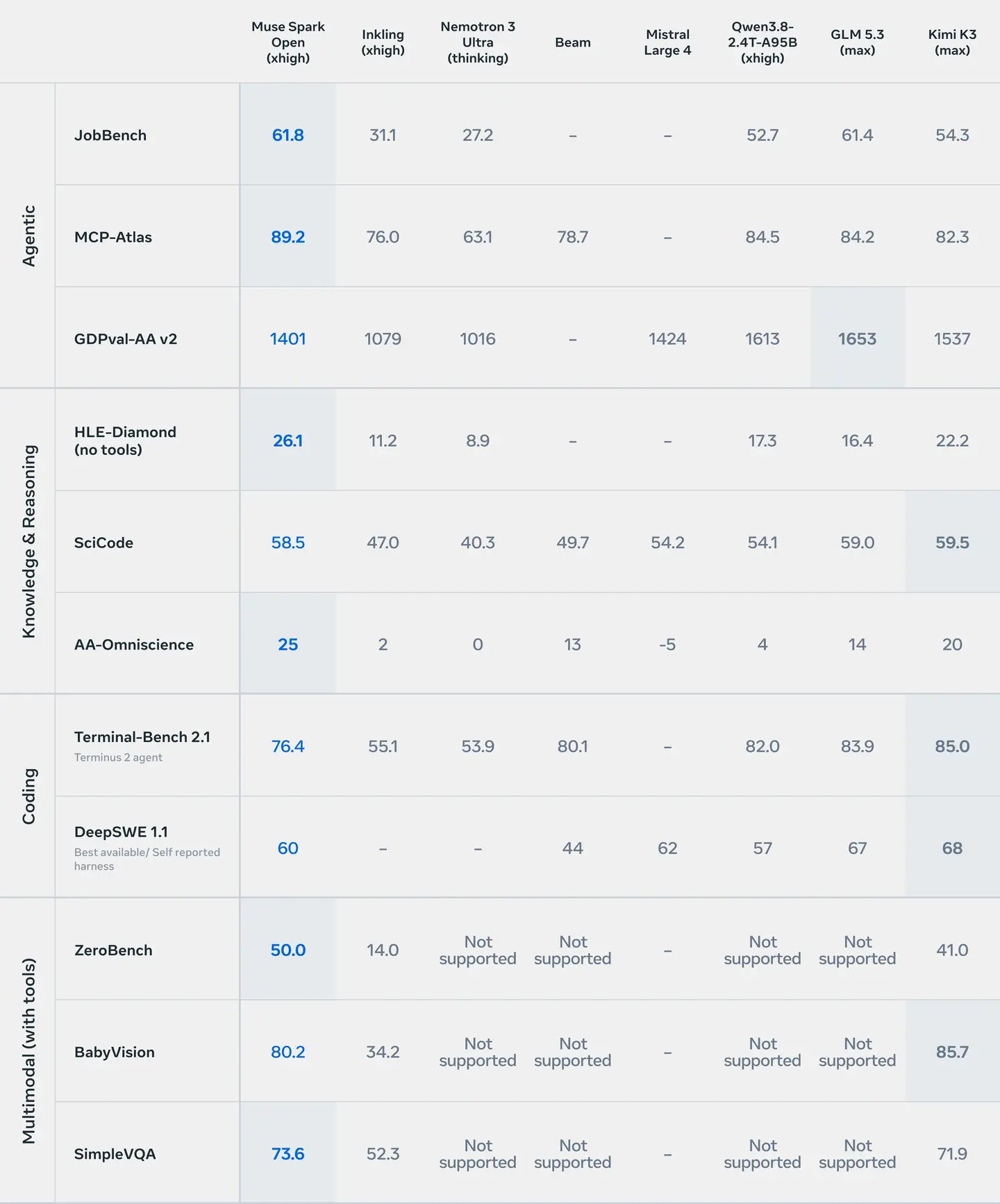
Meta’s table compares only open-weight models. Muse Spark Open uses xhigh, while GLM 5.3 and Kimi K3 use max. According to Meta’s figures, Muse Spark Open leads on JobBench (61.8, versus 61.4 for GLM 5.3, nearly a tie), MCP-Atlas (tool use across apps, 89.2), HLE-Diamond (no tools, 26.1) and AA-Omniscience (25, a test that deducts points for wrong answers), and it also leads on two of the three tool-using image tests in the chart.
It trails on GDPval-AA v2 (1401, versus 1653 for GLM 5.3), Terminal-Bench 2.1 (76.4, versus 85.0 for Kimi K3), DeepSWE 1.1 (60, versus 68 for Kimi K3) and SciCode (58.5, versus 59.5 for Kimi K3). Meta pitches it for coding, but on the two coding tests in the chart, the Chinese models lead. It stands out on tool use and some multimodal tests in this table; GLM 5.3 and Qwen3.8-2.4T-A95B do not natively support multimodal input, so they have no image test scores.
The methodology notes say the tools and prompts for the other models were not specially tuned, and the scores mix official leaderboards, Meta’s internal tests and vendor-reported results. On DeepSWE 1.1, Muse Spark Open and Kimi K3 ran with Muse Code and Kimi Code respectively, so the gap should not be read as a difference between the models alone.
According to Artificial Analysis, Muse Spark Open (xhigh) scores 39 points on its index, not a percentage. On the same leaderboard, MiMo-V2.6-Pro scores 46, GLM-5.3 (max) 45 and Kimi K3 (max) 44; Meta’s own closed Muse Spark 1.3 scores 45 at xhigh and 48 at max. By this index, Muse Spark Open is not the top open-weight model; Meta’s claim is limited to US open-weight models.
Can an ordinary computer run it?
Ordinary hardware is not suited to it. Meta’s standard deployment loads all 816B weights, plus memory for the conversation cache and runtime; community quantized versions can also run with RAM or disk offload, but they slow down.
| Version | Weight size | Hardware cited by official or community sources |
|---|---|---|
| BF16 original format | About 1.65 TB | Meta: 8 NVIDIA B300 GPUs |
| NVFP4 (lower weight precision for a smaller file) | About 537 GB | Meta: 4 NVIDIA B300 GPUs |
| NVFP4 (Apple’s figure) | About 493 GB | Apple: two Mac Studio (M5 Ultra) machines with 512 GB each |
| Community compressed version UD-IQ1_S | 176 GB | The smallest version Unsloth released |
In Apple’s test with 8,192 tokens, two Mac Studios generated 15.74 or 24.99 tokens per second, depending on the parallelism method. MacRumors notes that the 512 GB Mac Studio is not on sale yet. An 8 to 24 GB gaming graphics card is nowhere near enough. So for most people, “open” in practice means a cheap third-party API, not running it at home.
Pricing and how to use it
Muse Spark Open is not on Meta’s own Model API. Together AI, Fireworks, Baseten, Modal and OpenRouter all charge the same: $1.25 per million input tokens, $4.25 per million output tokens and $0.15 per million cached input tokens. One million input tokens plus one million output tokens costs $5.50; the same usage on the Muse Wonder API costs $24. Fireworks’ serverless offering is a limited preview running until October 29, with US-only compute; Groq is an enterprise preview with a context of 131,072.
Input support also varies by platform: Fireworks currently accepts text and images, and Modal lists text, images and video. If you need audio and video input, choose Together AI or Baseten, whose pages explicitly list both.
To download the weights, the Hugging Face page asks you to fill in a form first with your full name, date of birth and organization. Meta also lists Amazon SageMaker, Google Cloud Model Garden and Microsoft Foundry.
As for regions, the license text does not exclude any country, but each API platform has its own sign-up rules, so check when you register.
What to watch for in the license
- Commercial use is allowed: you can use, modify, fine-tune, distill and sell it without paying a license fee, but you must follow the use policy; when you distribute the model itself or a derivative model, you must include the copyright notice, the license and the use policy.
- Attribution is required: products or services that use the model itself or a derivative model must prominently display “Built with Muse Spark Open” in the interface, documentation, website or settings menu.
- Large companies offering the model as a service must negotiate: if you and your affiliates together have total revenue above $20 million in any 12 consecutive months and you provide third parties with access to the model and its outputs through an API or similar interface, you must notify Meta first and sign a separate written agreement. Internal use, research and commercial activity that is not model-as-a-service are not covered by this clause; the exception for features in your own products also applies only when that product is not model-as-a-service.
- Outputs and derivative models: Meta does not claim ownership of outputs, but a model trained on its outputs counts as a derivative model under the license.
- Not for under-18s: the model card states that it is not intended for use by people under 18.
The New Stack’s verdict is that the license “isn’t fully open.”
Penchan’s summary
Muse Spark Open suits developers who want an open-weight model from a US company and companies that must host models themselves; if you need audio and video input, pick a platform that explicitly lists support, such as Together AI or Baseten.
For users with ordinary hardware, using the API directly is usually the practical choice; running it locally generally takes hundreds of GB of memory, or accepting the slowdown that offload brings. If the two coding tests in the chart are your main concern, Kimi K3 scores higher, though you should still keep the evaluation settings and harness in mind.
The bottom line: by the Artificial Analysis index, it is not the highest-scoring open-weight model right now; whether it suits you depends on API pricing, input support and how it performs on your actual tasks.
Further reading
Cover image source: Meta (research.meta.ai/blog/muse-spark-open)
This article introduces AI tool features and compares subscription plans from a consumer’s point of view; it is not securities or investment advice. Actual pricing follows each platform’s latest official announcements, and the information here may be out of date (data as of October 16, 2026).