
The one-sentence takeaway
Meta Superintelligence Labs announced the Muse Wonder series on October 12, 2026 (US time). It includes two models: Muse Wonder is available through the API and Muse Code, while the more capable Muse Wonder Full is only open to Muse Code subscribers. Meta says both models reach state-of-the-art on personal and professional agent tasks. In the Artificial Analysis chart Meta cited on October 12, Full scores 56, below Claude Opus 5.5’s 58, and Muse Wonder’s API price is the same as Opus 5.5. Muse Wonder here is a model, not the Muse app; for the app’s features and usage limits, see What is Meta Muse. Meta says this is the result of rebuilding its AI work starting 14 months ago, with a focus on professional work such as law, finance and health, and on agents that work on their own for long periods. These are Meta’s own claims.
Muse Wonder vs Muse Wonder Full
| Muse Wonder | Muse Wonder Full | |
|---|---|---|
| model ID | muse-wonder-1.0 | muse-wonder-full-1.0 |
| Where to use it | Meta Model API, Muse Code | Muse Code Power and Maximum plans only |
| Price | API input $4 / output $20 (per million tokens) | No API price; subscription only |
| AA Intelligence Index | 52 | 56 |
| context | 1M tokens | 1M tokens |
As for the Muse app, Meta says Wonder is coming to Muse “soon,” with subscribers first, and gave no date. Setting reasoning effort to max does not switch you to Full; they are two different models. Muse Wonder is still labeled preview. It accepts text, images, video, audio and PDFs as input, and its output is text.
How to read the benchmarks
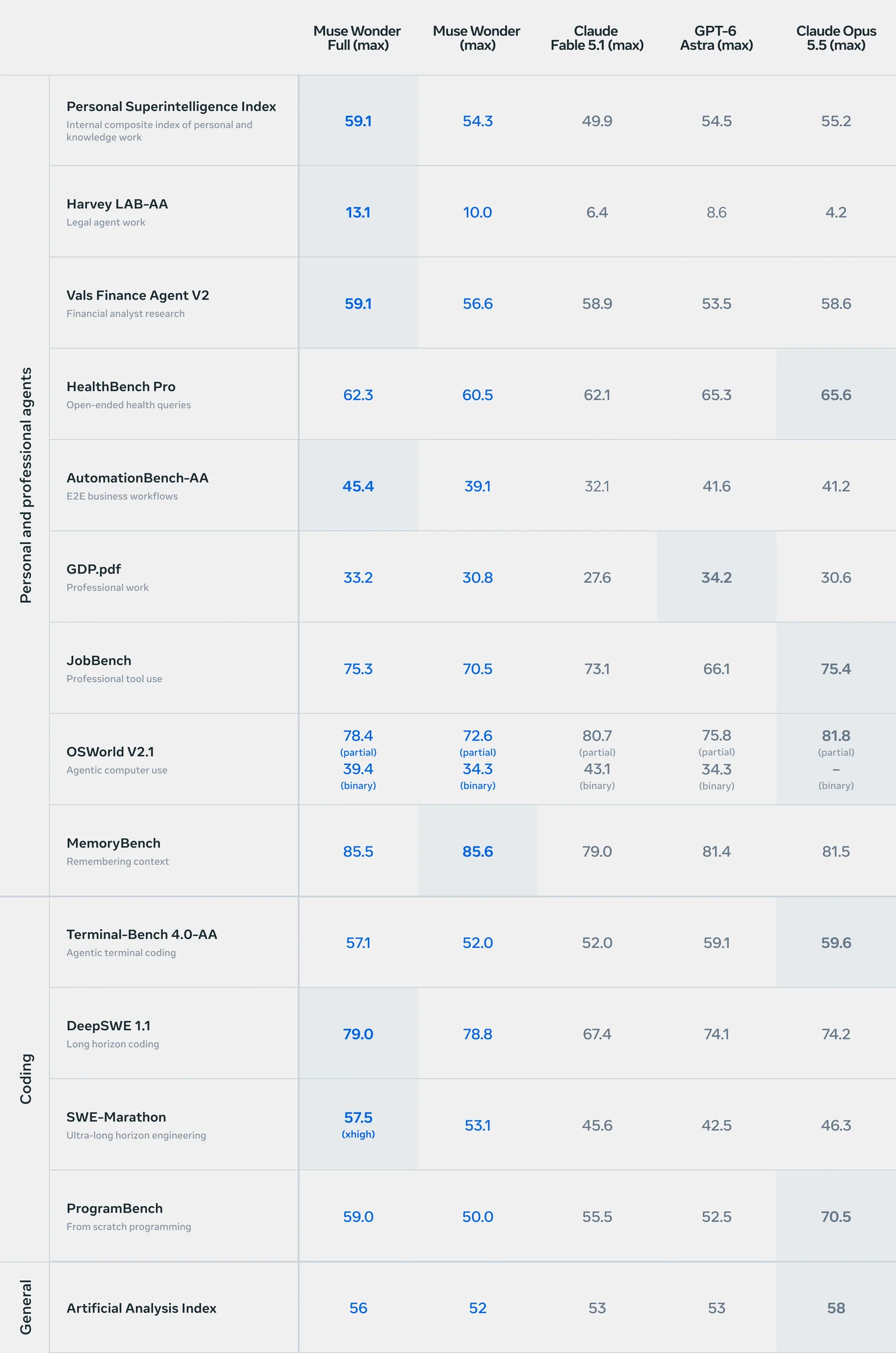
A benchmark has a model complete a set of tasks, then scores it by each test’s rules. Most of this table is labeled max effort, but Full uses xhigh on SWE-Marathon; and even when different models use a setting with the same name, that does not mean they spend the same time or compute. Beyond the scores, also check who wrote the tasks, who ran them, and whether the comparison conditions match.
The evaluations run by third parties include Harvey LAB-AA, AutomationBench-AA and Vals Finance Agent V2. According to Meta’s table, on Harvey LAB-AA v1.1 Full scores 13.1 and Opus 5.5 scores 4.2; the share of tasks fully passed without major hallucinations is still low. On AutomationBench-AA, Full scores 45.4 and GPT-6 Astra 41.6; the model card says this uses a strict whole-task pass rate, which differs from the goal-completion score AA lists separately on its website. Vals Finance Agent V2 is run by Vals AI: Full scores 59.1 and Fable 5.1 58.9, a very small gap. These comparisons are limited to the models in the table and do not mean first place on a full leaderboard.
For the other category, keep internal evaluations and comparison conditions clearly distinct. The Personal Superintelligence Index is Meta’s internal composite index, made up of 7 tests, and the model card does not disclose how it is calculated; MemoryBench and FocusBench are also Meta internal tests. DeepSWE 1.1 mixes third-party results from Datacurve with vendor-reported scores. SWE-Marathon results come from Abundant AI, but the competing models used different agents and Full also used xhigh, so it cannot be treated as a comparison in the same execution environment. Meta also notes that the competitor tests it ran itself are only best-effort comparisons, and the prompts, tools and execution environment may not be tuned to their best.
In Meta’s table, Opus 5.5 leads on HealthBench Pro, Terminal-Bench 4.0-AA and the OSWorld V2.1 partial score (81.8); on JobBench, its 75.4 is very close to Full’s 75.3, and GPT-6 Astra leads on GDP.pdf (34.2). On ProgramBench, every model in the table uses mini-swe-agent; Opus 5.5 scores 70.5 and Full 59.0. This counts the share of runs that pass at least 95% of the tests, not the success rate of a complete reconstruction. This test was built by Meta together with an academic team. Terminal-Bench 4.0-AA also uses mini-swe-agent.
If you only want one number, start with the Artificial Analysis Intelligence Index. It is made up of 10 tests, and all models are evaluated in the same way by the same third party (cited by Meta, dated 2026-10-12; scores are index points, not percentages):
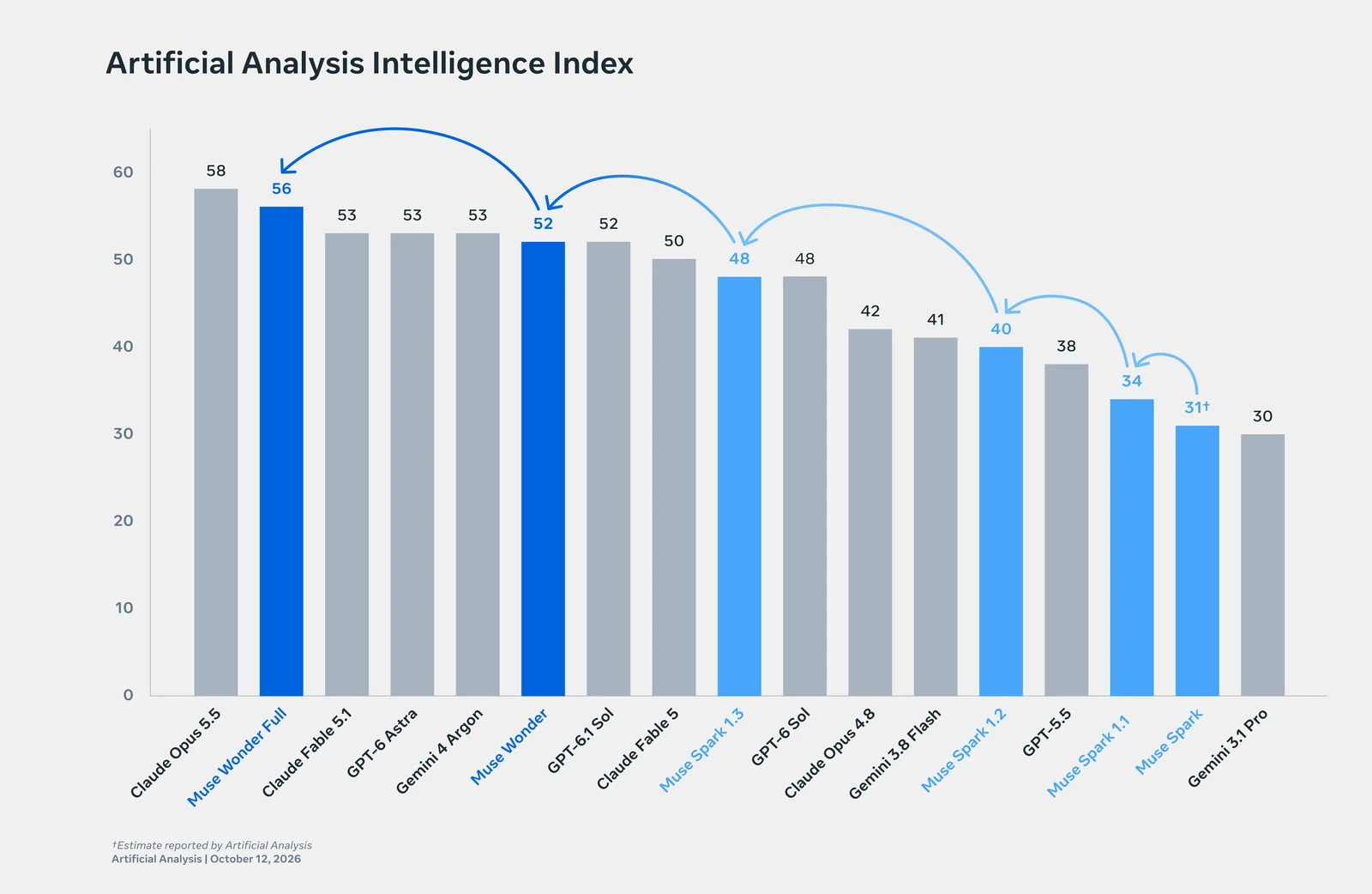
In Meta’s October 12 chart, Full scores 56, below Opus 5.5’s 58. Fable 5.1, GPT-6 Astra and Gemini 4 Argon all score 53 in the chart, 1 point above Muse Wonder. The API version, Muse Wonder, scores 52; its base token price is the same as Opus 5.5, but its index is 6 points lower. This compares the models listed in the chart and does not reflect rankings on the current full leaderboard.
As of October 13, 2026, Artificial Analysis has published evaluation pages for Muse Wonder and Full, with the same scores of 52 and 56, and Full ranks 4th on AA’s full leaderboard; Vals’ Finance Agent V2 also lists both models. The chart above is still the snapshot Meta published on October 12, and should not be read as the latest full ranking on the third-party sites.
Pricing and how to use it
| API, per million tokens | Input | Output | Cached input |
|---|---|---|---|
Muse Wonder (muse-wonder-1.0) | $4 | $20 | $0.20 |
| Claude Opus 5.5 | $4 | $20 | $0.20 |
With 1 million input tokens and 1 million output tokens, both come to $24. Muse Wonder’s web search grounding costs an extra $2.50 per 1,000 queries. It is also listed on OpenRouter (meta/muse-wonder) at the same price. The official docs also state that long context has no surcharge and reasoning tokens are priced the same as output tokens, so raising effort to max uses more tokens, and your bill goes up with it.
Muse Code is Meta’s coding agent that runs in the terminal and in CI; it can plan, edit code and run commands. Subscriptions come in four plans, all monthly:
| Plan | Monthly price | Muse Wonder Full available |
|---|---|---|
| Everyday Usage | $5 | No |
| High Usage | $15 | No |
| Power Usage | $50 | Yes |
| Maximum Usage | $200 | Yes |
Two things to know first:
- Contributor mode: Muse Code subscriptions turn on Contributor mode by default. It gives you more usage, and in exchange lets Meta use the prompts, code, files, context and model responses you send to train future models. You can turn it off in settings, and new content after that will not be used for training. The Muse Wonder API only has Standard mode, and its content is not used to train Meta’s models.
- Taiwan: Meta has not published a country-by-country list. It only says the API is available in “most countries and regions where Meta AI is available and payments are supported.” Taiwan is not listed as available, and it is not on the restricted list either (China, including Hong Kong and Macau, is). So you cannot say for certain that it is available to use; check when you sign up.
Active Memory and Active Focus
These are the two features Meta highlights. Active Memory remembers important information across conversations and, when needed, proactively pulls up details relevant to the current task. Active Focus switches approach and keeps going when it runs into trouble, asks questions when necessary, and checks with you before important actions. Meta uses MemoryBench and FocusBench to show these two abilities, and both are Meta internal tests. These are all Meta’s own claims and tests, with no independent testing to verify them yet; whether they work as advertised in real use remains to be seen from user reports.
Safety and open source
According to the model card, without safeguards Meta cannot rule out that Full reaches the high risk threshold in the chemical and biological domains; cybersecurity and loss-of-control risks are moderate or below. With safeguards in place, every domain is moderate or below, and Meta decided to launch on that basis. Meta also says the model has safeguards against sharing private information without permission and resists malicious instructions. As for a separate full safety report, Meta says it will be “available soon”; as of October 13, we had not seen it.
Meta has not announced whether the Muse Wonder series will have open weights. In the Meta Model API model overview, the open-weight model is Muse Glimmer (30B). Axios reports that Alexandr Wang, head of Meta Superintelligence Labs, still says Meta will keep supporting open source.
Penchan’s summary
AA’s Intelligence Index shows the Muse Wonder series is now close to the leading models, but Full’s 56 is still below Opus 5.5’s 58. In Meta’s launch table, Full scores higher than the listed competitors on the law and automation tests; that does not mean first place on a full leaderboard, and it cannot be applied directly to the API version, Muse Wonder. Each test’s source and comparison conditions still need to be read separately.
For API users, Muse Wonder’s base token price is the same as Opus 5.5, with an AA index of 52 versus 58; Full’s leading results cannot be applied directly to the API version. You can start with the evaluations AA and Vals have published, then run small tests on your own workflows; the same unit price does not mean the same total cost to finish the same task. To use Full in Muse Code, pick the Power ($50 per month) or Maximum ($200 per month) plan, and check your Contributor mode setting before you start.
Further reading
Cover image source: Meta (research.meta.ai/blog/muse-wonder)
This article introduces AI tool features and compares subscription plans from a consumer’s point of view; it is not securities or investment advice. Actual pricing follows each platform’s latest official announcements, and the information here may be out of date (data as of October 13, 2026).