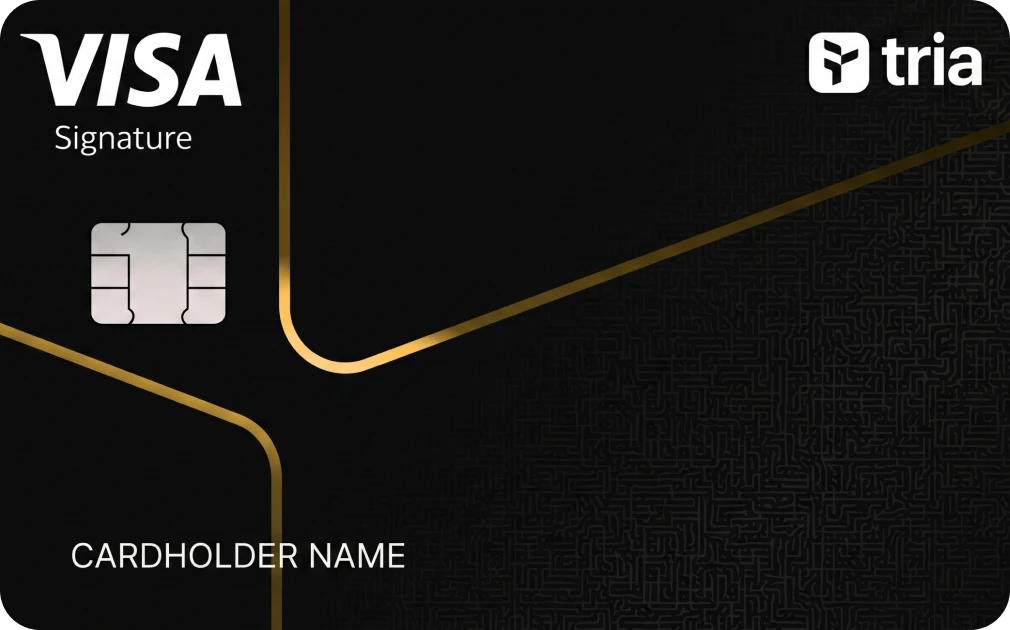
Tria pairs a self-custodial wallet with a Visa card. Spending is secured by collateral you deposit, which neither Tria nor the issuer holds. There are three plans—Lite, Pro and Max—with annual fees of $20, $109 and $250, respectively; rewards are paid in stablecoins. Compare it with other cards in the crypto card comparison. Fees and risks are covered below in What to know before applying.
What Is Tria? Company Background
Tria is operated by Threely Dimensions, Inc. Its co-founders are Parth Bhalla and Vijit Katta. In October 2025, it raised $12 million in pre-seed and strategic funding, with P2 Ventures and Aptos among the participants.
The company’s July 29, 2026 announcement said it had more than 570,000 users across over 150 countries. Tria also offers a self-custodial wallet, Earn, trading and travel bookings. The card is one part of that wallet product: when you apply, you first enter the Tria app and choose a plan there.
For users in Taiwan, the card is issued by Nimbus, LLC. Tria provides the app interface, and the card runs on the Visa network.
Tria Card Plans and Cashback: Lite, Pro and Max
You choose a plan by purchasing it; spending does not automatically move you up a tier. Upgrading affects future spending only.
| Item | Lite | Pro | Max |
|---|---|---|---|
| Annual fee (Taiwan checkout, 2026-09-29) | $20 | $109 | $250 |
| Cashback (monthly spend cap) | 1.5% on the first $1,000; 0.5% after that | 4.5% on the first $1,000; 1% after that | 6% on the first $2,000; 1% after that |
| Reward form | Stablecoin | Stablecoin | Stablecoin |
| Physical card | — | Yes, shipped in phases by country | Yes, shipped in phases by country |
| Card available immediately after verification | — | Lite card with this plan’s rewards | Lite card with this plan’s rewards |
The cap applies to spending, not the reward amount. For Lite, the first $1,000 of monthly spend earns 1.5%; spending above that earns 0.5%.
ATM withdrawals, gaming, gambling, cash equivalents, P2P transfers, balance repayments, refunds and Tria Travel bookings do not earn rewards. Unpaid rewards are forfeited if the account is closed.
See the Tria review and comparison for a full comparison.
Tria Funding and Fees
- Annual fee: Lite $20, Pro $109 and Max $250, paid before KYC. Fees are non-refundable except where required by law.
- Funding: Tria currently charges no direct deposit service fee. A provider may charge for swaps or cross-chain transfers; the amount appears on the confirmation screen.
- Minimum deposit: $10; BTC minimum is $50.
- Supported networks: Bitcoin, Ethereum, Polygon, Base, Arbitrum, Optimism, BSC, Aptos and Solana. Solana deposits require SOL for gas.
- Funds moved into the card balance cannot be sent back to the wallet; they can only be spent or withdrawn at an ATM.
For the basics of stablecoins, see the stablecoin storage guide.
Collateral and Liquidation Rules
Tria is self-custodial: neither Tria nor the issuer holds your collateral. Spending is secured by collateral you deposit, valued at market price at a 1:1 ratio. Unlike an ordinary prepaid card, your assets remain in your wallet, but the liquidation rules below apply.
Collateral may be liquidated to repay what you owe in either of these situations:
- A payment remains unpaid for more than one calendar day.
- The collateral value falls below the amount owed and you do not add more collateral.
If collateral is insufficient and you do not top it up, the outstanding amount may be liquidated.
The Tria card details also explain collateral and liquidation.
What to Know Before Applying
- The annual fee is paid before KYC and is non-refundable except where required by law.
- Plans are purchased, not earned through spending; an upgrade affects future spending only.
- Spending above the monthly cap earns 0.5% or 1% cashback.
- Money moved into the card balance cannot be returned to the wallet. Decide how much to deposit first.
- News reports said that in August 2026, Rain, Tria’s card infrastructure provider, had a contract vulnerability that affected 636 Tria users and about $430,000. Tria reimbursed users in full and added 10%; self-custodial wallets were not affected.
How to Apply for Tria (Where to Enter the Referral Code)
Open the referral link using a button in this article. Tria will automatically fill in the referral code EBYNJ69ALE; you do not need to enter it separately during sign-up.
- In the app, select Apply Now for the plan you want. Pro and Max cost more, so first check that your monthly card spending justifies the fee. If you want to try the card first, Lite has the lowest annual fee; you can upgrade later.
- Select the country where you actually live.
- Pay the annual fee with crypto or a credit card.
- Complete KYC in the mobile app.
- Activate the card.
A referral code is required to register. If you did not open the referral link, enter EBYNJ69ALE yourself.
Using Tria in Taiwan
Penchan confirmed that Taiwan residents could apply (September 24, 2026). Taiwan KYC accepts a passport (full spread), national ID (both sides), NHI card (front), driver’s license (front) or residence permit (both sides). You must also record a live selfie and be at least 18.
You must be physically present in the country selected for your application. VPN use is prohibited and will result in rejection. KYC can only be completed in the mobile app.
For mobile payments, JKOPay cannot be linked because it accepts credit cards issued by domestic partner banks only.