The short answer: Google hasn’t said why, but there are clues
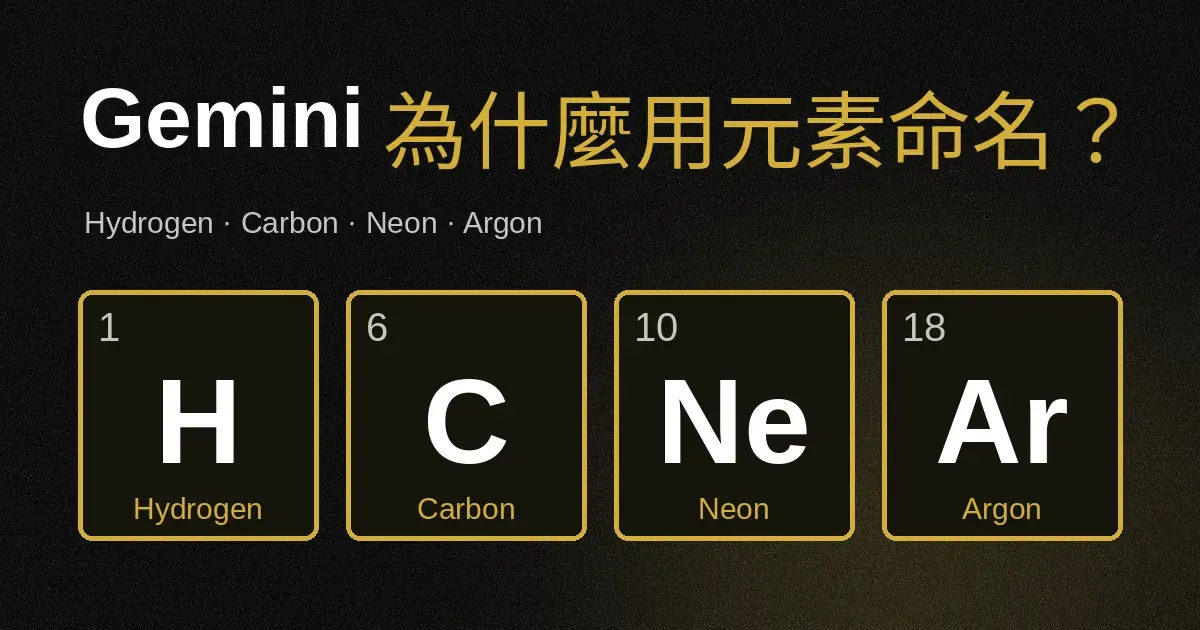
Google has never publicly explained why Gemini 4 uses element names. Not one line in the four announcement posts, the API docs, the Gemini Help Center, or the Q3 earnings call covers the naming logic. Three clues can be confirmed:
- Some of the names began as internal codenames. The tech outlet Business Insider reported on October 13 that internal documents called the Gemini 4 test models Argon, Barium, and Carbon, and that Barium-B later launched under the name Argon. Google declined to comment.
- Google’s own people are in on the joke. Google’s Logan Kilpatrick wrote on X, “we are having a little too much fun with naming”. Google DeepMind’s Omar Sanseviero said AI Studio added a periodic table model menu and wrote “Shipping will continue”, hinting that more models are coming. We saw both posts through search snippets and did not open the originals.
- The release pace behind the names is fast. Argon became generally available on October 13, Carbon on November 10, Hydrogen on November 12, and Neon on November 18. The AI evaluation firm Artificial Analysis called Neon Google’s fourth model in seven weeks.
Below, the confirmed facts are laid out as a map, then the popular theories get tested, and my own read comes last.
The map: what each element does, who can use it, and what it costs
Google’s Neon announcement includes a lineup chart that lists only three models: Carbon, Neon, and Hydrogen. In the table below, positioning uses Google’s own descriptions, plans follow the Gemini Help Center and the Taiwan plan page, and prices are API prices per 1 million tokens, input / output.
| Element (atomic number) | Google’s positioning | Who can use it in the Gemini app | API price |
|---|---|---|---|
| Carbon (6) | Strongest reasoning, for the hardest and longest projects | Google AI Ultra | US$2 / US$10 through November 30, then US$4 / US$20 from December 1 |
| Neon (10) | Between Hydrogen and Carbon, for complex but high-frequency work | Google AI Pro, Ultra | US$3 / US$15, no free quota |
| Hydrogen (1) | Everyday workhorse, fast on day-to-day coding and AI agent tasks | Everyone, including the free plan | US$1.5 / US$7.5, with a free quota |
| Argon (18) | The API docs now say “efficient frontier reasoning model” | Not listed in the Help Center or the lineup chart; available on paid API tiers | Same as Carbon |
Argon’s description has shifted: the October 13 changelog said “most capable”, while the current API model page says “efficient”. The tech outlet 9to5Google says Neon replaces Argon, but Google’s API page still lists Argon and gives no retirement date.
Google’s API docs also give an upgrade map from the old names: Gemini 3.8 Flash and 3.6 Flash move to Hydrogen, Gemini 3.1 Pro Preview moves to Neon, and the hardest problems go to Carbon. No row says “Hydrogen is Flash.”
Do the elements mean anything? Three theories against the actual lineup
All of the following are guesses from netizens and commentators, and Google has adopted none of them. I checked each one against the map above.
| Theory | Result against the lineup |
|---|---|
| Larger atomic number means stronger | Hydrogen 1, Carbon 6, Neon 10, Argon 18. Google ranks depth as Carbon, Neon, Hydrogen, which is 6, 10, 1, not smallest to largest. The launch order is 18, 6, 1, 10, which isn’t either |
| Alphabetical order | The launch order Argon, Carbon, Hydrogen, Neon is exactly A, C, H, N, and someone on the engineer forum Hacker News argued this. But there are only four points, and if the rumored next name Helium launches, the order breaks |
| Noble gases | Neon and Argon are; Carbon and Hydrogen are not. Google’s Neon announcement pairs Carbon and Hydrogen with “fire” and Argon and Neon with “gas discharge tubes”, which makes two groups, but it doesn’t say that is the naming basis |
Two more explanations circulate: “they are all elements that glow” and “each name’s meaning matches its positioning”. The first is an observation from Hacker News users, and the second is the reading of the tech outlet 36Kr, for example hydrogen being the lightest element and so matching speed. They can explain the four that already exist, but they can’t predict the next one.
The conclusion is that no theory fits the capability order, the launch order, and Google’s own grouping all at once, and alphabetical order matches only the launch order. 36Kr’s summary says the same: “no one can figure out the pattern”.
Penchan’s analysis: the possible business logic behind the names
This section is my analysis, not Google’s account. Facts come first, inference after.
One: names detached from version numbers let Google ship a model every few weeks. Kilpatrick said on X that Carbon is the next generation of Argon and from the same family, and a netizen asked why it isn’t called 4.1. Under version numbers, Hydrogen, which launched later, could easily be read as newer and stronger than Carbon, when it is actually the cheapest everyday model. Google shipped four models in these seven weeks, and Google CEO Sundar Pichai said on the earnings call that he expects the pace to keep accelerating over the next 12 months. Element names let each model stand on its own, without the expectation of “4.2 comes after 4.1”. Evgenii Zinner of the developer platform dev.to has a similar view, seeing them as parallel choices among cost, speed, and depth.
Two: the names follow the plans and became the steps of a subscription ladder. In Google’s lineup chart, the subscription column puts Carbon on Ultra, Neon on Pro and Ultra, and Hydrogen on everyone. The Taiwan plan page is headlined “Get Gemini 4 Neon and more”, where Pro gets you Neon and Ultra gets you Carbon. Alphabet’s CFO said on the call that Google One is the fastest-growing subscription product, driven by AI plans. My read is that a name like Flash-Lite tells free users they are getting the small one, while an element name carries no hint of size, so Hydrogen on the free plan sounds like a peer of the paid models. On the other hand, 36Kr notes that some Pro users couldn’t see the new model when Carbon opened, so the mapping between plans and names is confusing too.
Three: if tools pick the model for you, the names don’t need to mark rank. The Orchestrator introduced in the Hydrogen announcement (a feature in Google’s AI agent development tool Antigravity that assigns models) switches between Carbon and Hydrogen inside one session, and the Neon announcement also says it directs parallel Hydrogen sub-agents. Hydrogen is also the default model for the Antigravity agent in Gemini Managed Agents (Google’s hosted AI agent service), at US$1.5 per million input tokens, against US$4 for Carbon from December 1. Thomas Claburn of the tech outlet The Register argues that Google is happy to let the platform handle the choices that move a developer’s bill.
Four: the price order flips, and element names never show a crack. Developer Simon Willison points out that until November 30, Carbon is half price, so Neon’s US$3 / US$15 is the most expensive of the three. On December 1, Carbon rises to US$4 / US$20, and Neon is 25% cheaper (9to5Google’s calculation). Artificial Analysis measured Neon at about US$6.44 per task and Carbon at about US$7.76, but that result uses Carbon at undiscounted pricing and compares Neon at xhigh thinking effort with Carbon at high. Had the names been small, medium, and large, a price flip would contradict them. This is my inference, and Google has not said it.
The price of this naming scheme is that you have to bring your own map. A 9to5Google reader commented “getting difficult to keep up with all these names”, someone on Hacker News listed a long run of model names with thinking-effort levels attached, and Willison says Neon makes pricing messier. Google itself added a lineup chart and a section called “Where Neon sits in the Gemini 4 family”.
Comparison with OpenAI and Anthropic. The Register argues that OpenAI’s Astra, Sol, Luna, and Terra “maps celestial position to capability”, while Google’s elements have no hierarchy. The tech outlet Crypto Briefing says OpenAI’s new format puts the generation number first and the tier after. Anthropic’s Haiku, Sonnet, Opus, and Fable look to Google developer forum users like a ladder from small to large. By these commentators’ account, the OpenAI and Anthropic names carry rank themselves, while Google’s names need a lineup chart to read.
How Taiwan users should choose: go by plan and positioning, not the name
According to the Taiwan plan page, the plans and the models they include are:
- Free, NT$0: includes Hydrogen. With “Auto” selected, Gemini picks Hydrogen or a fast lightweight model.
- Google AI Plus, NT$165: 2x the free usage, with Hydrogen.
- Google AI Pro, NT$650: 4x the free usage, with Neon and Hydrogen.
- Google AI Ultra, from NT$3,300: usage cap 5x Pro, and NT$6,500 is 20x. Includes Carbon, Neon, and Hydrogen.
My advice is to work backward from your use case. For daily questions, copywriting, and research, Hydrogen is what Google defines as the everyday workhorse, so the free plan or Plus is enough. For complex coding or deep analysis, Neon on Google AI Pro is what Google positions as balancing depth and efficiency, and in Artificial Analysis’s test, Neon cost less per task than Carbon at undiscounted pricing. Carbon is for the hardest, longest software projects, and whether it’s worth paying extra for Ultra depends on whether you have that kind of work.
Developers can follow Google’s docs and default to Hydrogen, moving up to Neon or Carbon for hard problems. After Carbon’s price rise on December 1, Neon’s US$3 / US$15 is cheaper than Carbon, so compare costs on your own tasks first. Sanseviero’s “Shipping will continue” hints that Google will release more models, so choose by positioning and price, not by guessing from the name. For the full lineup, see the Gemini model family overview.
Penchan’s Take
Google hasn’t said why it uses elements, and no popular theory explains it fully. My view is that element names treat models as parallel products instead of rungs on a version ladder, which lets Google ship one every few weeks, adjust plans and prices at any time, and keep the names from contradicting the price order. The cost is that users have to look up the map themselves. Next time a new element shows up, ask three things first: how does Google position it, which plan can use it, and what does it cost. If Google later explains the naming, I will update this page.
Further reading
- Google Gemini model family overview
- What is Gemini 4 Neon
- What is Gemini 4 Hydrogen
- What is Gemini 4 Carbon
- What is Gemini 4 Argon
- Gemini hub
This article is consumer information about AI models and does not constitute securities or investment advice. Information is current as of November 20, 2026; see Google’s latest announcements for the actual details.