World Labs launched Atlas on September 1, 2026, an AI model that generates 3D worlds from photos. World Labs was co-founded by Fei-Fei Li, a driving force behind ImageNet and the former head of Stanford University’s AI lab, who is known in the AI community as a godmother-level figure. So far, the company has raised more than $1.2 billion from Nvidia, AMD, Autodesk, and others.
Atlas is different from the AI video generation tools you may know, such as Sora and Runway. It does not just generate a video clip; it creates an entire space with 3D depth, and you can freely control the camera angle, as if moving your viewpoint in a game.
What it can do
Atlas calls itself a “world model”. In simple terms:
- Give it one photo and it “imagines” the entire 3D world behind the image
- It can generate a video up to 1 minute long at a maximum resolution of 1440p
- The camera can move freely in any direction—forward, backward, left, right, up, or down
- In addition to video, it can export point clouds and 3D Gaussian splats (which can be used in game engines or 3D software)
- You can provide up to 8 photos, and it automatically combines them into a complete scene
One phrase the official announcement emphasizes is spatial intelligence: AI does not just understand the pixels in an image; it understands the physical space behind it—how far apart objects are, what is behind what, and where the light is coming from.
How to use it
You can try it directly at marble.worldlabs.ai. The interface has two input modes:
- 2D input: provide a photo, video, or panorama and let Atlas generate a 3D world
- 3D input: build a scene with 3D models and basic geometric shapes
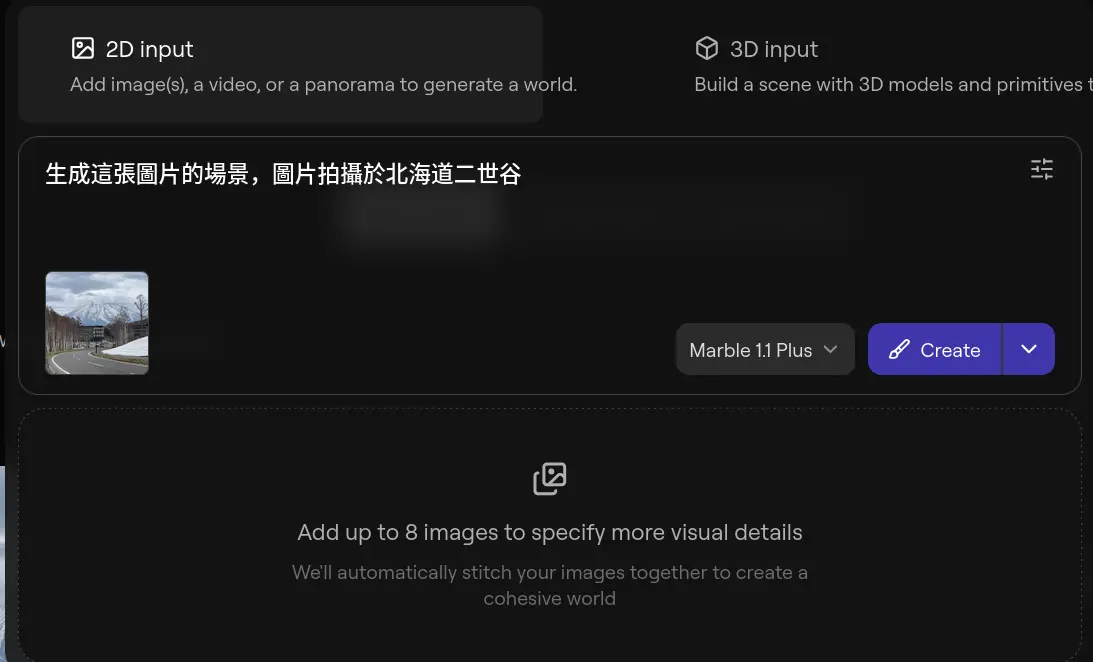
The process is intuitive: select 2D input, upload a photo, describe the scene you want with text, choose a model (currently Marble 1.1 Plus), and click Create. Generation takes a few minutes. Once it is complete, you can drag the mouse to change the camera angle and export a video.
Penchan’s test: generating an entire 3D world from one Hokkaido photo
Penchan tested Atlas with a photo from a previous family trip to Niseko, Hokkaido. The prompt was simple: “Generate the scene in this image; the image was taken in Niseko, Hokkaido.” Penchan selected Marble 1.1 Plus and clicked Create.
After waiting about ten minutes, Atlas generated a 3D scene in which the camera could move freely. The video above shows the complete generation process, including the loading animation and the final result.
A few observations:
- The overall atmosphere is reproduced well, with convincing snow and building textures
- Geometric consistency during camera movement is decent, though there are occasional visual glitches and distortions
- The farther the camera moves from the original photo’s viewpoint, the blurrier the generated details become (as expected)
- Generation takes about 10 minutes—not fast, but acceptable
How it works technically
Atlas is built on a “multimodal autoregressive diffusion Transformer”. In plain English: it is a single model that can process text, images, video, and 3D data at the same time, operating within a unified spatial architecture.
The difference from typical AI video tools is that Atlas treats camera trajectories and geometry as native inputs instead of guessing the desired angle from a text description. That is why it can offer “pixel-level camera control.”
In the official blind tests, Atlas outperformed Gemini Omni Flash and FLUX in camera-path accuracy. It also surpassed leading open-source models in 3D geometry reconstruction.
Official introduction video
World Labs’ official video demonstrates more of Atlas’s capabilities, including the process of converting a single photo into a complete 3D scene:
▶️ World Labs Atlas official introduction video (YouTube)
Penchan’s Take
- This is not just another AI video tool. Tools such as Grok Imagine and the retired Sora focused on “text-to-video”, where the key was writing a precise prompt. Atlas instead rebuilds a 3D space from photos and text. It may sound similar, but the ability to freely control the camera alone shows that it truly understands space to some degree.
- The actual experience is better than expected. I initially thought the 3D quality generated from a single photo would be rough, but the results during camera movement were still surprisingly impressive. There are visual glitches, but it makes me excited to see what future versions will release.
- Interestingly, training robots is what they really want to do. The official X account shows robot scenes several times. After looking into the official materials, I found that robot training is their primary application: capture real spaces with a phone, reconstruct them as 3D environments, and let robots practice in a simulator. For Atlas, spatial understanding is the real core.
Further reading
References
Cover image: World Labs (worldlabs.ai/blog/atlas)